Most home baristas blame the grinder when shots run fast, sour and uneven — but a wobbly, badly sized tamper is just as often the culprit. The LuxHaus tamper is one of the most-bought budget espresso tampers online, sold in a flat stainless version and a spring-loaded calibrated version, in 49mm, 51mm, 53mm and 58mm sizes.
- Quick Answer
- Luxhaus Tamper
- Key Takeaways
- LuxHaus Tamper at a Glance
- Where the calibrated model earns its money
- Where it falls down
- The honest middle ground
- The base
- The handle
- Weight
- The pouch and packaging
- Step 1 — Dose and settle
- Step 2 — Distribute before you tamp
- Step 3 — Seat the tamper level
- Step 4 — Press straight down
- Step 5 — Don't twist, don't tap
- Step 6 — Brew immediately
- Is the LuxHaus tamper worth it?
- What size LuxHaus tamper do I need?
- Is a calibrated tamper better than a flat tamper?
- How much pressure should I use when tamping?
- Will a better tamper fix my sour or bitter espresso?
- Do I still need a WDT tool if I have a good tamper?
- Does the LuxHaus tamper fit a Breville Barista Express?
- Is the stainless steel base safe for coffee?
- How do I know if I'm tamping level?
- Is the calibrated LuxHaus tamper's spring reliable?
Short answer: it’s a solid, genuine upgrade over the plastic tamper in your machine’s box, and the flat model is the better buy of the two — but it’s an entry-level tool, not a lifetime precision instrument.
In this guide we’ll cover what you actually get for the money, how the flat and calibrated models differ, how to pick the right size for your portafilter, where the LuxHaus falls short compared with pricier tampers, and the tamping technique that matters far more than the tool itself.
Quick Answer
The LuxHaus tamper is a good-value entry-level espresso tamper. It has a flat, food-safe stainless steel base with no coating to flake, comes in four portafilter sizes, ships in a velvet pouch and is backed by a lifetime satisfaction guarantee.
The standard flat model (around $25) is the one most home baristas should buy. The calibrated 30 lb spring model (roughly $30–$50 depending on size) helps beginners build consistency, but its internal spring is the weakest part of the design.
Anyone chasing a truly flat, precisely machined base for a prosumer machine should budget for a higher-end tamper instead.
Luxhaus Tamper
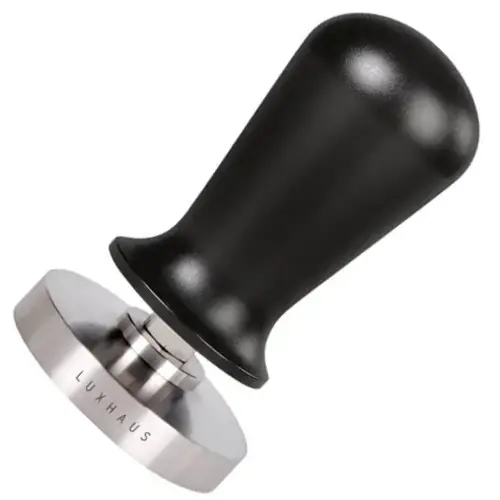
The LuxHaus Tamper delivers precision and durability with its stainless steel base and calibrated design, ensuring a consistent tamp for barista-quality espresso at home.
Key Takeaways
- Best for: beginners and mid-range home machines wanting a real metal tamper on a budget
- Best model: the flat stainless LuxHaus tamper — simpler, cheaper, nothing to wear out
- Calibrated model: useful training wheels; the spring mechanism is the reported weak point
- Sizes: 49mm, 51mm, 53mm and 58mm — measure your basket before ordering
- Biggest limitation: base machining tolerances aren’t in the same league as premium tampers
- Not a fix for: channelling caused by poor grind distribution — pair it with a WDT tool
LuxHaus Tamper at a Glance
| LuxHaus Flat Tamper | LuxHaus Calibrated Tamper | |
|---|---|---|
| Base | 100% flat stainless steel, uncoated | Flat stainless steel, uncoated |
| Mechanism | None — solid tamper | Spring-loaded, clicks at ~30 lb |
| Sizes | 49 / 51 / 53 / 58mm | 49 / 51 / 53 / 58mm |
| Typical price | ~$25 | ~$30–$50 by size |
| Included | Red velvet storage pouch | Red velvet pouch, gift box |
| Warranty | Lifetime satisfaction guarantee | Lifetime satisfaction guarantee |
| Best for | Most home baristas | Beginners building muscle memory |
What Is the LuxHaus Tamper?
A tamper is the hand tool that compresses ground coffee into an even, level puck inside your portafilter basket before you lock it into the machine.
The LuxHaus tamper is a budget-to-mid-range espresso tamper sold by LuxHaus, a kitchenware brand best known online for coffee accessories. It comes in two versions built around the same idea: a flat stainless steel base attached to a rounded handle, supplied in a red velvet pouch.
The pitch is straightforward. The brand positions it as an upgrade from the lightweight plastic tampers bundled with most entry-level espresso machines, emphasising a food-safe, uncoated stainless base so there’s no finish to chip into your coffee.
LuxHaus lists the tamper in 49mm, 51mm, 53mm and 58mm and explicitly asks buyers to measure their portafilter basket before ordering — good advice, because sizing is where most tamper purchases go wrong.
In one line: it’s the tamper you buy when you’ve outgrown the plastic one but aren’t ready to spend $80 on a precision-machined base.
LuxHaus Flat Tamper vs Calibrated Tamper: Which Should You Buy?
This is the decision most people land on this page for, so let’s answer it before the detail.
Buy the flat tamper if you want the simplest, cheapest, most durable option. There’s no mechanism, so there’s nothing to rust, bind or wear out. Almost every experienced home barista eventually ends up on a flat tamper.
Buy the calibrated tamper if you’re new to espresso and your shots are wildly inconsistent from one day to the next. The spring compresses and clicks at a set pressure — LuxHaus specifies roughly 30 lb — so you physically can’t over- or under-tamp by much while you’re learning what a proper tamp feels like.
Where the calibrated model earns its money
Consistency is the real currency in espresso. If you tamp with 15 lb on Monday and 40 lb on Tuesday, you’re changing a variable while trying to dial in your grind, and you’ll chase your tail.
A calibrated tamper removes that variable outright. For a beginner sharing a machine with a partner or housemate who tamps differently, that’s genuinely useful.
Where it falls down
The mechanism is also the failure point. The most common complaint in owner feedback for calibrated tampers in this price bracket — LuxHaus included — concerns the internal spring: simple construction, and at least one owner has reported the spring arriving already rusted, which raises obvious questions about lifespan in a humid kitchen. You’re adding a moving part to a tool that doesn’t strictly need one.
The honest middle ground
Most baristas use a calibrated tamper for a few weeks, learn what 30 lb feels like in their hands, and then never need it again. If that’s the plan, the cheaper flat model plus a bathroom scale will teach you the same lesson for free: tamp on the scale until it reads 30 lb, repeat ten times, and your hands will remember.
☕ Frothy Fusion Tip
Tamping pressure matters far less than most people think. Once the puck is compressed enough to eliminate air gaps, extra force adds very little — the specialty coffee community has largely moved on from arguing about pounds. Levelness is what actually decides whether water channels through one side of your puck. A perfectly level 20 lb tamp beats a crooked 40 lb tamp every single time.
Build Quality and Materials
The base
LuxHaus advertises a 100% flat, uncoated food-safe stainless steel base. That “uncoated” detail is worth more than it sounds. Cheap tampers sometimes use a plated or painted base, and plating on a surface that gets scraped against a steel basket twice a day will eventually chip. Bare stainless has nothing to shed.
What you don’t get at this price is guaranteed machining precision. Premium tampers are machined to tight tolerances and sized within fractions of a millimetre of the basket wall so the puck edge is fully compressed. Budget tampers,
LuxHaus included, run looser. In practice that means a small ring of uncompressed grounds around the rim, which is a classic cause of edge channelling. It’s a real limitation, but it’s also one that good distribution technique largely neutralises.
The handle
The handle is a rounded, palm-filling shape rather than the flat-topped “barista” style. Comfort is personal here. A rounded handle encourages a straight-down push with your palm, which is arguably better for beginners than a thin handle that invites wrist rotation. If you have small hands, it can feel bulky.
Weight
Budget tampers are generally lighter than premium ones. Heft helps: a heavier tamper does more of the work for you and makes it easier to feel when the puck stops compressing. The LuxHaus sits in the middle — noticeably more substantial than plastic, not as reassuring as a machined aluminium-and-steel tamper.
The pouch and packaging
The red velvet pouch is genuinely practical, not just a gift-box flourish. Tampers get scratched rattling around in a kitchen drawer, and a scratched base is a base that grips damp coffee grounds. If you’re buying this as a gift — and a lot of people do — the presentation does the job.
Sizing: The Single Most Important Decision
More returns happen over sizing than over quality. Here’s how to get it right.
Your tamper needs to match the internal diameter of your basket, not the external diameter of your portafilter. Take the basket out, measure across the inside at the top with a ruler or callipers, and round to the nearest listed size.
| Tamper size | Commonly fits |
|---|---|
| 58mm | Most prosumer and commercial-style machines (Breville/Sage Dual Boiler, Rancilio Silvia, E61 machines, La Marzocco) |
| 53mm | Breville/Sage Bambino, Barista Express, Infuser and similar |
| 51mm | Many Delonghi models, some entry-level machines |
| 49mm | Compact and older entry-level machines, some stovetop-adjacent setups |
A note on 58mm: many “58mm” baskets are actually 58.3–58.5mm internally, which is why premium brands sell 58.35mm and 58.5mm tampers. A nominal 58mm budget tamper will be slightly undersized in those baskets. It still works; it just leaves a thin uncompressed ring at the edge.
❌ Avoid these sizing mistakes
- Measuring the portafilter body instead of the basket interior
- Assuming your machine uses 58mm because it looks professional
- Buying “one size fits all” — no such thing exists
- Sizing up “for a tighter fit” — an oversized tamper won’t enter the basket at all
Performance: What to Expect in the Cup
Let’s set expectations honestly. A tamper will not fix bad coffee. It won’t compensate for stale beans, a grinder that can’t hold a consistent particle size, or an unbalanced dose. What a good tamper does is remove one source of inconsistency so your other adjustments actually show up in the cup.
Moving from a plastic bundled tamper to the LuxHaus, the differences owners consistently report are:
- Fewer gushers. A plastic tamper that doesn’t fill the basket leaves a loose edge, and water takes the path of least resistance. A properly sized metal tamper reduces that.
- More repeatable shot times. Same dose, same grind, same tamp — your shots start landing in a tighter window, which is what makes dialling in possible.
- Better crema consistency. Not more crema; more consistent crema, which is the meaningful version.
What it won’t deliver is the last 5% of precision. If you’re weighing shots to 0.1g and chasing single-second repeatability on a prosumer machine, the base flatness and sizing tolerance will eventually become your limiting factor and you’ll want to upgrade.
How to Tamp Properly (Step by Step)
The tool matters less than the technique. Here’s the sequence that fixes most home espresso problems.
Step 1 — Dose and settle
Grind directly into a dry basket and settle the grounds with a gentle tap or two on the bench. Wet baskets clump; clumps channel.
Step 2 — Distribute before you tamp
This is the step almost everyone skips, and it matters more than the tamp itself. Break up clumps and even out the bed using a WDT tool — a set of fine needles stirred through the grounds — or at minimum level the surface with a finger swept across the rim. Tamping only locks in whatever distribution you’ve already created; it can’t repair a lopsided bed.
Read next: our guide to using a WDT tool for even espresso extraction.
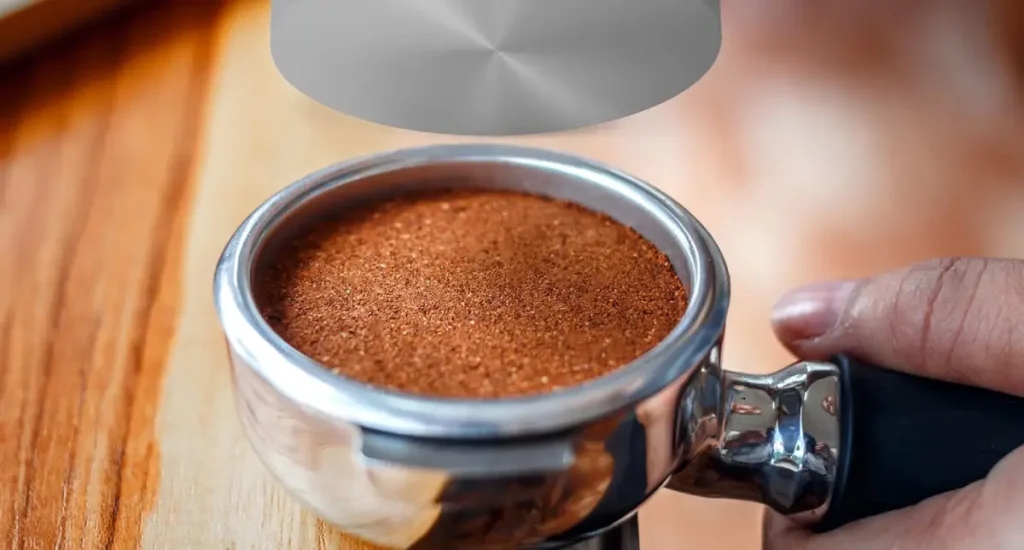
Step 3 — Seat the tamper level
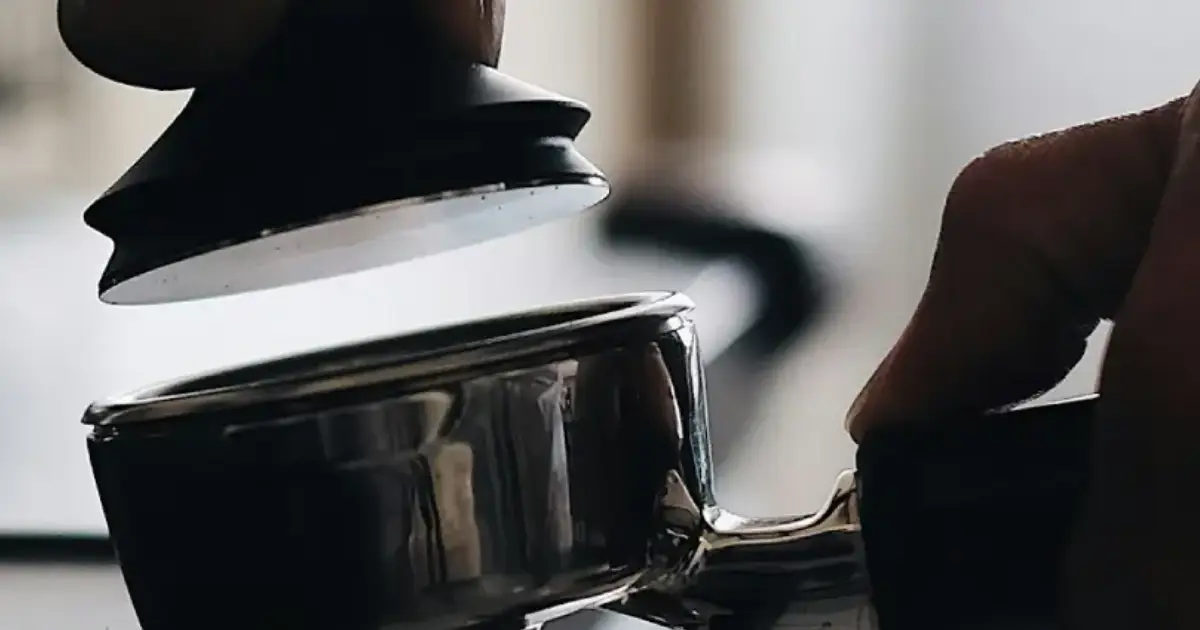
Rest the tamper flat on the coffee bed before applying any force. Check by eye that it’s sitting parallel to the basket rim, not tilted.
Step 4 — Press straight down
Push down through your forearm with your elbow directly above the portafilter, wrist locked straight. Around 15–30 lb is plenty. Stop when the puck stops compressing — you’ll feel it go solid.
Step 5 — Don’t twist, don’t tap
The old advice to give a polish twist and tap the side of the portafilter is outdated. Tapping can crack the puck and create a channel; the twist adds nothing once the surface is level. Lift the tamper straight up and out.
Step 6 — Brew immediately
A prepared basket left sitting dries unevenly at the surface. Lock in and pull the shot.
LuxHaus Tamper Pros and Cons
Pros
- ✔ Uncoated food-safe stainless base — nothing to flake into your coffee
- ✔ Four sizes covering most home espresso machines
- ✔ Big step up from bundled plastic tampers
- ✔ Comfortable rounded handle that encourages a straight push
- ✔ Velvet pouch protects the base in a drawer
- ✔ Lifetime satisfaction guarantee from the brand
- ✔ Priced well under premium machined tampers
Cons
- ✘ Base flatness and sizing tolerances aren’t premium-grade
- ✘ Nominal 58mm leaves a gap in slightly oversized baskets
- ✘ Calibrated model’s spring is the reported weak point
- ✘ Lighter than heavier machined tampers
- ✘ Rounded handle won’t suit everyone
- ✘ Marketing claims are more enthusiastic than the product warrants
Who It’s Best For
Buy it if you:
- Just bought an entry- or mid-range espresso machine and want to replace the plastic tamper
- Are shopping under $30 and want metal rather than plastic
- Need a gift for someone getting into home espresso
- Are building a starter puck-prep kit alongside a distribution tool and scales
Skip it if you:
- Own a prosumer machine and are chasing repeatability to the second
- Already have a precision-sized tamper — this isn’t an upgrade
- Want a self-levelling or palm tamper design
- Have a basket that measures oddly and needs a specific fractional size
LuxHaus Tamper vs the Alternatives
| LuxHaus | Normcore | Premium machined (e.g. Pullman, Force) | |
|---|---|---|---|
| Price band | $ | $$ | $$$ |
| Base precision | Standard | Close-fit sizing available | Precisely sized to basket |
| Calibrated option | Yes, spring | Yes, spring | Yes, on some models |
| Base shapes | Flat only | Flat and ripple | Flat, ripple, convex |
| Best for | Beginners, gifts | Enthusiasts on a budget | Dialled-in setups |
The realistic comparison is against other sub-$30 tampers, and there LuxHaus holds its own on materials and warranty. Step up a tier and you’re paying for tighter sizing (58.35mm and 58.5mm options), heavier stock, and alternative base profiles.
That upgrade is worth it — but only once your grinder and technique are good enough for it to show.
Care and Maintenance
Tampers are low-maintenance, but two habits extend their life and improve your coffee:
- Wipe the base after every session. Dried coffee oils build a sticky film, and a tacky base lifts grounds off the puck surface as you pull it away.
- Hand wash only. Dishwasher detergent is harsh on handles and finishes, and for the calibrated model, moisture reaching the internal spring is exactly what you don’t want.
- Store it in the pouch or on a stand. Base scratches are permanent.
- Calibrated model only: keep it dry, and never submerge it. If the click becomes vague or uneven, the spring has likely degraded — this is the moment to move to a flat tamper.
☕ Quick Verdict
Luxhaus Tamper
The LuxHaus Tamper delivers precision and durability with its stainless steel base and calibrated design, ensuring a consistent tamp for barista-quality espresso at home.
👉 Check Price on AmazonFrequently Asked Questions
Is the LuxHaus tamper worth it?
For beginners and casual home baristas, yes. At around $25 for the flat model, it’s a meaningful upgrade over the plastic tamper that ships with most espresso machines: a real stainless base, correct sizing options and a lifetime satisfaction guarantee. It’s not a precision instrument, and serious enthusiasts will eventually want a tamper machined to a tighter fit, but as a first metal tamper it delivers what it promises for the price.
What size LuxHaus tamper do I need?
Measure the internal diameter of your portafilter basket — not the portafilter itself — across the top, and match it to the nearest available size (49mm, 51mm, 53mm or 58mm). Most prosumer and commercial-style machines use 58mm. Breville/Sage Bambino and Barista Express models are typically 53mm. Many Delonghi machines use 51mm. If you’re between sizes, size down rather than up: an oversized tamper won’t fit the basket at all.
Is a calibrated tamper better than a flat tamper?
Not better, just different. A calibrated tamper limits how hard you can press, which helps beginners build consistency quickly. A flat tamper gives you full control and has no mechanism to wear out. Most experienced baristas prefer flat tampers, because once you know what a correct tamp feels like, the spring is a moving part solving a problem you no longer have.
How much pressure should I use when tamping?
Around 15 to 30 pounds is the widely used range, but the exact number matters far less than consistency and levelness. Once the coffee bed is compressed enough that air gaps are gone, extra force adds very little to extraction. Pressing unevenly, however, causes channelling immediately. Focus on keeping the tamper parallel to the basket rim and pressing straight down.
Will a better tamper fix my sour or bitter espresso?
Only partly. Sourness usually means under-extraction — grind finer, or check your dose. Bitterness usually means over-extraction — grind coarser or shorten the shot. A tamper helps by removing inconsistency, so your adjustments produce predictable results instead of random ones. It can’t compensate for stale beans or a grinder that produces very uneven particles.
Do I still need a WDT tool if I have a good tamper?
Yes, and if you had to choose one, distribution usually matters more. A tamper compresses whatever bed you’ve built; it can’t redistribute clumps or fill gaps. Stirring the grounds with fine needles before tamping breaks up clumps from the grinder and evens the bed, which is where most channelling actually originates. The two tools work together.
Does the LuxHaus tamper fit a Breville Barista Express?
The Barista Express and most Breville/Sage entry and mid-range models use a 54mm portafilter with a basket that measures close to 53mm internally, so the 53mm LuxHaus is the version to order. Always measure your own basket first — Breville has used different sizes across its range and generations.
Is the stainless steel base safe for coffee?
Yes. LuxHaus specifies food-safe stainless steel with no coating on the base, which is the desirable configuration: there’s no plating or finish that can chip and end up in your grounds. Wipe it after use to prevent coffee oils building up.
How do I know if I’m tamping level?
After you pull the shot, pop the puck out and look at it. An even, uniformly dark puck with a smooth surface means good extraction. A puck with a pitted area, a hole, or one side noticeably lighter means water channelled through a weak spot — usually a tilted tamp or poor distribution. You can also check your tamp by eye before pressing: the tamper should sit parallel to the basket rim.
Is the calibrated LuxHaus tamper’s spring reliable?
It’s the model’s weakest point. Owner feedback in this price bracket frequently mentions basic spring mechanisms, including at least one report of a spring arriving rusted. It’s not a universal failure, and the lifetime satisfaction guarantee provides recourse, but if long-term durability is your priority, the flat model has no mechanism to fail.
Final Verdict
The LuxHaus tamper does the job it’s priced to do. For someone who’s just bought their first espresso machine and is still using the plastic tamper from the box, it’s an easy, low-risk upgrade: real stainless steel, the right sizes, a protective pouch and a guarantee behind it. The flat model is the one we’d recommend — it’s cheaper, simpler and has nothing to break.
Who should skip it: anyone running a prosumer setup and dialling shots to the second. At that level, sizing precision and base flatness become limiting factors, and a machined tamper sized specifically to your basket is worth the extra money.
Who should consider the calibrated model: complete beginners, or households where several people pull shots and tamp differently. Just understand you’re buying training wheels with a spring inside, and plan to move to a flat tamper eventually.
The bigger picture: before you spend anything on a tamper, make sure you’re distributing your grounds properly. A $25 tamper with good distribution technique will beat an $80 tamper with clumpy, lopsided pucks every single time.
Next steps: Pair your new tamper with a WDT tool to fix channelling at the source, then work through our guide to dialling in espresso at home to get your shot times where you want them.
Next Steps
- Espresso Machine Buying Guide
- Home Espresso Setup Guide
- Using A WDT Tool For Even Extraction
- Dialling In Espresso at Home
- How To Fix Channelling In Espresso
- Choosing a Grinder for Espresso
- Espresso Puck Prep Tools Compared
☕ Just a heads up—this post contains affiliate links. If you buy through them, Frothy Fusion may earn a small commission (at no cost to you). Thanks for supporting our coffee-fueled content!