Espresso troubleshooting doesn’t have to mean changing everything at once. If your shot tastes sour, bitter, weak, runs too fast, runs too slowly, or behaves inconsistently, the key is to diagnose the problem before reaching for the grinder.
- Espresso Troubleshooting at a Glance
- How to Diagnose an Espresso Shot
- Start With Taste
- Then Look at the Flow
- Check Time, Dose and Yield Together
- Why Is My Espresso Running Too Fast?
- When Grind Isn't the Problem
- Why Is My Espresso Running Too Slowly?
- When to Check Dose or Puck Preparation
- Why Does My Espresso Taste Sour?
- Why Does My Espresso Taste Bitter?
- Why Does My Espresso Taste Weak or Watery?
- Dose and Yield Matter
- Why Does My Espresso Taste Harsh, Dry or Astringent?
- Why Is My Espresso Channeling?
- Why Is My Espresso Flow Uneven?
- Why Are My Espresso Shots Inconsistent?
- ☕ Espresso Troubleshooting Decision Tree
- What Should I Adjust First?
- Common Espresso Troubleshooting Mistakes
- Chasing a Specific Shot Time
- Adjusting the Grinder Too Aggressively
- Ignoring Taste
- Blaming the Machine Too Soon
- Forgetting Coffee Freshness
- How to Dial In Espresso After Troubleshooting
- Pull → Observe → Taste → Identify → Adjust → Repeat
- Frequently Asked Questions
- Why is my espresso running too fast?
- Why is my espresso running too slowly?
- Why does my espresso taste sour?
- Why does my espresso taste bitter?
- Why does my espresso taste weak?
- Why is my espresso channeling?
- Should I adjust grind size or dose first?
- Can fresh coffee cause espresso problems?
- How do I troubleshoot inconsistent espresso shots?
- Final Verdict
- ☕ The Espresso Troubleshooting Method
Start with taste and flow, then check your dose, yield, puck preparation and grind. Make one controlled adjustment at a time, pull another shot, and taste again.
That’s how you turn frustrating espresso problems into a repeatable dialing-in process.
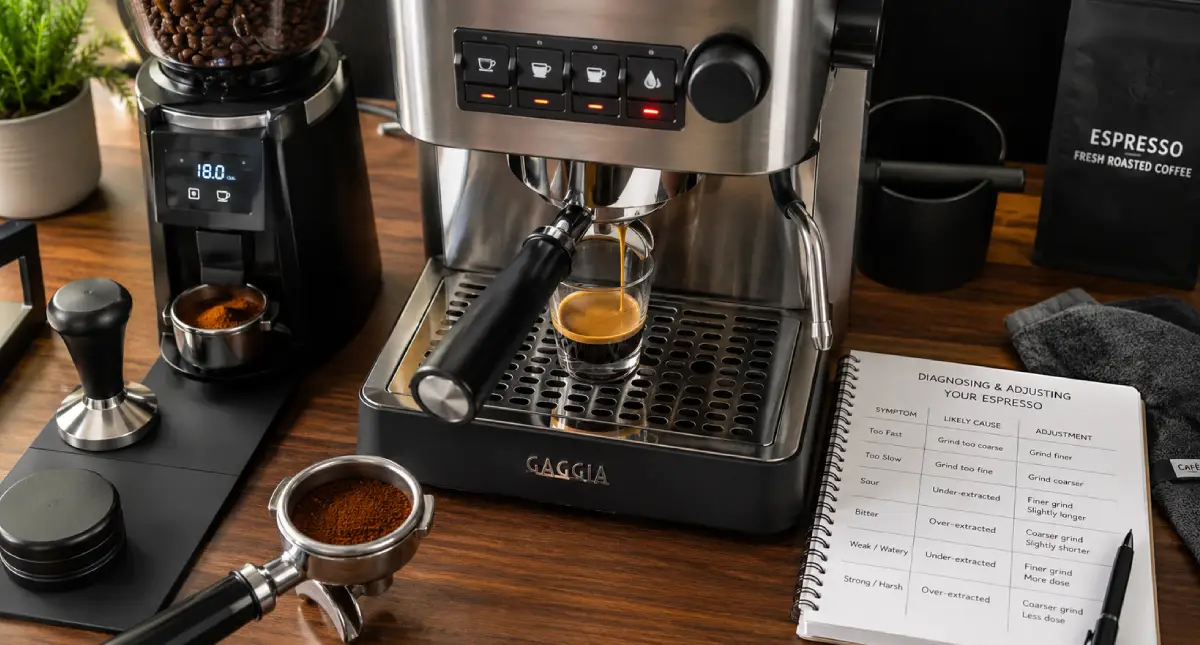
Espresso Troubleshooting at a Glance
If your espresso isn’t behaving the way you expect, this quick guide can help you identify where to start.
| Espresso problem | Possible causes | What to check first |
|---|---|---|
| Shot runs too fast | Grind too coarse, puck resistance, channeling | Grind and puck preparation |
| Shot runs too slowly | Grind too fine, high dose, restricted puck | Grind and dose |
| Espresso tastes sour | Under-extraction, fast flow, recipe imbalance | Flow and extraction |
| Espresso tastes bitter | Over-extraction, slow flow, recipe imbalance | Extraction and flow |
| Espresso tastes weak | Low dose, high yield, under-extraction | Dose and yield |
| Espresso tastes watery | High yield, low concentration, under-extraction | Recipe and extraction |
| Espresso tastes harsh or dry | Over-extraction, channeling | Extraction and puck |
| Espresso spurts or sprays | Channeling, uneven puck | Distribution |
| Shots are inconsistent | Grind, dose, distribution, retention | Repeatability of preparation |
These are starting points, not absolute diagnoses. Espresso problems can have several possible causes, which is why changing one variable at a time is so useful.
How to Diagnose an Espresso Shot
Before changing your grind setting, take a moment to look at what actually happened.
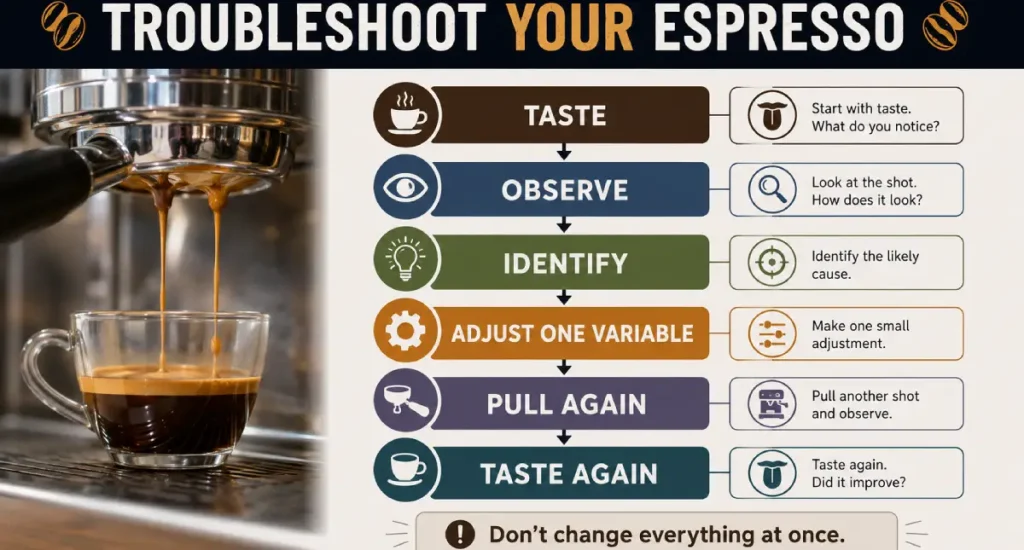
A useful troubleshooting process is:
Taste → Observe flow → Check recipe → Check puck → Adjust → Taste again
This approach gives you much more information than simply asking whether the shot took a certain number of seconds.
→ How Coffee Grind Size Affects Flavor
Start With Taste
Taste tells you what the extraction ultimately produced.
Common problems include:
Sour
A noticeably sharp, acidic or unpleasantly sour espresso can indicate under-extraction.
The coffee may not have extracted enough of its soluble compounds before the shot finished.
Bitter
A harsh or strongly bitter espresso can indicate over-extraction, although bitterness can also be influenced by the coffee itself and the brewing recipe.
Weak or Watery
A shot can taste thin when the recipe produces a low concentration, the dose is too small for the yield, or extraction is not being managed effectively.
Dry or Astringent
A drying sensation can be associated with over-extraction or uneven extraction, including channeling.
Taste doesn’t always tell you the exact cause—but it gives you an important clue.
Then Look at the Flow
The way espresso flows from the portafilter can reveal problems with the coffee bed.
Pay attention to:
- how quickly the first drops appear
- whether the flow is even
- whether the stream suddenly accelerates
- whether espresso spurts from one area
- whether the shot slows dramatically
- whether the flow becomes pale toward the end
A fast stream doesn’t automatically mean the grind is wrong, and a slow stream doesn’t automatically mean you should change the grind.
Look at the whole shot.
Check Time, Dose and Yield Together

Shot time is useful, but it shouldn’t be treated as a magic number.
Instead, consider three measurements together:
Dose: how much ground coffee goes into the basket
Yield: how much espresso comes out
Time: how long the extraction takes
These measurements help you understand what happened during the extraction.
For example, two shots can take a similar amount of time but taste completely different because their dose, yield, puck preparation or flow characteristics differ.
That’s why dialing in espresso is better approached as a process of observation and adjustment, rather than chasing a single number.
Why Is My Espresso Running Too Fast?
A fast shot means water is passing through the coffee bed with relatively little resistance.
Common causes include:
- grind is too coarse
- dose is too low for the basket
- puck preparation is uneven
- channeling is allowing water to find easy pathways
- the coffee bed isn’t providing consistent resistance
What should you try first?
If your preparation and dose are consistent, try a slightly finer grind.
Then pull another shot and evaluate the result.
Don’t immediately change the grind, dose and yield together. If you do, you won’t know which change made the difference.
For a deeper guide to making controlled grind adjustments, see:
👉 How to Adjust Espresso Grind Size
When Grind Isn’t the Problem
If making the grind finer doesn’t resolve the problem, look at the puck.
Uneven distribution can create areas of lower resistance where water moves more easily.
That can produce fast flow, spurting and uneven extraction even when the grinder setting appears reasonable.
This is where Espresso Distribution becomes an important part of troubleshooting.
Why Is My Espresso Running Too Slowly?
A slow espresso shot means water is meeting substantial resistance as it moves through the coffee bed.
Possible causes include:
- grind is too fine
- dose is too high
- the puck is overly restrictive
- preparation has created excessive resistance
- the coffee or grinder is producing an unexpectedly fine grind
What should you try first?
If your dose and preparation are consistent, try moving slightly coarser.
Pull another shot and reassess the flow and taste.
Small adjustments are usually easier to evaluate than dramatic ones.
When to Check Dose or Puck Preparation
If the shot continues to run slowly despite reasonable grind adjustments, look beyond the grinder.
Check whether:
- you’re consistently dosing the same amount
- the basket is appropriate for the dose
- the grounds are distributed evenly
- the puck is being prepared consistently
- there is excessive coffee contacting the shower screen
Troubleshooting works best when you investigate the entire preparation process rather than blaming one variable automatically.
Why Does My Espresso Taste Sour?
Sour espresso is one of the most common complaints from home baristas.
A sour or sharply acidic taste can indicate that the coffee is under-extracted.
That means the extraction hasn’t removed enough soluble compounds from the coffee.
Possible causes include:
- flow is too fast
- grind is too coarse
- extraction is insufficient
- recipe variables are unbalanced
- puck preparation is producing uneven extraction
What should you check?
Start with the flow.
If the espresso is rushing through the puck, a slightly finer grind may help increase resistance and extraction.
Then pull another shot and taste it.
For a deeper explanation of the relationship between flow, extraction and taste, see:
Espresso Extraction: How to Dial In the Perfect Shot
Why Does My Espresso Taste Bitter?
Bitter espresso can be associated with over-extraction, although the coffee itself and the recipe can also contribute.
Possible causes include:
- extraction is excessive
- flow is too slow
- grind is too fine
- the recipe is producing an imbalance
- the coffee itself has strongly bitter characteristics
Rather than automatically making the grind coarser, look at the entire shot.
Ask:
How fast did it flow?
What was the dose?
What was the yield?
How did the coffee taste throughout the shot?
Then make one controlled adjustment.
Why Does My Espresso Taste Weak or Watery?
A weak espresso isn’t necessarily caused by the grind.
Look at the recipe first.
Possible causes include:
- insufficient coffee dose
- excessive yield
- low concentration
- under-extraction
- coffee that has lost freshness
- inconsistent preparation
If you are getting substantially more liquid than intended, the resulting espresso may taste thin or diluted.
Check your dose and yield together before making a major grind adjustment.
Dose and Yield Matter
Think of espresso as a relationship rather than a single measurement.
If the amount of coffee going into the basket changes while everything else remains the same, your extraction can change.
Likewise, allowing substantially more liquid to leave the basket can change the concentration and balance of the finished espresso.
Consistency matters.
Why Does My Espresso Taste Harsh, Dry or Astringent?
A harsh or drying espresso can be particularly frustrating because it doesn’t always point to one obvious problem.
Possible causes include:
- excessive extraction
- channeling
- uneven extraction
- very fine grinding
- coffee characteristics
- recipe imbalance
Look at the puck as well as the cup
If the espresso tastes unpleasant and you also notice uneven flow or spurting, puck preparation deserves attention.
Channeling can cause some areas of the coffee bed to receive disproportionately more water than others.
The result can be an uneven extraction where parts of the coffee are extracted differently from the rest.
Why Is My Espresso Channeling?
Channeling occurs when water finds preferential pathways through the coffee bed rather than flowing evenly through the puck.
What can channeling look like?
You may notice:
- spurting
- spraying
- uneven streams
- flow concentrated in one area
- sudden changes in flow
- inconsistent results from seemingly identical preparations
Common causes include:
- uneven distribution
- clumps in the ground coffee
- inconsistent puck preparation
- poor grinder distribution
- problems with the coffee bed
One of the most useful ways to reduce this risk is to make your puck preparation more consistent.
For more detail, see:
Why Is My Espresso Flow Uneven?
Not every espresso stream will look perfectly symmetrical, but obvious spurting or highly uneven flow can indicate a problem.
Look for:
- one side flowing significantly faster
- multiple streams appearing unexpectedly
- sudden spurting
- flow changing dramatically during extraction
If the coffee bed isn’t prepared evenly, water may find easier pathways through some areas.
Before making a major grinder adjustment, check your distribution and puck preparation.
Why Are My Espresso Shots Inconsistent?
This is one of the most important troubleshooting questions.
If one shot tastes excellent and the next tastes completely different, the problem may not be the grinder setting at all.
Check your dose
Are you consistently measuring the same amount of coffee?
Check your grind
Is the grinder producing a consistent grind?
Check distribution
Are you preparing the coffee bed in the same way every time?
Check grinder retention
Are old grounds remaining inside the grinder and affecting the next dose?
Check coffee freshness
Coffee changes as it ages, which can affect extraction and dialing-in.
Most importantly: check your process
If every shot is prepared differently, it becomes almost impossible to identify the variable responsible for the result.
Consistency makes troubleshooting possible.
☕ Espresso Troubleshooting Decision Tree
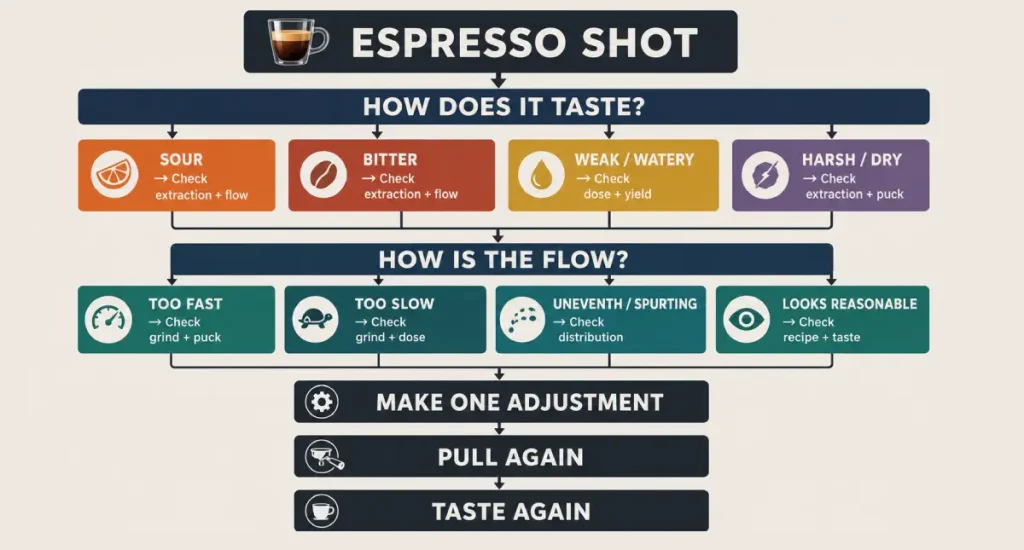
When your espresso isn’t right, use this simple process.
ESPRESSO SHOT
↓
HOW DOES IT TASTE?
SOUR
→ Check for under-extraction and fast flow
BITTER
→ Check for excessive extraction and slow flow
WEAK / WATERY
→ Check dose, yield and concentration
HARSH / DRY
→ Check extraction and puck preparation
↓
HOW IS THE FLOW?
TOO FAST
→ Check grind and puck preparation
TOO SLOW
→ Check grind and dose
UNEVENTH / SPURTING
→ Check distribution and channeling
FLOW LOOKS REASONABLE
→ Taste and evaluate the recipe
↓
MAKE ONE ADJUSTMENT
↓
PULL AGAIN
↓
TASTE AGAIN
This is the key habit to develop:
Don’t troubleshoot five variables at once.
What Should I Adjust First?
When you’re unsure where to start, use this troubleshooting order:
1. Taste
What is actually wrong with the cup?
2. Flow
Was the shot unusually fast, slow or uneven?
3. Dose and Yield
Were you consistent with the recipe?
4. Puck Preparation
Was the coffee distributed and tamped consistently?
5. Grind
Now make a controlled grind adjustment if the evidence points there.
6. Coffee
Consider freshness, roast characteristics and the coffee itself.
7. Machine
If the basic variables are controlled and the problem continues, investigate the equipment.
This isn’t a rigid law of espresso.
It’s a diagnostic framework designed to stop you from changing everything simultaneously.
Common Espresso Troubleshooting Mistakes
Changing Several Variables at Once
This is probably the easiest way to make espresso troubleshooting confusing.
If you change:
- grind
- dose
- yield
- temperature
- tamping
all at once, you won’t know which change affected the result.
Make one meaningful adjustment at a time whenever possible.
👉 Espresso Grind Size teaches you the variable.
Chasing a Specific Shot Time
Time is useful.
But time alone doesn’t tell you whether espresso tastes good.
A shot can hit a particular time and still taste unpleasant.
Use time alongside:
dose + yield + flow + taste
Adjusting the Grinder Too Aggressively
Large grind changes can make it difficult to understand what’s happening.
Small, deliberate changes make the feedback from the next shot easier to interpret.
👉 How to Adjust Your Espresso Grind
Ignoring Taste
Your espresso machine doesn’t drink the espresso—you do.
Visual flow and timing provide useful information, but taste ultimately tells you whether the result is working for your coffee and recipe.
Blaming the Machine Too Soon
It’s tempting to assume the machine is responsible whenever espresso goes wrong.
But many problems come from:
- grind
- dose
- distribution
- puck preparation
- coffee freshness
- recipe consistency
Work through the fundamentals first.
Forgetting Coffee Freshness
Coffee isn’t a static ingredient.
As beans age, their behaviour during extraction can change.
If your previously reliable grind setting suddenly produces different results, consider whether the coffee has changed before making extreme adjustments.
How to Dial In Espresso After Troubleshooting
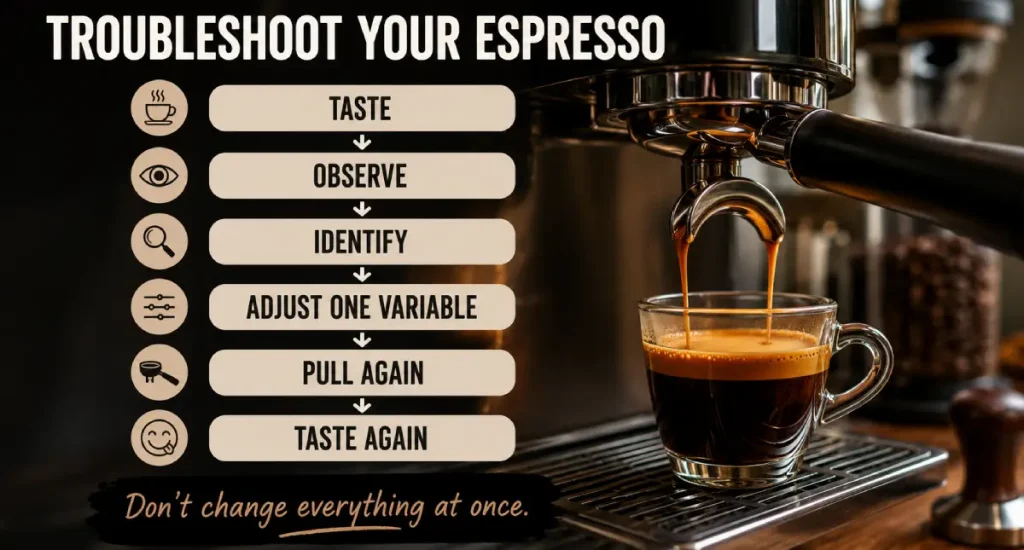
Once you’ve identified the likely problem, return to a controlled dialing-in process.
Use:
Pull → Observe → Taste → Identify → Adjust → Repeat
Pull a shot.
Observe its flow.
Taste it.
Identify the most likely problem.
Make one adjustment.
Pull again.
Then evaluate the result.
This process becomes much easier once you stop treating espresso as a recipe that must be followed perfectly and start treating it as a system that gives you feedback.
For the complete dialing-in process, continue to:
Espresso Extraction: How to Dial In the Perfect Shot
And when the required adjustment is grind size, use:
How to Adjust Espresso Grind Size
Frequently Asked Questions
Why is my espresso running too fast?
A fast shot can be caused by a grind that is too coarse, insufficient resistance, uneven puck preparation or channeling. If your dose and preparation are consistent, try a slightly finer grind and reassess the next shot.
Why is my espresso running too slowly?
A slow shot can result from a grind that is too fine, a high dose or excessive resistance through the coffee bed. Check your grind and dose before making larger changes.
Why does my espresso taste sour?
Sour espresso can indicate under-extraction. Check the flow first. If the shot is running quickly, a slightly finer grind may help increase resistance and extraction.
Why does my espresso taste bitter?
Bitter espresso can be associated with over-extraction, although coffee characteristics and recipe variables can also contribute. Look at flow, grind, dose and yield together rather than changing one variable automatically.
Why does my espresso taste weak?
Weak espresso can result from a low dose, high yield, low concentration or under-extraction. Check your dose and yield before assuming the grind is the problem.
Why is my espresso channeling?
Channeling occurs when water finds preferential pathways through the coffee bed. Uneven distribution, clumping and inconsistent puck preparation can all contribute.
Should I adjust grind size or dose first?
There isn’t one universal answer. First diagnose the shot using taste, flow and recipe information. If dose is already consistent and the evidence points toward flow resistance, a controlled grind adjustment may be the appropriate next step.
Can fresh coffee cause espresso problems?
Yes. Coffee changes as it ages, so a grinder setting that worked well previously may need adjustment as the beans change.
How do I troubleshoot inconsistent espresso shots?
Start by making your preparation consistent. Measure your dose, keep your puck preparation repeatable, monitor your grind and check coffee freshness. Once the process is consistent, individual problems become much easier to identify.
Final Verdict
☕ Frothy Fusion Verdict
The best way to troubleshoot espresso is to diagnose before you adjust.
Don’t immediately turn the grinder.
Start with taste, observe the flow, check dose and yield, inspect your puck preparation, and then make one controlled adjustment.
Pull another shot.
Taste it again.
That’s the real skill behind dialing in espresso.
You don’t need to guess your way to a better shot—you need to learn how to read what the espresso is telling you.
☕ The Espresso Troubleshooting Method
TASTE
↓
OBSERVE
↓
IDENTIFY
↓
ADJUST ONE VARIABLE
↓
PULL AGAIN
↓
TASTE AGAIN