

If you love traditional coffee and want to master the art of authentic Greek or Turkish coffee, you’ve probably come across two terms: Briki and Cezve.
While they look similar and are often used interchangeably, there are subtle differences that can affect your brewing ritual and the flavor of your coffee. Let’s dive in! 🧐✨
What Are Briki and Cezve?
Briki
The Briki is a small, long-handled pot used primarily in Greece for making traditional Greek coffee. It’s designed to create a thick layer of foam called kaimaki, which is a signature of Greek coffee. Briki pots usually have a slightly wider base and a narrow top to help control the foam.
Cezve
The Cezve (pronounced jez-veh) is the Turkish equivalent of a Briki. It’s used to brew Turkish coffee and is typically made of copper, brass, or stainless steel. The design often features a long handle and a slightly more pronounced spout for pouring, allowing a precise pour over tiny cups.
Key Differences Between Briki and Cezve
| Feature | Briki | Cezve |
|---|---|---|
| Origin | Greece | Turkey |
| Material | Copper, stainless steel | Copper, brass, stainless steel |
| Shape | Slightly wider base, narrow top | Taller, narrower body, pronounced spout |
| Capacity | Usually 1–4 cups | Usually 1–4 cups |
| Foam Control | Designed for thicker foam (kaimaki) | Foam may be lighter but consistent |
| Pour Style | Narrow top prevents spilling | Spout makes pouring easier |
💡 Tip: Both are small, often handmade, and perfect for the slow, ritualistic brewing method that defines Mediterranean coffee culture.
Brewing with a Briki or Cezve
- Measure water: Use cold water according to the number of cups.
- Add coffee & sugar: Traditionally, finely ground coffee is used. Sugar can be added to taste.
- Heat slowly: Place on low heat. Do not stir once heating begins.
- Watch the foam: Foam rises as it heats. Remove just before it boils over.
- Pour & serve: Slowly pour into small demitasse cups, keeping the foam intact.
✨ Pro Tip: A Briki often produces a slightly thicker foam than a Cezve, giving Greek coffee its characteristic texture.
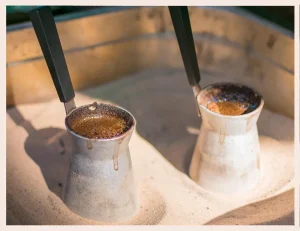
Briki vs Cezve: Which One Should You Choose?
- Choose a Briki if you want a traditional Greek coffee experience with a rich foam layer and slightly thicker texture.
- Choose a Cezve if you prefer Turkish coffee with a smoother pour and precise control over the coffee layer.
Both are fantastic for slow coffee rituals and make a beautiful addition to any home coffee bar.
FAQs ❓
Can I use a Briki as a Cezve and vice versa?
Yes! They are very similar, but the foam and pouring style may differ slightly.
What’s the best material for Briki and Cezve?
Copper is traditional and heats evenly, but stainless steel is easier to maintain.
Can I make more than one cup at a time?
Absolutely! Both come in various sizes, usually from 1 to 4 cups.
Do I need special coffee for Briki or Cezve?
Yes, use extra fine grind coffee for the best authentic experience.
You May Also Like 🌟
- How to Make Turkish Coffee at Home ☕
- Greek Coffee 101: Brew, Taste & Cultural Traditions 🇬🇷
- Greek vs Turkish Coffee: What’s the Difference? 🤔
- Top Coffee Grinders for Fine Powder ☕