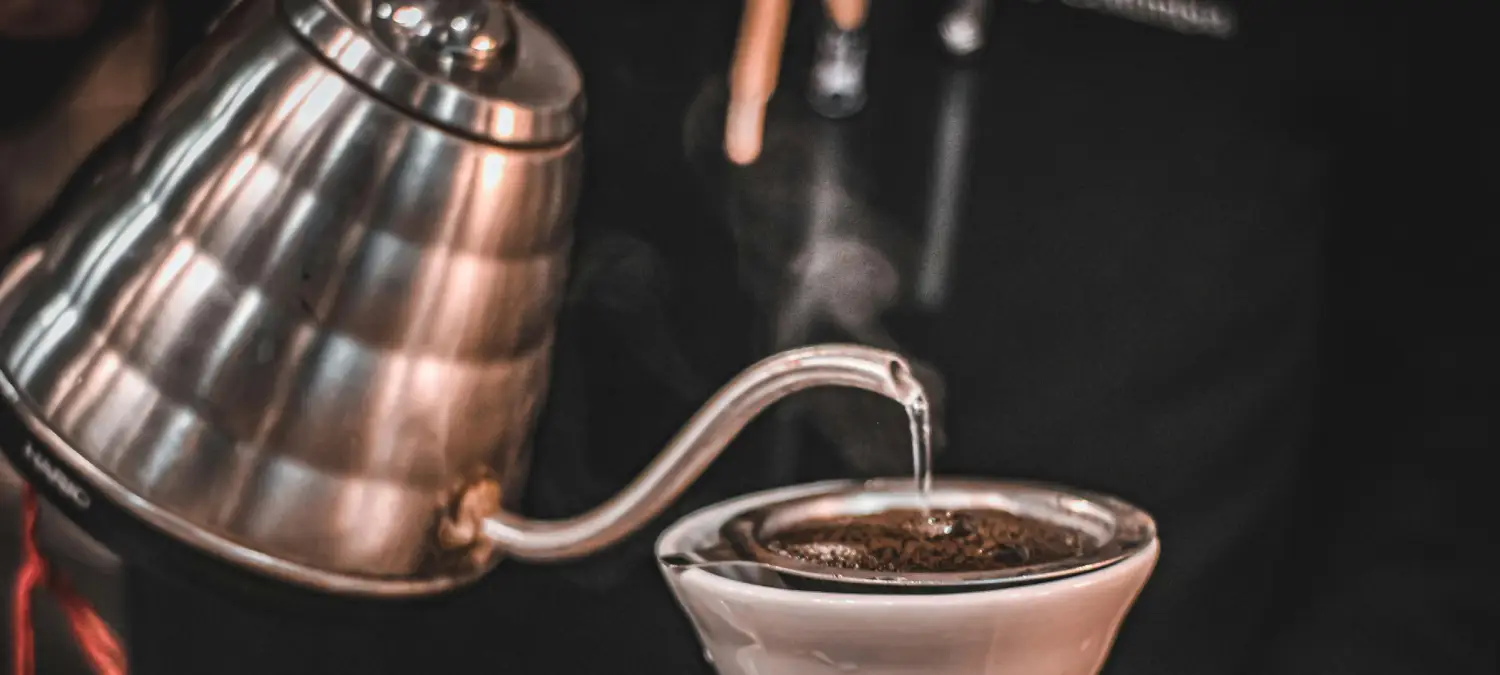
Learning how to use a gooseneck kettle is the quickest way to make your pour over coffee more consistent. The narrow, curved spout lets you pour slowly and aim water exactly where you want it, so every coffee ground gets wet evenly.
- Quick Answer
- Key takeaways
- What is a gooseneck kettle?
- How to use a gooseneck kettle: step by step
- Gooseneck kettle pouring techniques and water temperature
- Common gooseneck kettle mistakes
- What to look for in a gooseneck kettle
- FAQs How to Use A Gooseneck Kettle
- What is a gooseneck kettle used for?
- Can you use a gooseneck kettle on the stove?
- What temperature should a gooseneck kettle be for pour over?
- Can I use a regular kettle instead of a gooseneck kettle?
- Is an electric or stovetop gooseneck kettle better?
- How do you clean a gooseneck kettle?
- How much water should I put in a gooseneck kettle?
- Can you use a gooseneck kettle for tea?
- Final verdict: how to use a gooseneck kettle with confidence
- Related Reads to How to Use a Gooseneck Kettle
Whether you own a stovetop or an electric model, the routine is the same: heat the water to the right temperature, pour a short bloom, then add water in slow, steady circles.
This guide covers each step, the temperatures to aim for, common mistakes, and how to keep your kettle clean.
Quick Answer
To use a gooseneck kettle, fill it with fresh water, heat it to about 195–205°F (90–96°C), and rest the spout close to the coffee bed.
Pour a short bloom, wait 30–45 seconds, then add water in slow, steady circles from the centre outward. Keep the flow thin and even until you reach your target weight.
How this guide was written: it draws on manufacturer instructions and published brewing guides, not hands-on testing of every kettle mentioned.
Key takeaways
- A gooseneck kettle gives you control over flow rate and pour placement, which is what pour over brewing depends on.
- Aim for water at roughly 195–205°F (90–96°C) for pour over.
- Bloom first, then pour in slow circles and keep the stream steady.
- You do not need one for French press or AeroPress, where the grounds are fully immersed.
- Electric models hold an exact temperature; stovetop models need a thermometer.
- Rinse after each use and descale regularly so the narrow spout keeps flowing freely.
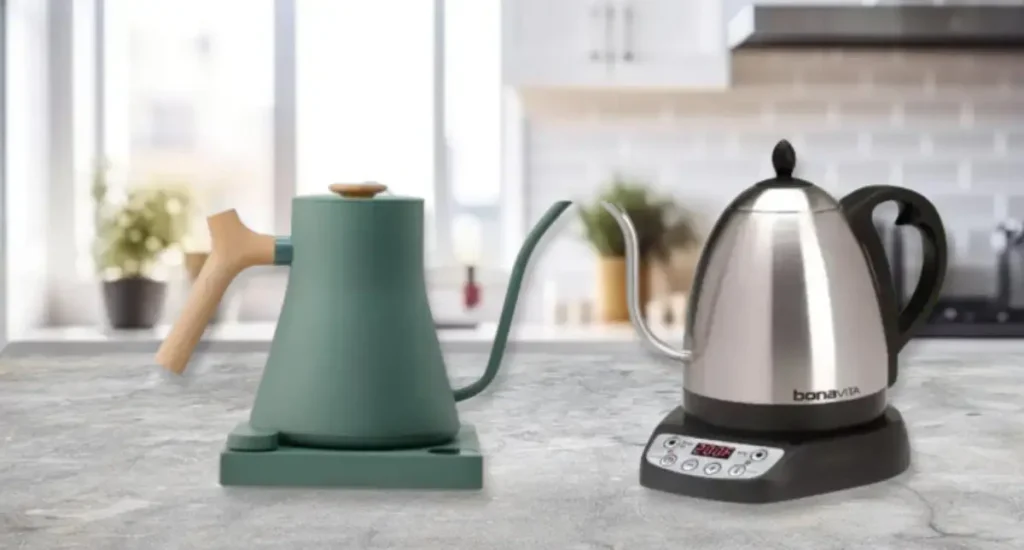
Gooseneck kettle vs standard kettle
| Gooseneck kettle | Standard kettle | |
|---|---|---|
| Water flow | Slow, thin, steady stream | Fast, wide, hard to slow down |
| Pour placement | Precise, close to the coffee bed | Broad and splashy |
| Best for | Pour over (V60, Chemex, Kalita Wave) | French press, AeroPress, tea bags, general boiling |
| Temperature control | Presets on electric models; thermometer needed on stovetop | Usually boil only |
| Learning curve | Moderate; takes a few brews to get steady | None |
| Typical cost | Higher | Lower |
What is a gooseneck kettle?
A gooseneck kettle is a kettle with a long, thin, curved spout that restricts water to a narrow, slow stream. That design lets you control how fast water flows and exactly where it lands on your coffee, which is why it is the standard tool for pour over brewing. Some roasters prefer the name “swan neck kettle”
Why the spout matters
In pour over, the way water enters the coffee bed affects how evenly the grounds extract. A fast, wide stream can carve channels through the bed, so some grounds over-extract while others barely get wet. A thin, steady stream lets you saturate the bed evenly and slow the flow when you need to.
Electric vs stovetop
| Electric gooseneck | Stovetop gooseneck | |
|---|---|---|
| Temperature | Set and hold a target, often to the degree | Needs a thermometer or careful timing |
| Heat source | Plug-in base | Gas, electric, ceramic or glass hob; check the maker’s notes for induction |
| Convenience | Auto shut-off; some have a hold function | Simple and long-lasting, but you watch the heat |
| Cooling during the brew | Holds temperature | Loses heat once off the burner |
| Typical cost | Higher | Lower |
Do you need one?
Not strictly. Any kettle can make pour over, but a gooseneck makes consistent results much easier. Immersion methods such as French press and AeroPress work fine with any kettle. A gooseneck is also handy for tea and for any recipe that needs a precise amount of hot water, such as oatmeal.
How to use a gooseneck kettle: step by step
These steps suit a V60, Kalita Wave or Chemex. You will need a gooseneck kettle, a dripper with a paper filter, freshly ground medium-fine coffee, a mug or carafe, and a scale. As a starting recipe, try 20 g of coffee to 320 g of water (about 1:16) and adjust to taste.
Step 1: Fill the kettle with fresh water
Use fresh, filtered water. Leave headroom so water does not slop out as you tilt the kettle. Make enough for rinsing the filter as well as the brew. Never heat the kettle empty.
Step 2: Heat the water to temperature
For pour over, aim for roughly 195–205°F (90–96°C).
- Electric kettle: set the target, for example 200°F (93°C), and wait for it to hold.
- Stovetop kettle: use medium heat, because high heat overshoots quickly. Choose a burner that fits the base so flames never climb the sides.
- No thermometer: bring the water to a light simmer, which is close to 200°F (93°C)
☕ Frothy Fusion Tip: Lift the kettle off the heat as soon as it reaches temperature. A stovetop kettle keeps heating, and the water cools as you pour.
Step 3: Rinse the filter and warm the dripper
Place the filter in the dripper and pour hot water through it. This removes papery taste and warms the dripper and mug. Discard the rinse water.
Step 4: Add the coffee and zero the scale
Add 20 g of ground coffee, level the bed with a gentle shake, and place everything on the scale. Tare it to zero.
Step 5: Pour the bloom
Pour about twice the weight of the coffee (around 40 g) in a slow, gentle stream. Make sure every ground is wet, then wait 30–45 seconds while the coffee releases gas.
Step 6: Pour in slow circles
After the bloom, pour in a steady spiral from the centre outward, then back toward the centre. Keep the spout low and close to the coffee bed and keep the stream thin and even. Add water in two or three pulses until the scale reads 320 g.
☕ Frothy Fusion Tip: Aim for the grounds, not the filter wall. Water that runs down the paper bypasses the coffee and weakens the cup.
Step 7: Let it drain and serve
A typical brew finishes in about 2:30 to 3:30 minutes. Once the dripper stops dripping, remove it, swirl the coffee and serve.
Step 8: Empty and dry the kettle
Empty any leftover water straight away while the kettle is still warm, rinse it, and let it dry so scale does not build up.
Gooseneck kettle pouring techniques and water temperature
A gooseneck kettle gives you four main ways to pour. Most brewers combine them: a centre pour for the bloom, then a spiral or pulses for the rest.
| Technique | How to do it | Best for |
|---|---|---|
| Centre pour | Pour a small, slow circle in the middle of the bed | The bloom; gentle saturation |
| Spiral pour | Pour from the centre outward, then back to the centre | The main pour on cone drippers like the V60 |
| Pulse pour | Add water in 2–4 stages, letting the bed drop between pours | Controlling total brew time |
| Continuous pour | One slow, unbroken pour to the target weight | Simple routines; flat-bed drippers forgive uneven pouring more than steep cones |
As a rough guide, a gentle 3–6 g of water per second suits most brews. Pouring harder agitates the bed more, and pouring more gently agitates it less, so keep the stream consistent from brew to brew.
Water temperature guide
Hotter water extracts more from the coffee, so lighter, denser roasts tend to suit the upper end of the range. Treat these as starting points.
| Brew | Temperature |
|---|---|
| Light roast pour over | 200–205°F (93–96°C) |
| Medium roast pour over | About 200°F (93°C) |
| Dark roast pour over | 195–200°F (90–93°C) |
| Green tea | About 160–180°F (70–82°C) |
| Black tea | 195–212°F (90–100°C) |
☕ Frothy Fusion Tip: If your coffee tastes sour, try slightly hotter water, a finer grind or a slower pour. If it tastes bitter, go the other way.
The temperature at the grounds matters more than the number on your kettle, and it drops as you pour. Preheating the dripper and mug helps.
Common gooseneck kettle mistakes
Avoid
- ❌ Pouring too fast or too high, which churns the bed and cools the water
- ❌ Heating a stovetop kettle on high and overshooting your target temperature
- ❌ Heating the kettle empty, which can warp the metal or damage electric parts
- ❌ Aiming water at the filter wall instead of the grounds
- ❌ Skipping the bloom, so gas blocks even saturation
- ❌ Overfilling, so water slops from the spout as you tilt
- ❌ Ignoring limescale, which can slow or sputter the stream
Pros and cons
Pros
- ✔ Precise, slow pouring that you can repeat from brew to brew
- ✔ Electric models hold an exact temperature
- ✔ Useful for tea and any recipe that needs a measured pour
- ✔ Looks good on the counter
Cons
- ✘ Costs more than a standard kettle
- ✘ Takes a few brews to pour steadily
- ✘ Most hold under about a litre, so large batches need a refill
- ✘ The narrow spout needs regular descaling
- ✘ Some stovetop handles get hot
Who it is best for
A gooseneck kettle suits anyone who brews pour over at least a few times a week, and anyone who wants consistent results. It is also a good gift for a home barista.
Who can skip it
If you brew mostly with a French press, AeroPress or capsule machine, a standard kettle does the job. Try pour over with a regular kettle first if you are not sure.
What to look for in a gooseneck kettle
If you do not own one yet, these are the features that matter most for pour over.
| Feature | What to look for |
|---|---|
| Heating method | Electric for set-and-hold temperature; stovetop for simplicity and lower cost |
| Temperature control | Presets or a dial on electric models; a built-in thermometer on stovetop models |
| Capacity | Around 0.8–1 L suits most home brewing. A kettle holding about twice the water you need leaves room for rinsing |
| Spout and flow | A narrow spout that can slow to a trickle without dribbling down the side |
| Handle | Heat-resistant and balanced when full, since you hold it steady for a minute or more |
| Material | Stainless steel inside, which resists corrosion and is easy to wipe clean |
| Safety | Auto shut-off and boil-dry protection on electric models |
| Warranty and brand | A clear warranty period and available spare parts |
For a sense of electric specs, the Fellow Stagg EKG is listed at 0.9 L and 1200 W with a 135–212°F range. It is one example, not a recommendation.
How to clean and descale your gooseneck kettle
Rinse the kettle after every use and descale it regularly so mineral build-up does not slow the narrow spout. Advice on frequency varies from monthly to every few months, depending on how hard your water is.
- Empty the kettle while it is still warm and rinse it, swirling water around the inside.
- For stovetop kettles, boil a 1:1 mix of white vinegar and water. For electric kettles, follow the maker’s descaling instructions.
- Let it sit, then scrub the spout with a narrow brush.
- Rinse several times until no vinegar smell remains.
- Dry it, and store it with the lid off or loosely on.
☕ Frothy Fusion Tip: Brew one cup of tea or run a plain-water boil after descaling to flush out any leftover vinegar taste before your next coffee.
FAQs How to Use A Gooseneck Kettle
What is a gooseneck kettle used for?
A gooseneck kettle is used mainly for pour over coffee, where its thin, curved spout lets you pour slowly and place water exactly where you want it. It also suits tea, especially varieties that need a specific water temperature, and any recipe that needs a measured pour of hot water, such as oatmeal. For immersion brewing like French press, a standard kettle works just as well.
Can you use a gooseneck kettle on the stove?
Yes, if it is a stovetop model. Stovetop gooseneck kettles work on gas, electric and glass hobs, and some suit induction, so check the maker’s instructions for your model. Choose a burner that matches the base so flames never climb the sides, and use medium heat to avoid overshooting your target temperature. Never put an electric gooseneck kettle on a hob; it only works on its own power base.
What temperature should a gooseneck kettle be for pour over?
Aim for roughly 195–205°F (90–96°C) for pour over coffee. Lighter roasts usually taste best toward the hotter end, while darker roasts do well a little cooler. Electric kettles let you set and hold the temperature, while stovetop kettles need a thermometer or a short rest after boiling. If your coffee tastes sour, try slightly hotter water; if it tastes bitter, try slightly cooler.
Can I use a regular kettle instead of a gooseneck kettle?
Yes, but consistent results are harder. A standard kettle pours faster and less precisely, which can cause uneven extraction. You can improve your odds by pouring in small, slow pulses, using a forgiving flat-bed dripper such as the Kalita Wave, or moving the hot water into a small jug with a narrow spout first. If you brew pour over often, a gooseneck is worth the upgrade.
Is an electric or stovetop gooseneck kettle better?
Electric is better if you want precise, repeatable temperature, since it holds your target while you brew. Stovetop is better if you want a simpler, cheaper kettle that can last for years and you are happy to use a thermometer. Neither pours better by design; spout shape and handle balance matter more than the heat source. Choose based on how much you value convenience against cost.
How do you clean a gooseneck kettle?
Rinse it with fresh water after every use, then descale with a 1:1 mix of white vinegar and water when you see limescale or the stream starts to sputter. Use a narrow brush on the spout, then rinse several times until the vinegar smell is gone. For electric kettles, follow the manufacturer’s descaling instructions and never immerse the power base in water.
How much water should I put in a gooseneck kettle?
Fill it with more water than your brew needs, but leave headroom below the maximum line so water does not spill when you tilt it. One maker suggests 800 mL to 1 L in a 1.2 L kettle. For a 320 g brew, about 500–600 mL leaves enough for rinsing the filter and warming your mug. Never run the kettle empty.
Can you use a gooseneck kettle for tea?
Yes. A gooseneck kettle gives you a gentle, controlled pour that is kind to delicate leaves, and temperature-controlled electric models let you set the right heat for each tea, from about 160–180°F for green tea to near boiling for black tea. It can also replace a separate kettle for most hot-water jobs in the kitchen.
Final verdict: how to use a gooseneck kettle with confidence
Knowing how to use a gooseneck kettle comes down to three habits: heat the water to the right temperature, bloom the grounds, and pour slowly in steady circles. Do those consistently and your pour over will taste more even and repeatable from one brew to the next.
Who it is for: home brewers who make pour over a few times a week, beginners who want a more forgiving routine, and anyone who likes tea and precise hot-water recipes.
Who should skip it: people who mostly brew with a French press, AeroPress or capsule machine, where a standard kettle does the job.
Best alternatives: a temperature-control standard kettle for general use, or a standard kettle with slow, pulsed pours while you decide whether pour over is for you.
Next step: grab your scale, try the starting recipe above, and change one thing at a time, such as grind size or water temperature, until the cup tastes the way you like it. Then read our other brewing guides and browse our coffee recipes to put your new kettle to work.
Related Reads to How to Use a Gooseneck Kettle
- Best Pour-Over Coffee Makers for Beginners
- How to Master the Perfect Bloom in Pour-Over Brewing
- Gooseneck Kettle vs Standard Kettle: Which One is Right for You?
- Fellow Stagg EKG Electric Kettle Review –>
☕ Just a heads up—this How to use a Gooseneck Kettle post contains affiliate links. If you buy through them, Frothy Fusion may earn a small commission (at no cost to you). Thanks for supporting our coffee-fueled content!