Getting the right espresso grind size is only half the battle. The real skill is knowing when and how to adjust your grinder when a shot runs too quickly, too slowly, or simply doesn’t taste right.
- What Does Adjusting Espresso Grind Size Actually Do?
- When Should You Grind Finer?
- When Should You Grind Coarser?
- How Much Should You Adjust Your Espresso Grind?
- How to Adjust Espresso Grind Size Step by Step
- How is the espresso flowing?
- How to Use Espresso Shot Time When Adjusting Grind
- Taste Your Espresso Before Making Another Adjustment
- When Changing the Grind Won't Fix Your Espresso
- Coffee freshness
- Grinder retention
- Espresso Grind Adjustment Troubleshooting Chart
- How Often Should You Adjust Espresso Grind Size?
- Common Espresso Grind Adjustment Mistakes
- Frequently Asked Questions
- Should espresso be ground finer or coarser?
- How do I know if my espresso grind is too fine?
- How do I know if my espresso grind is too coarse?
- How much should I adjust my espresso grinder?
- Why is my espresso suddenly running too fast?
- Why is my espresso suddenly running too slow?
- Should I adjust espresso grind based on time or taste?
- Does changing coffee beans require a new grind setting?
- The Simple Espresso Grind Adjustment Rule
- Final Takeaway
- Frothy Fusion Quick Reference
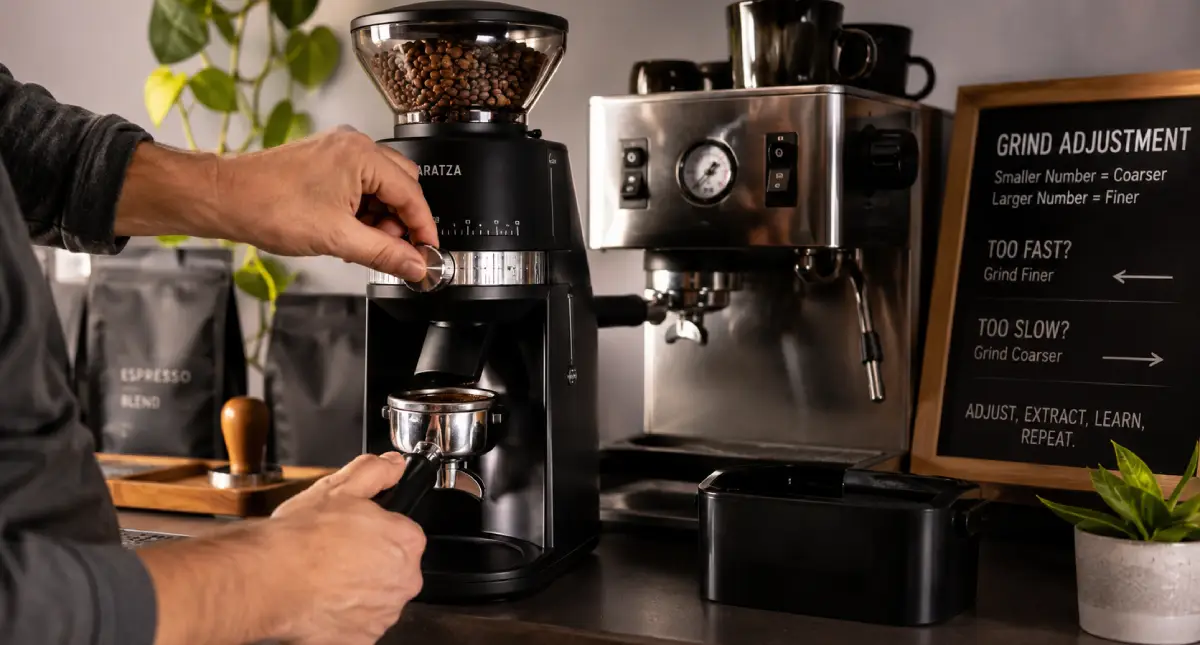
If your espresso is flowing too fast, the usual starting point is a finer grind.
If it is flowing too slowly, a coarser grind is usually the better direction.
But good espresso isn’t about blindly chasing a grinder number or forcing every shot to fit a particular extraction time.
Instead, learn to read the shot:
Observe → Adjust → Test → Taste → Repeat.
This guide shows you how to adjust espresso grind size systematically,
It will also teach how much to change, when shot time matters, and how to recognise when the grind isn’t actually the problem.
Quick answer: If your espresso is running too fast, try a slightly finer grind. If it is running too slowly, try a slightly coarser grind. Keep your other variables consistent, make one change at a time, then pull another shot and taste it.
What Does Adjusting Espresso Grind Size Actually Do?
Your espresso grinder controls the size of the coffee particles that make up the puck.
Changing that particle size changes how easily water can move through the coffee.
If you want a deeper explanation of how grind size affects espresso, start with our guide to espresso grind size.
A finer grind
A finer grind creates smaller particles and generally increases resistance to water flow.
That can:
- Slow the espresso flow
- Increase contact between water and coffee
- Increase extraction
- Help a fast-flowing shot move toward a more balanced result
If you go too fine, however, the shot can become excessively slow and may taste bitter, harsh, or dry.
☕ Fellow Digital Scale Review – Barista Grade Tool
A coarser grind
A coarser grind creates larger particles and generally reduces resistance.
That can:
- Increase the flow rate
- Shorten the time water spends moving through the puck
- Reduce extraction
- Help a very slow shot flow more freely
Go too coarse, though, and the shot may run quickly and taste thin, sharp, sour, or under-extracted.
If you want a deeper explanation of how grind size affects espresso in the first place, start with our guide to Espresso Grind Size.
When Should You Grind Finer?
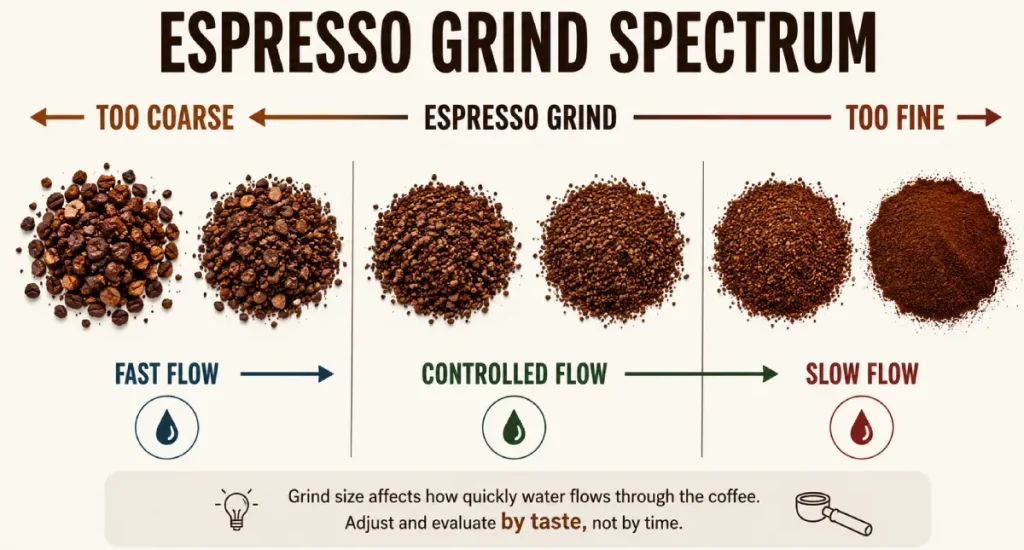
The classic reason to grind finer is a shot that is flowing too quickly.
For example, you might notice that:
- Espresso begins flowing very quickly
- The shot reaches your intended yield sooner than expected
- The stream looks unusually fast or thin
- The espresso tastes sour, sharp, thin, or under-extracted
In that situation, try moving the grinder slightly finer.
Don’t make the biggest adjustment possible
If the shot is only a little too fast, you usually don’t need a dramatic grinder change.
Make a small adjustment, pull another shot, and compare the result.
The goal is not to find a magical grinder number. Your grinder’s settings are specific to that grinder, and the ideal setting can change with the coffee.
Remember: fast does not automatically mean bad
A faster shot isn’t automatically wrong.
If the espresso flows relatively quickly but tastes balanced and enjoyable, there may be no reason to change it simply to satisfy a stopwatch.
Use time and flow as information. Use taste to help decide whether the result actually needs correcting.
When Should You Grind Coarser?
The opposite situation is a shot that is flowing too slowly.
You may notice:
- Very slow or restricted flow
- The shot takes substantially longer than expected
- Espresso drips rather than forming a steady stream
- The coffee tastes bitter, harsh, dry, or overly intense
In that situation, try moving the grinder slightly coarser.
A coarser grind reduces resistance and can allow water to pass through the puck more easily.
Again, make a controlled adjustment rather than immediately moving several settings.
Pull another shot using the same dose and other recipe variables, then compare the result.
How Much Should You Adjust Your Espresso Grind?
There is no universal adjustment amount because grinders behave differently.
Some grinders make relatively large changes between settings. Others allow extremely small adjustments.
A useful general principle is:
Make larger corrections when you’re clearly far from your target and smaller corrections as you get closer.
For example:
Very fast shot → make a noticeable but controlled move finer.
Slightly fast shot → make a smaller move finer.
Very slow shot → make a controlled move coarser.
Almost there → make a very small adjustment.
This prevents the common beginner cycle of:
Too fast → huge finer adjustment → too slow → huge coarser adjustment → too fast again.
You’re trying to narrow in on the right setting, not bounce between extremes.
How to Adjust Espresso Grind Size Step by Step
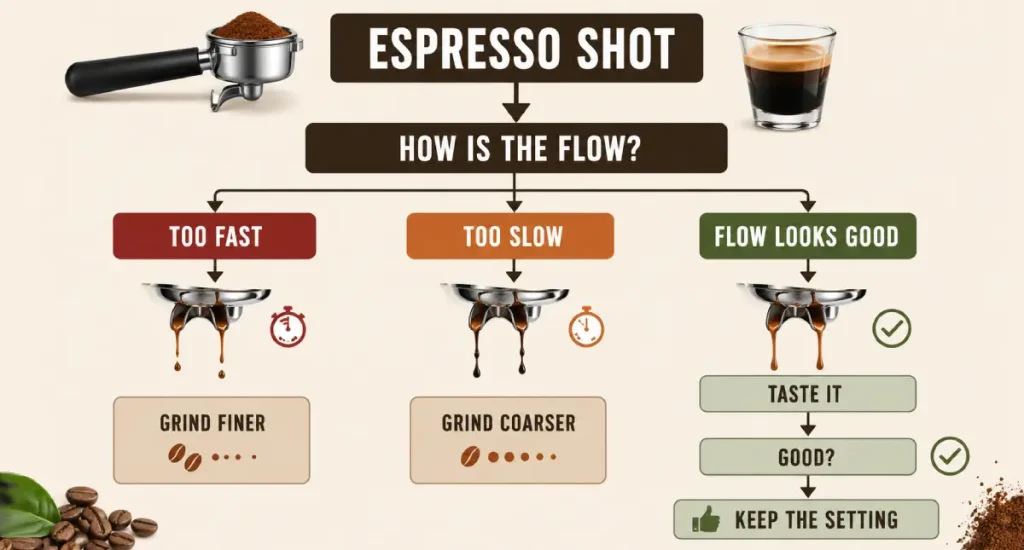
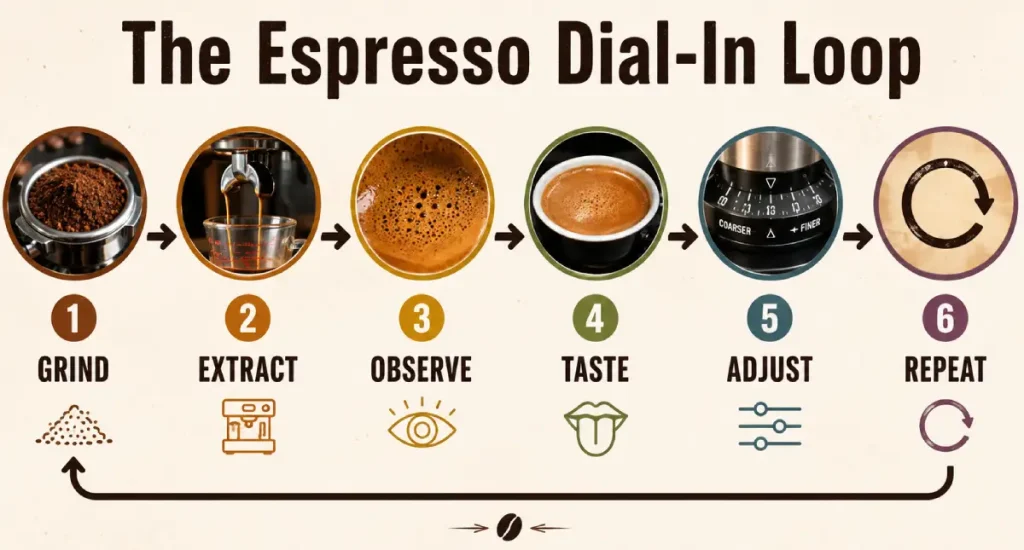
The most reliable approach is to treat espresso dialing in as a repeatable experiment.
Step 1: Start With a Consistent Recipe
Before changing your grinder, establish a repeatable starting point.
Keep as many variables consistent as possible:
- Coffee beans
- Dose
- Basket
- Espresso machine
- Yield
- Puck preparation
You don’t need laboratory precision. You simply want enough consistency that you can tell whether the grinder adjustment actually made a difference.
Step 2: Pull the Shot
Make your espresso normally.
If possible, keep track of:
- Dose
- Grinder setting
- Yield
- Shot time
- What the flow looked like
- How the espresso tasted
You don’t need to record every detail forever. But when you’re learning to dial in, simple notes can make the process much easier.
Step 3: Observe the Flow
Now ask one simple question:
How is the espresso flowing?
Too fast?
Try finer.
Too slow?
Try coarser.
Flow looks reasonable?
Don’t automatically change the grind.
Taste the espresso first.
This is one of the most important habits you can develop as a home barista.
Step 4: Make One Adjustment
Change the grind and leave the other major variables alone.
If you change:
- Grind
- Dose
- Yield
- Tamp
- Distribution
all at the same time, you won’t know which change caused the result.
Instead:
Change one thing → pull another shot → compare.
Step 5: Pull Another Shot
Use the same basic recipe.
Compare the second shot with the first.
Did the flow slow down or speed up as expected?
Did the shot become more balanced?
Did the taste improve?
Did you overshoot?
The second shot isn’t just another cup of coffee. It’s feedback about the adjustment you made.
Step 6: Taste the Espresso
This is where the stopwatch takes a back seat.
Ask:
- Is it sour or sharp?
- Is it bitter or dry?
- Is it thin?
- Is it harsh?
- Does it have good body?
- Does it taste balanced?
- Would I happily drink it?
Your answers tell you whether the adjustment moved you in the right direction.
Step 7: Repeat With Smaller Adjustments
If the shot improved but isn’t quite there, repeat the process.
As you get closer:
Make smaller adjustments.
Eventually you’ll reach a point where another change isn’t improving the coffee.
That’s when you stop.
How to Use Espresso Shot Time When Adjusting Grind
Shot time is useful, but it shouldn’t become an obsession.
You will often hear espresso recipes built around a particular extraction time. A target can be helpful as a starting reference, but there is no single number that guarantees great espresso.
The same shot time can produce very different results depending on:
- Dose
- Yield
- Brew ratio
- Grind size
- Coffee
- Machine
- Basket
- Puck preparation
- Flow behaviour
Instead of asking:
“Did my espresso take exactly 30 seconds?”
ask:
“What does the time tell me about how this shot behaved?”
If your shot is flowing very quickly and tastes thin and sour, the time supports the decision to investigate a finer grind.
If your shot is flowing slowly and tastes bitter or dry, the time supports investigating a coarser grind.
But if a shot falls outside a commonly quoted time range and tastes fantastic?
Drink it.
The goal is good espresso, not winning a stopwatch competition.
Taste Your Espresso Before Making Another Adjustment
Taste is one of the most valuable pieces of information available to you.
Sour or sharp
A sour, sharp, or thin espresso can indicate under-extraction.
If the shot is also flowing quickly, a finer grind may be a sensible next adjustment.
But don’t diagnose from taste alone. Consider the entire recipe and how the shot behaved.
Bitter, dry, or harsh
Bitter, dry, or harsh flavours can indicate over-extraction.
If the shot is also flowing slowly, a coarser grind may be a sensible next adjustment.
Again, look at the complete picture rather than applying one symptom-to-setting rule blindly.
Balanced and pleasant
This is the easiest diagnosis of all:
Stop adjusting.
If the espresso tastes good, you’ve achieved the thing that matters.
Don’t keep changing the grinder simply because another barista uses a different setting or because your shot took a few seconds longer than an internet recipe suggested.
When Changing the Grind Won’t Fix Your Espresso
Sometimes the grinder gets blamed for a problem that actually starts somewhere else.
If your shots are inconsistent from one pull to the next, investigate your preparation before endlessly moving the grinder.
Dose inconsistency
Changing the amount of coffee changes the puck and can change the way water flows through it.
Try to keep your dose consistent while dialing in.
Uneven distribution
If coffee grounds aren’t distributed evenly, water may find easier pathways through the puck.
That can produce uneven extraction and inconsistent results.
Tamping inconsistency
Tamping doesn’t need to become a strength competition, but consistent puck preparation matters.
If your preparation changes dramatically between shots, diagnosing grind size becomes much harder.
Channeling
Channeling occurs when water finds preferential pathways through the coffee puck.
A grinder adjustment alone won’t necessarily solve a puck-preparation problem.
If you see signs of uneven flow or notice that your shots vary significantly despite using the same grinder setting, investigate puck preparation.
Coffee freshness
Coffee changes as it ages.
A grinder setting that worked beautifully when you opened a bag may eventually need adjustment as the coffee develops.
That isn’t necessarily a sign that your grinder is malfunctioning.
It’s part of working with fresh coffee.
Grinder retention
If coffee remains inside the grinder, the grounds coming out of the grinder may not perfectly represent the setting or dose you think you’re using.
Consistent grinder use and sensible retention management can help reduce another source of variability.
Espresso Grind Adjustment Troubleshooting Chart
Use this as your quick reference when dialing in:
| What you observe | First thing to try |
|---|---|
| Shot flows too fast | Grind slightly finer |
| Shot flows too slowly | Grind slightly coarser |
| Shot is fast and tastes sour or thin | Consider a finer adjustment |
| Shot is slow and tastes bitter or dry | Consider a coarser adjustment |
| Flow looks reasonable but taste is off | Evaluate taste, recipe, and extraction before changing grind |
| Shot-to-shot results vary significantly | Check dose and puck preparation |
| You changed to new beans | Expect to re-dial the grinder |
| Your adjustment overshoots the target | Make a smaller correction in the opposite direction |
| Espresso tastes balanced | Stop adjusting |
Quick rule: Too fast → finer. Too slow → coarser. Almost right → make smaller adjustments. Tastes good → stop.
👉 Espresso Ttroubleshooting Guide
How Often Should You Adjust Espresso Grind Size?
There isn’t a fixed schedule.
Adjust the grinder when the coffee tells you that something has changed.
You may need to re-dial when:
You open a new bag of coffee
Different beans almost always mean a different starting point.
The coffee gets older
As coffee ages, its behaviour can change and you may find that your previous setting no longer produces the same flow.
You switch roast levels
Different coffees can behave differently in the grinder and during extraction.
Your environment changes
Temperature and humidity can influence coffee preparation, particularly in home environments where conditions aren’t tightly controlled.
You change your recipe
Changing dose, yield, basket, or other important variables can change the relationship between grind and extraction.
The key principle is:
Don’t adjust the grinder because the calendar says you should. Adjust it when the coffee’s behaviour changes.
Common Espresso Grind Adjustment Mistakes
1. Making huge adjustments
Large changes can take you from too fast to too slow without teaching you much about what happened.
Make controlled adjustments.
2. Changing several variables at once
If you change grind, dose, yield and preparation simultaneously, you lose the ability to identify cause and effect.
Change one major variable at a time.
3. Copying another person’s grinder setting
A grinder setting of “10” or “15” means very little without knowing the grinder.
Even two grinders with similar adjustment scales can produce very different results.
Use other people’s settings as starting references, not universal instructions.
4. Treating 30 seconds as a law
Shot time is useful information.
It isn’t a universal definition of good espresso.
Use time together with flow, recipe and taste.
5. Ignoring taste
A shot can look perfect on paper and still taste unpleasant.
Taste the coffee.
6. Blaming the grinder for inconsistent puck preparation
If your shots vary wildly, don’t immediately start moving the grinder back and forth.
First ask whether your:
- Dose
- Distribution
- Tamping
- Basket
- Workflow
are reasonably consistent.
7. Chasing perfection forever
Dialing in should eventually end.
If the espresso tastes balanced and enjoyable, you’ve done the job.
Frequently Asked Questions
Should espresso be ground finer or coarser?
It depends on how the shot is behaving. If espresso is flowing too quickly, try a slightly finer grind. If it is flowing too slowly, try a slightly coarser grind. Always consider flow and taste together rather than relying on grind direction alone.
How do I know if my espresso grind is too fine?
A grind may be too fine if the espresso is extremely slow or restricted and the resulting coffee tastes bitter, dry, harsh, or overly intense. If the shot is too slow, try a small move toward a coarser setting and test again.
How do I know if my espresso grind is too coarse?
A grind may be too coarse if the espresso flows very quickly and produces a thin, sharp, or sour result. If the shot is clearly too fast, try a small move toward a finer setting and pull another shot.
How much should I adjust my espresso grinder?
There is no universal adjustment amount because grinders differ. Make larger controlled corrections when the shot is clearly far from your target, then use progressively smaller adjustments as you get closer.
Why is my espresso suddenly running too fast?
Possible causes include a grind that is too coarse, changes in coffee freshness, dose differences, puck-preparation problems, or changes in your recipe. If the rest of your workflow is consistent, try a small finer grind adjustment first.
Why is my espresso suddenly running too slow?
A grind that is too fine is one common cause, but dose, puck preparation, coffee changes and recipe changes can also affect flow. If the shot is consistently too slow, try a small coarser adjustment after checking the rest of your workflow.
Should I adjust espresso grind based on time or taste?
Use both, but don’t treat time as an absolute target. Shot time helps you understand how the extraction behaved, while taste tells you whether the resulting espresso is actually enjoyable.
Does changing coffee beans require a new grind setting?
Usually, yes. Different beans, roast levels, processing methods and freshness can behave differently during grinding and extraction. Treat a new coffee as a new dialing-in exercise rather than assuming your previous grinder setting will transfer perfectly.
The Simple Espresso Grind Adjustment Rule
You don’t need to memorize dozens of espresso rules.
Start with this:
OBSERVE
Look at the flow and consider the shot time.
↓
ADJUST
Too fast?
Go finer.
Too slow?
Go coarser.
↓
TEST
Pull another shot while keeping the other variables consistent.
↓
TASTE
Is it sour, bitter, thin, dry, harsh, or balanced?
↓
REPEAT
Make a smaller adjustment if necessary.
Eventually:
STOP WHEN THE COFFEE TASTES RIGHT.
That’s the real goal of dialing in.
Final Takeaway
Adjusting espresso grind size isn’t about finding one perfect grinder number.
It’s about learning how your coffee responds.
Too fast → start finer.
Too slow → start coarser.
Almost there → make smaller adjustments.
Inconsistent → investigate your preparation.
Tastes good → stop.
The more consistently you observe, adjust, test and taste, the less you’ll rely on guesswork.
And once you’ve learned to control grind, the next step is understanding how grind interacts with **dose, yield, ratio, extraction and the other variables that determine the final espresso.
Continue with our guide to Espresso Extraction: How to Dial In the Perfect Shot to bring those variables together.**
Frothy Fusion Quick Reference
THE ESPRESSO DIAL-IN LOOP
GRIND → EXTRACT → OBSERVE → TASTE → ADJUST → REPEAT
Good espresso isn’t about following a magic number.
It’s about learning to read the coffee.
☕ Just a heads up—this post contains affiliate links. If you buy through them, Frothy Fusion may earn a small commission (at no cost to you). Thanks for supporting our coffee-fueled content!