The right espresso grind size can make the difference between a fast, thin shot and a balanced espresso with the body and flavor you’re looking for. But there isn’t one universal grinder setting that works for every coffee.
- What Is Espresso Grind Size?
- What Grind Size Should You Use for Espresso?
- Espresso Grind Size Chart
- How Grind Size Affects Espresso Extraction
- Grind Too Fine vs. Grind Too Coarse
- How to Adjust Espresso Grind Size
- How Fine Should Espresso Be?
- How Coffee Freshness Affects Grind Size
- How Roast Level Can Affect Espresso Grind
- Does Dose Affect Espresso Grind Size?
- Grind Size vs. Dose vs. Yield
- How Your Espresso Grinder Affects Grind Size
- Common Espresso Grind Size Mistakes
- Espresso Grind Size Troubleshooting
- A Simple Espresso Grind Dial-In Routine
- Frequently Asked Questions
- What grind size is best for espresso?
- How fine should espresso coffee be?
- Is espresso ground finer than filter coffee?
- What happens if espresso is ground too fine?
- What happens if espresso is ground too coarse?
- Should I grind finer if my espresso runs too fast?
- Should I grind coarser if my espresso runs too slow?
- Does grind size affect espresso taste?
- Does every espresso coffee need the same grind setting?
- How do I know when my espresso grind is right?
- The Bottom Line
- ☕ Continue Your Espresso Journey
Espresso generally requires a fine grind, but the correct setting depends on your grinder, coffee beans, roast, dose, basket and recipe.
The simplest way to think about it is:
Grind finer → slower water flow
Grind coarser → faster water flow
From there, you refine the grind by observing the shot and, most importantly, tasting the espresso.
What Is Espresso Grind Size?
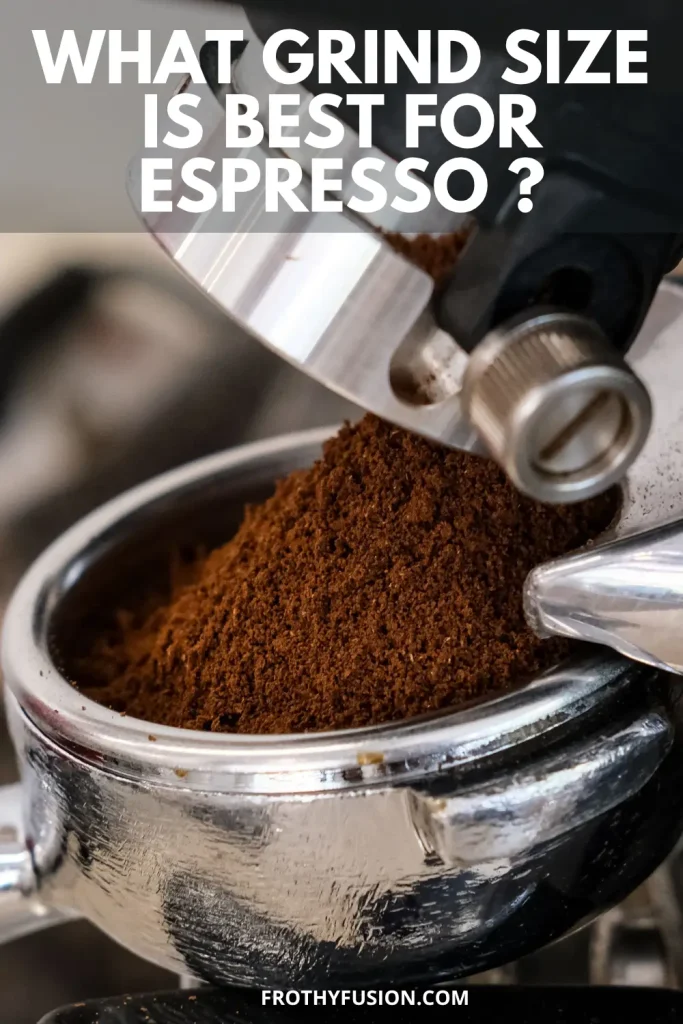
Espresso grind size refers to the size of the coffee particles produced by your grinder.
Espresso uses a relatively fine grind because the coffee is brewed with pressurised water over a comparatively short period.
The smaller particles create greater resistance to water flow, helping the water interact with the coffee during extraction.
However, espresso grind size is not the same thing as a grinder setting.
A grinder setting is simply a position on a particular grinder.
A setting of 10 on one grinder may produce completely different particles from setting 10 on another.
How fine should espresso be?
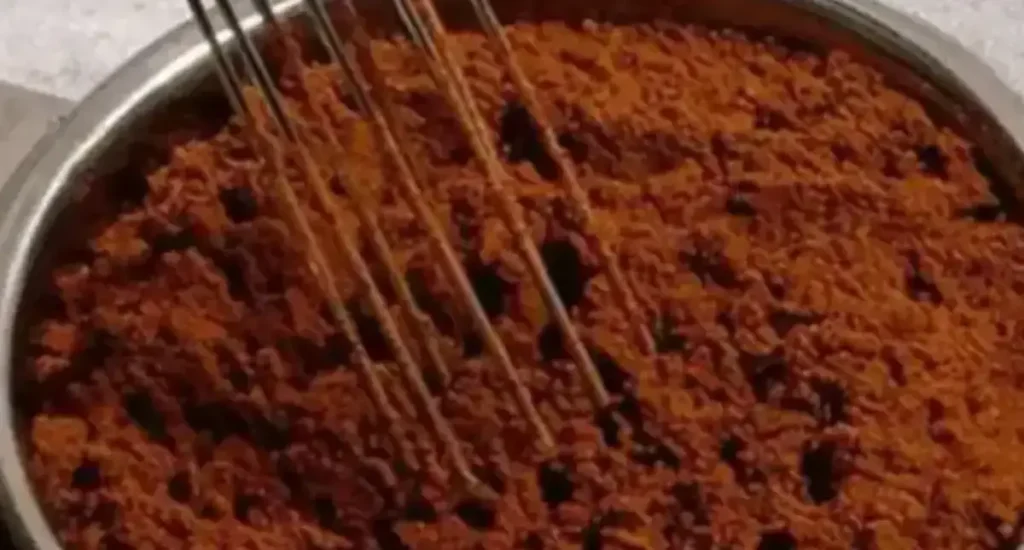
Espresso should generally be ground much finer than coffee intended for filter brewing, with a texture often compared with fine sand.
But there is no universal particle size or grinder number that guarantees a good shot.
Your coffee and equipment determine the starting point, while the resulting espresso tells you whether you need to adjust.
The goal isn’t to find a magic grinder number. The goal is to find the grind that produces the extraction and flavor you want.
What Grind Size Should You Use for Espresso?
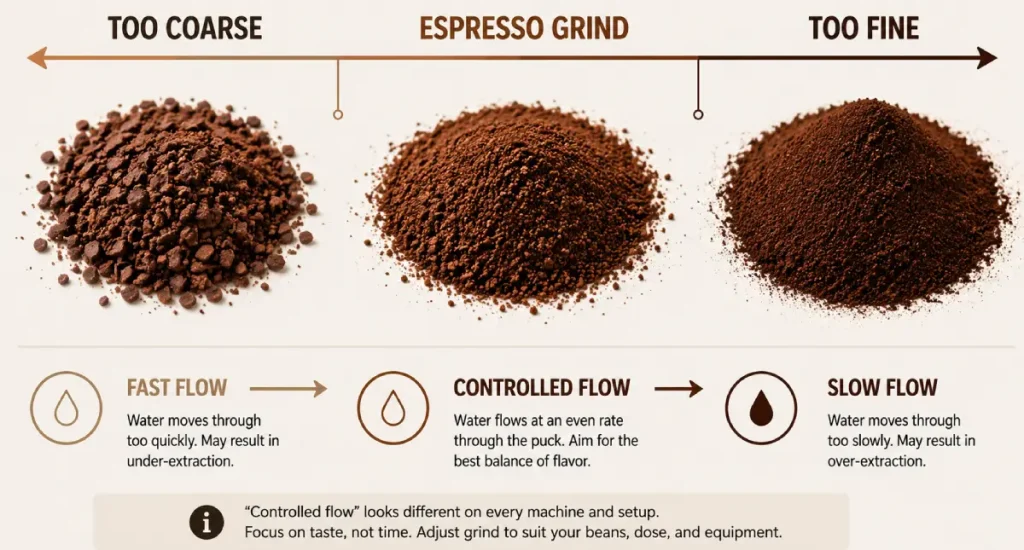
A good starting point is a fine espresso grind, but don’t treat that description as a precise recipe.
Your ideal grind depends on several variables:
- Grinder and burr design
- Grinder calibration
- Coffee variety
- Roast level
- Coffee freshness
- Dose
- Basket size and design
- Espresso recipe
- Machine
- Desired extraction
This is why copying another person’s grinder setting rarely works perfectly.
Two people can use the same coffee and still need different settings because their grinders, baskets or recipes are different.
Why there isn’t one correct espresso grinder setting
Imagine someone tells you:
“I use setting 8 for espresso.”
That information isn’t particularly useful unless you also know which grinder they use.
A grinder setting is relative to that grinder.
Instead of asking:
“What number should my grinder be on?”
a better question is:
“What grind produces the right flow and flavor for my recipe?”
That’s the mindset that makes dialing in much easier.
👉 How To Brew French Press Coffee Perfectly
Espresso Grind Size Chart
Use the following table as a starting-point diagnostic, not an absolute rule.
| What you’re seeing | Likely adjustment | What else to check |
|---|---|---|
| Espresso runs very fast | Grind finer | Dose, yield and puck preparation |
| Espresso runs very slowly | Grind coarser | Dose and puck preparation |
| Fast shot + sour taste | Usually grind finer | Under-extraction and recipe |
| Slow shot + bitter taste | Usually grind coarser | Over-extraction and recipe |
| Flow looks good but flavor is poor | Don’t automatically change grind | Dose, yield, temperature and coffee |
The important word is likely.
Espresso extraction is affected by multiple variables, so grind size should be treated as a powerful adjustment rather than a guaranteed diagnosis.
How Grind Size Affects Espresso Extraction
Grind size has a major influence on how quickly water moves through the coffee puck.
Finer grind
Smaller particles create more resistance to water flow.
This generally means:
Finer grind → greater resistance → slower flow
If you grind substantially finer, the shot can take longer to reach the same yield.
Coarser grind
Larger particles generally create less resistance.
This means:
Coarser grind → less resistance → faster flow
If your espresso is running much faster than expected, moving slightly finer is often the first adjustment to investigate.
The reverse applies to a shot that is running unusually slowly.
For the bigger picture—including dose, yield and extraction time—see our guide to Espresso Extraction: How to Dial In the Perfect Shot.
Grind Too Fine vs. Grind Too Coarse
Understanding the two extremes makes espresso troubleshooting much easier.
| Grind too fine | Grind too coarse |
|---|---|
| Slow flow | Fast flow |
| Greater resistance | Less resistance |
| May choke the shot | May produce a very fast shot |
| Can contribute to over-extraction | Can contribute to under-extraction |
| May taste bitter or harsh | May taste sour, thin or weak |
These are useful clues, but they aren’t definitive diagnoses.
For example, a sour espresso doesn’t automatically mean you need to grind finer. The coffee, recipe, temperature, yield and other variables can all influence flavor.
Think of the symptoms as evidence, not instructions.
How to Adjust Espresso Grind Size
This is where grind size becomes a practical dial-in tool.
1. Start With a Consistent Recipe
Before adjusting the grinder, make your other major variables as consistent as possible.
Keep track of:
- Coffee dose
- Espresso yield
- Extraction time
- Basket
- Coffee beans
- Machine
- Puck preparation
If everything changes at once, it becomes difficult to know what actually improved the shot.
2. Observe the Shot
Pay attention to how the espresso flows.
Is it:
- Extremely fast?
- Extremely slow?
- Uneven?
- Consistent?
- Producing the expected yield?
A scale and timer make this much easier to evaluate.
3. Taste the Espresso
This is the step beginners sometimes overlook.
A shot that reaches your target time can still taste unpleasant.
Likewise, a shot that doesn’t perfectly match a commonly quoted time may still taste excellent.
Use time and flow as diagnostic information, but use flavour to decide whether you’re moving in the right direction.
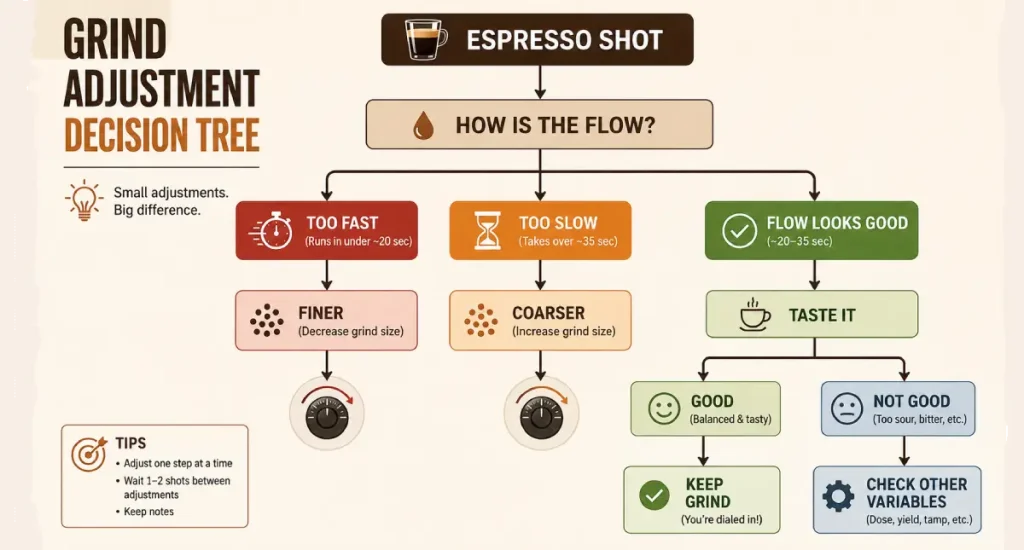
4. Make a Small Grind Adjustment
If the shot is running too quickly, try moving slightly finer.
If it is running too slowly, try moving slightly coarser.
Avoid making enormous adjustments unless the shot is dramatically far from your target.
5. Pull Another Shot
Keep the recipe consistent and see what changed.
6. Change One Major Variable at a Time
If you simultaneously change:
- Grind
- Dose
- Yield
- Temperature
- Tamping
you won’t know which change caused the result.
A controlled approach makes dialling in much easier.
How Fine Should Espresso Be?
Espresso is generally ground fine enough to create substantial resistance to water flow, but it shouldn’t necessarily resemble flour or powder.
The exact particle size depends on the grinder and coffee.
A useful comparison is:
Filter coffee → coarser
Espresso → much finer
But even within espresso, different coffees and recipes can require different settings.
The important distinction
“Fine” describes the general grind category.
It does not tell you:
“Set every espresso grinder to number 5.”
That’s why espresso recipes should provide a starting point, rather than pretending a grinder number is universal.
How Coffee Freshness Affects Grind Size
Coffee doesn’t behave identically throughout its life.
As roasted coffee ages, its extraction behavior can change, which can mean you need to make small adjustments to maintain a similar espresso recipe.
You may notice that a coffee that dialled in beautifully when you opened the bag gradually requires a different grind setting later.
That’s normal.
It doesn’t necessarily mean your grinder has changed.
A practical approach
When opening a new bag:
- Start with a sensible espresso grind.
- Use a consistent dose and yield.
- Observe the shot.
- Taste it.
- Adjust the grind.
- Record what works.
Then be prepared to make small adjustments as the coffee ages.
How Roast Level Can Affect Espresso Grind
Roast level can also influence where you begin when dialling in.
Light, medium and dark roasts can behave differently during extraction, so you shouldn’t assume every coffee will require the same grind.
However, avoid rigid rules such as:
“Light roast always needs setting X.”
or:
“Dark roast always needs setting Y.”
A better approach is:
Use roast level as a starting clue, then let the coffee and extraction tell you where to go.
The grinder setting that works for one bag isn’t automatically the correct setting for another—even if both coffees have the same roast level.
Does Dose Affect Espresso Grind Size?
Yes.
Changing the amount of coffee in the basket can change the resistance of the puck and therefore influence how the water flows.
For example, changing from one espresso recipe to another with a substantially different dose may mean the grind needs adjustment.
That’s one reason a grinder setting shouldn’t be considered independently from the recipe.
For practical examples, see our guides to How to Make a Double Espresso and How to Make a Triple Shot Espresso.
The important principle is:
A grind setting belongs to a recipe—not necessarily to a coffee forever.
Grind Size vs. Dose vs. Yield
These three variables are closely connected, but they don’t do the same thing.
| Variable | What it primarily changes |
|---|---|
| Grind size | Particle size and puck resistance |
| Dose | Amount of coffee being brewed |
| Yield | Amount of espresso produced |
When dialling in, changing all three simultaneously makes troubleshooting difficult.
A more controlled approach is to establish your dose and target yield, then use grind size to adjust the flow.
Once the grind is reasonably dialled in, you can experiment with other recipe variables.
This gives you a much clearer understanding of how your coffee responds.
How Your Espresso Grinder Affects Grind Size
The grinder itself has a major influence on espresso preparation.
Two grinders can produce different results even when their settings appear similar.
Burr grinders
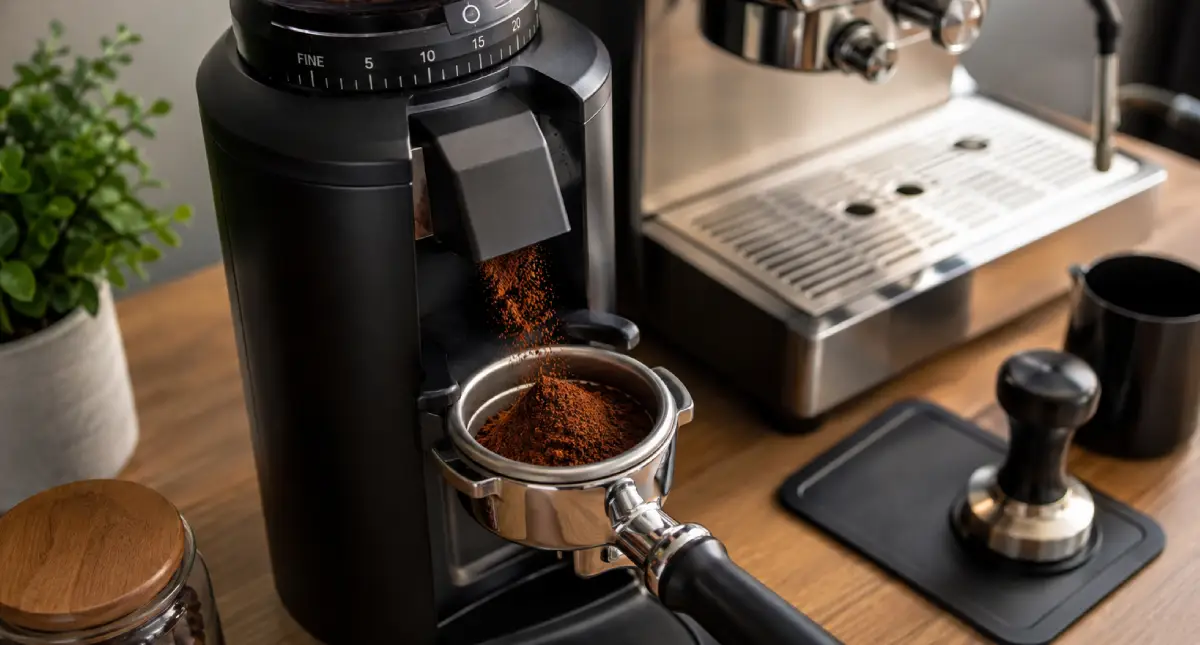
Espresso is generally best suited to a capable burr grinder that can produce a sufficiently fine and consistent grind with useful adjustment control.
Stepped vs. stepless grinders
A stepped grinder uses predefined adjustment positions.
A stepless grinder allows more continuous adjustment.
For espresso, smaller adjustment increments can make it easier to fine-tune a shot.
Burr alignment
The alignment of the burrs can affect grind consistency and therefore the distribution of particle sizes.
Grind retention
Coffee retained inside the grinder can mix with later doses and make small changes in the coffee you’re brewing.
Adjustment range
A grinder needs to be capable of reaching an appropriate espresso range and making useful adjustments around it.
This is why the grinder you use matters just as much as the number displayed on its adjustment dial.
Common Espresso Grind Size Mistakes
Copying Someone Else’s Grinder Setting
A grinder number isn’t universal.
Use other people’s settings as reference points at most—not as instructions.
Making Huge Grind Adjustments
If you’re close to the right extraction, a dramatic change can take you from too slow to too fast.
Make controlled adjustments.
Chasing Time Instead of Taste
Time is useful.
But espresso isn’t successful simply because it reaches a particular number of seconds.
Taste the result.
Changing Several Variables at Once
Changing grind, dose and yield simultaneously makes troubleshooting unnecessarily difficult.
Ignoring Coffee Freshness
Coffee can change as it ages, so your grinder setting may need occasional adjustment.
Confusing Grind Size With Grinder Setting
This is particularly important for beginners.
Grind size describes the resulting coffee particles.
Grinder setting describes where the adjustment mechanism is positioned.
They are related—but they are not interchangeable terms.
Espresso Grind Size Troubleshooting
Here’s a simple way to approach common problems.
My espresso runs too fast
Start by considering a finer grind.
Then check:
- Dose
- Yield
- Puck preparation
- Coffee freshness
- Basket
If you’re consistently getting a very fast, thin and sour shot, under-extraction may be contributing to the problem.
My espresso runs too slowly
Start by considering a coarser grind.
Then check:
- Dose
- Puck preparation
- Basket
- Coffee
- Recipe
If the espresso is extremely slow and tastes harsh or bitter, you may be dealing with excessive extraction or resistance.
My espresso is fast and sour
A finer grind is one logical adjustment to investigate.
But don’t automatically assume grind is the only problem.
Check the complete recipe.
My espresso is slow and bitter
A coarser grind may help reduce resistance and change the extraction.
Again, evaluate the entire recipe rather than changing grind repeatedly without tasting.
My flow looks good but the espresso tastes bad
This is where you shouldn’t automatically change the grinder.
Investigate:
- Dose
- Yield
- Coffee freshness
- Water
- Temperature
- Recipe
- Puck preparation
If you need a broader diagnostic process, continue to our Espresso Troubleshooting Guide.
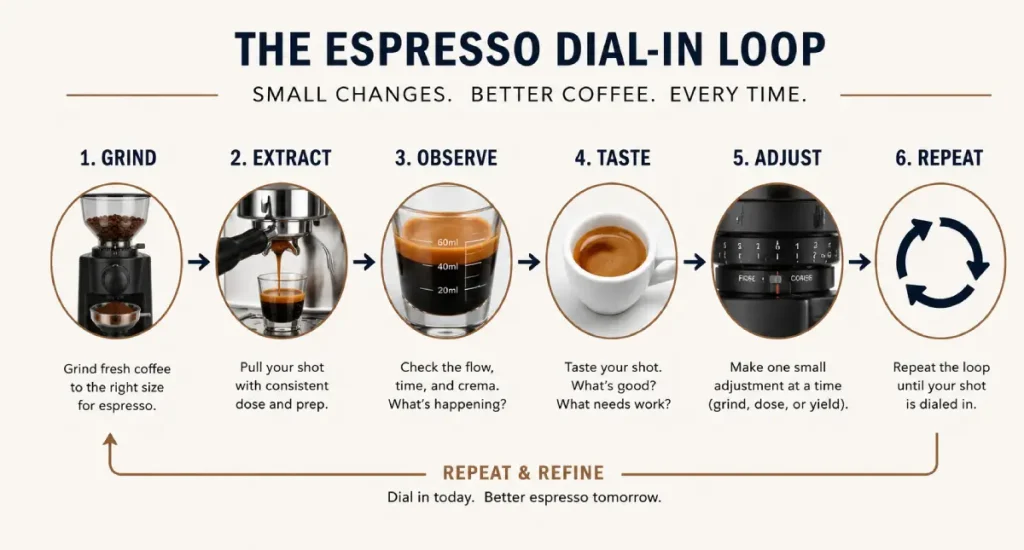
A Simple Espresso Grind Dial-In Routine
If you’re new to espresso, keep the process simple.
1. Choose a consistent recipe
Decide on your dose and target yield.
↓
2. Grind and prepare the puck
Distribute the coffee consistently before tamping.
Our guide to Espresso Distribution explains how puck preparation fits into the process.
↓
3. Extract
Record your dose, yield and extraction time.
↓
4. Observe
Look at the flow and overall behavior of the shot.
↓
5. Taste
Ask:
Is it balanced, or does it taste sour, bitter, thin, harsh or otherwise unpleasant?
↓
6. Adjust
Too fast → finer
Too slow → coarser
↓
7. Repeat
Make another shot and evaluate the result.
This is much more useful than searching for a magic grinder setting and hoping it works.
Frequently Asked Questions
What grind size is best for espresso?
Espresso generally requires a fine grind, but there isn’t one universal grind size that works for every coffee and grinder. The correct grind is the one that produces the desired flow, extraction and flavour for your recipe.
How fine should espresso coffee be?
Espresso coffee should generally be ground much finer than coffee for filter brewing. A fine-sand-like texture is a useful visual starting point, but the actual particle size depends on your grinder, coffee and recipe.
Is espresso ground finer than filter coffee?
Yes. Espresso is generally ground significantly finer than filter coffee because the brewing process uses pressurised water and a relatively short extraction period.
What happens if espresso is ground too fine?
A grind that is too fine can create excessive resistance, slowing the flow substantially or even choking the shot. It may also contribute to over-extraction and bitter or harsh flavors.
What happens if espresso is ground too coarse?
A grind that is too coarse can allow water to pass through the puck too quickly. This can contribute to under-extraction and espresso that tastes sour, thin or weak.
Should I grind finer if my espresso runs too fast?
Generally, yes. If your espresso is running significantly faster than expected, a slightly finer grind is a logical adjustment to try. Also check dose, yield and puck preparation.
Should I grind coarser if my espresso runs too slow?
Generally, yes. If the shot is taking substantially longer than expected, a slightly coarser grind can reduce resistance and increase flow.
Does grind size affect espresso taste?
Yes. Grind size affects water flow and extraction, which can significantly influence flavor. However, taste is also affected by coffee freshness, dose, yield, temperature, water and other variables.
Does every espresso coffee need the same grind setting?
No. Different coffees can require different grind settings, even when using the same grinder. Roast level, freshness, processing, dose and recipe can all influence the ideal starting point.
How do I know when my espresso grind is right?
Your grind is in a good range when the shot produces the flow, extraction and flavor you’re looking for with your chosen recipe. Use time and flow as useful measurements, but don’t ignore taste.
The Bottom Line
There is no magic espresso grinder setting.
The right grind is the one that works with your coffee, grinder, basket and recipe.
Start with a fine espresso grind, establish a consistent dose and yield, observe the shot, taste the espresso and make controlled adjustments.
Remember the simple sequence:
GRIND → EXTRACT → OBSERVE → TASTE → ADJUST
If the shot runs too quickly, investigate a finer grind.
If it runs too slowly, investigate a coarser grind.
And if the flow looks good but the espresso tastes wrong, don’t immediately blame the grinder. Look at the rest of the extraction recipe.
Once you understand that principle, espresso becomes much less about finding the “correct setting” and much more about learning to read and control the shot.
☕ Continue Your Espresso Journey
Learn how to prepare the puck:
→ Espresso Distribution
Learn how to dial in extraction:
→ Espresso Extraction: How to Dial In the Perfect Shot
Make a practical espresso recipe:
→ How to Make a Double Espresso
Explore a larger espresso recipe:
→ How to Make a Triple Shot Espresso
Having problems with your shots?
→ Espresso Troubleshooting Guide
☕ Just a heads up—this post contains affiliate links. If you buy through them, Frothy Fusion may earn a small commission (at no cost to you). Thanks for supporting our coffee-fueled content!