A double espresso is one of the best starting points for learning how to dial in an espresso machine. It gives you enough coffee to work with while making it easier to measure your dose, yield and extraction. Lets learn how to make a double espresso at home.
- Double Espresso Quick Recipe
- What Is a Double Espresso?
- Double Espresso Recipe at a Glance
- What You Need to Make a Double Espresso
- How to Make a Double Espresso Step by Step
- How to Dial In a Double Espresso
- Why Is My Double Espresso Sour?
- Why Is My Double Espresso Bitter?
- Why Is My Double Espresso Running Too Fast?
- Why Is My Double Espresso Running Too Slowly?
- 18 g vs 20 g vs 22 g: How Much Coffee Should You Use?
- What Is the Best Double Espresso Ratio?
- Double Espresso vs Single Espresso
- Double Espresso vs Triple Espresso
- Can You Make a Double Espresso Without an Espresso Machine?
- How Much Caffeine Is in a Double Espresso?
- Frequently Asked Questions
- How many grams of coffee are in a double espresso?
- How much espresso should 18 grams of coffee make?
- How long should a double espresso take?
- What grind size is best for a double espresso?
- Is 18 grams enough for a double espresso?
- Why is my double espresso sour?
- Why is my double espresso bitter?
- Is a doppio the same as a double espresso?
- Is 1:2 the best espresso ratio?
- The Bottom Line
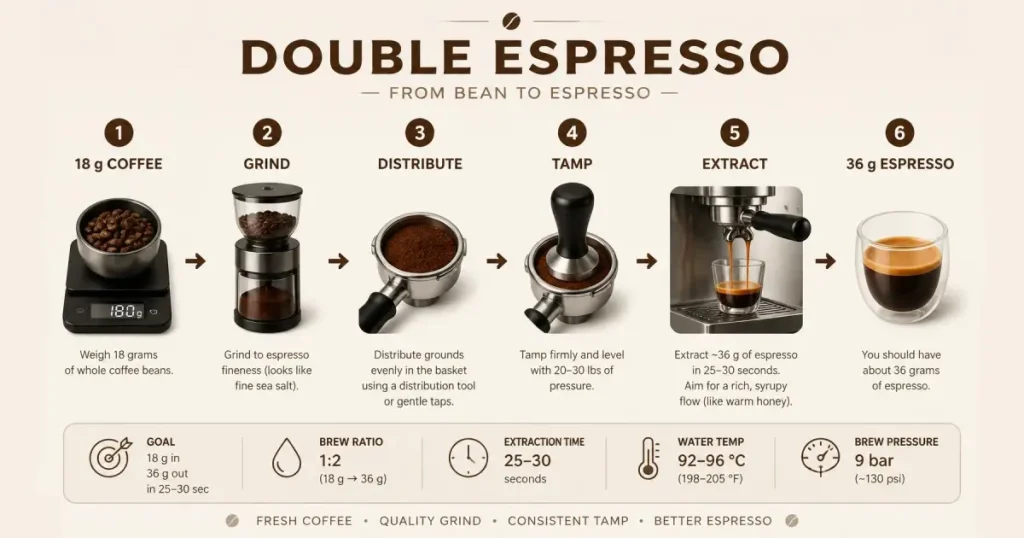
For a practical starting recipe, use 18 grams of coffee to produce about 36 grams of espresso in roughly 25–30 seconds. This is a 1:2 brew ratio and provides a useful baseline for dialing in your grinder.
The exact numbers don’t have to be identical every time. Your espresso basket, coffee beans, grinder and personal taste all affect the ideal recipe.
Double Espresso Quick Recipe
18 g coffee → fine grind → distribute → tamp → extract → 36 g espresso in about 25–30 seconds
If the shot tastes sour and runs quickly, try grinding finer. If it tastes bitter and runs slowly, try grinding slightly coarser.
What Is a Double Espresso?
A double espresso, also called a doppio, is an espresso made using a double basket and approximately twice the coffee of a traditional single espresso.
However, “double” does not always mean exactly twice a particular volume.
Modern espresso is generally measured by weight rather than volume because crema can make volume measurements misleading. A shot that appears to contain 30 or 60 ml may have a very different actual yield depending on the amount of crema.
That’s why weighing both the coffee going into the portafilter and the espresso coming out of the machine gives you a much more repeatable recipe.
For many home baristas, 18 g in and 36 g out is an excellent place to start.
How to Build a Morning Ritual with Espresso at Home ☕
Double Espresso Recipe at a Glance
| Variable | Starting Point |
|---|---|
| Coffee dose | 18 g |
| Espresso yield | 36 g |
| Brew ratio | 1:2 |
| Extraction time | 25–30 seconds |
| Grind | Fine espresso grind |
| Basket | Double basket |
| Water temperature | Approximately 90–96°C / 194–205°F |
Think of these numbers as a starting recipe, not a set of rules.
A different coffee may taste better at a 1:1.5 ratio, while another may perform better closer to 1:2.5. The goal is to use the numbers to make adjustments systematically rather than chasing a supposedly perfect shot.
What You Need to Make a Double Espresso
You don’t need a huge collection of equipment to make a good double espresso at home.
Espresso Machine
You’ll need an espresso machine capable of producing the pressure and temperature needed for espresso extraction.
Burr Grinder
A grinder capable of producing a consistent fine grind is one of the most important pieces of equipment for espresso.
A blade grinder generally isn’t suitable because it produces an inconsistent particle size.
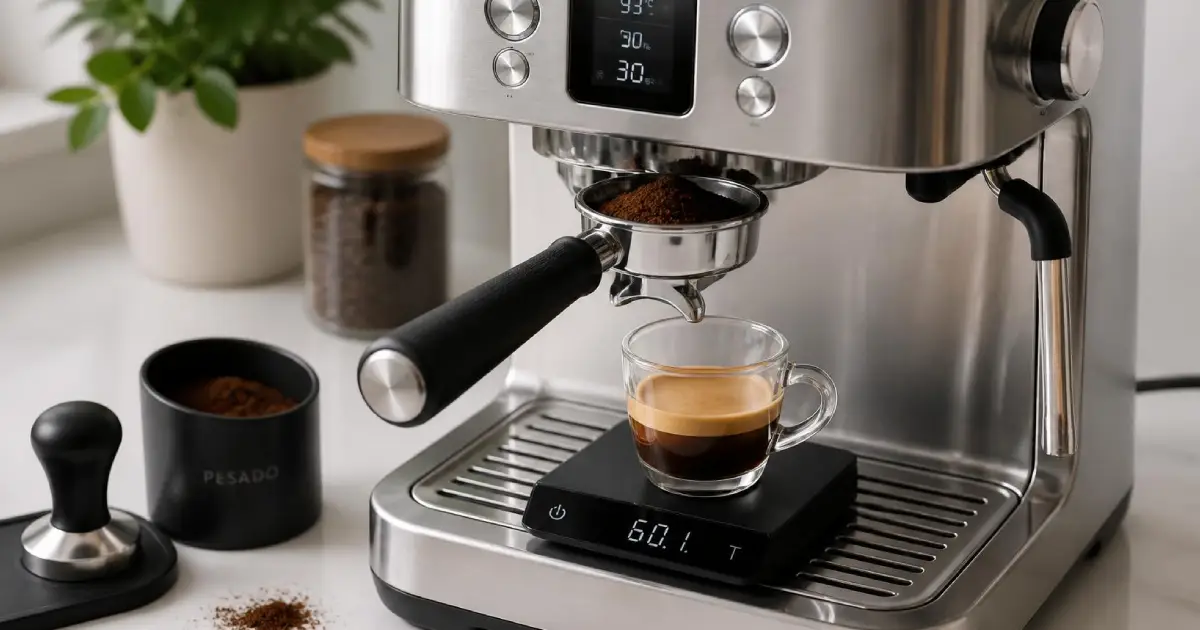
Espresso Scale
A small scale that measures in 0.1-gram increments makes dialing in considerably easier.
You can use it to measure both your coffee dose and espresso yield.
Double Espresso Basket
Use a basket designed for the dose you’re working with.
An 18 g basket is a sensible match for an 18 g recipe. If your machine uses a basket designed for 20–22 g, adjust the dose accordingly rather than forcing an 18 g recipe into it.
Tamper
Use a tamper that fits the basket properly so you can create an even, level puck.
Fresh Coffee Beans
Freshly roasted beans generally give you a better starting point for espresso than stale coffee.
For more on bean freshness, see our guide to Fresh Coffee Beans for Espresso?
How to Make a Double Espresso Step by Step
1. Warm Up Your Espresso Machine
Start with a properly heated espresso machine.
The group head, portafilter and basket should all be warm before extraction. If your machine has a specific warm-up procedure, follow the manufacturer’s instructions.
A cold portafilter can reduce the temperature of the brewing system and make your results less consistent.
2. Prepare the Double Basket
Insert a clean double basket into the portafilter.
Make sure the basket is dry before adding your coffee. Moisture can cause grounds to stick to the basket and interfere with even distribution.
Check the basket’s intended capacity if you know it.
For this guide, we’ll use an 18 g basket with an 18 g dose.
3. Weigh 18 Grams of Coffee
Measure 18 grams of coffee beans.
Weighing your dose instead of relying on a scoop gives you much more consistent results.
If you’re using a different basket size, follow the basket’s recommended dose instead.
For example:
- 18 g basket → start around 18 g
- 20 g basket → start around 20 g
- 22 g basket → start around 22 g
The important thing is to develop a recipe that matches your equipment.
4. Grind the Coffee Fine
Grind the beans to a fine setting suitable for espresso.
There isn’t one universal grinder setting because grinders differ significantly.
Your first goal is to produce a shot that approaches the target yield in roughly 25–30 seconds.
If the coffee runs dramatically faster than that and tastes sharp or sour, the grind may be too coarse.
If it barely drips and tastes harsh or bitter, the grind may be too fine.
5. Distribute the Grounds Evenly
After grinding, distribute the coffee evenly throughout the basket.
Uneven grounds can create weak points in the puck where water finds an easier path through the coffee.
This phenomenon is called channeling.
A distribution tool or careful hand distribution can help create a more even coffee bed.
For more information about this part of the process, see our guide to Espresso Distribution Tools
6. Tamp Evenly
Place the tamper level with the basket and press down evenly.
The exact amount of force is less important than creating a flat, stable and evenly compressed puck.
Avoid twisting aggressively or repeatedly tamping the coffee.
A consistent technique makes your espresso easier to reproduce.
7. Lock the Portafilter Into the Machine
Wipe away any loose coffee from the rim of the basket.
Lock the portafilter securely into the group head.
Start your extraction promptly after tamping rather than leaving the prepared puck sitting around unnecessarily.
8. Start the Extraction
Place your espresso scale underneath the cup or cups.
Start the shot and watch both the timer and the scale.
For our starting recipe, aim for:
18 g dose → 36 g espresso
Stop the extraction when the scale reaches approximately 36 grams.
Depending on your machine, there may be a small amount of additional liquid that continues flowing after you stop the pump. With experience, you can account for this.
👉 Triple Shot vs Double Shot Espresso: What’s the Difference?
9. Check the Extraction Time
For this recipe, aim for approximately 25–30 seconds.
Don’t become overly concerned if you get 28 seconds rather than exactly 30.
Extraction time is a useful diagnostic tool, but it isn’t the final measure of whether an espresso tastes good.
A delicious shot that takes 32 seconds isn’t automatically bad.
Likewise, a shot that reaches 36 grams in exactly 25 seconds isn’t automatically excellent.
Taste comes first.
10. Taste and Adjust
Taste the espresso once it has cooled enough to evaluate comfortably.
Ask yourself:
- Is it sour or sharp?
- Is it bitter or dry?
- Is it balanced?
- Does it taste thin?
- Does it taste harsh?
- Does it have a pleasant sweetness?
Use the answer to decide what to change.
Make one adjustment at a time so you know what caused the difference.
How to Dial In a Double Espresso
Dialing in means adjusting your recipe until the espresso tastes balanced.
The most useful variables to work with are:
- Grind size
- Dose
- Yield
- Extraction time
For beginners, changing the grind size first is usually the simplest way to control the flow of the shot.
Double Espresso Dial-In Guide
| What you notice | Likely problem | Try this |
|---|---|---|
| Shot runs very fast and tastes sour | Under-extraction | Grind finer |
| Shot runs very slowly and tastes bitter | Over-extraction | Grind coarser |
| Shot spurts or flows unevenly | Possible channeling | Improve distribution |
| Espresso tastes thin | Insufficient extraction or low yield | Adjust grind and evaluate yield |
| Espresso tastes harsh or dry | Possible over-extraction | Grind slightly coarser or reduce extraction |
| Numbers look good but taste is poor | Recipe doesn’t suit the coffee | Adjust based on taste |
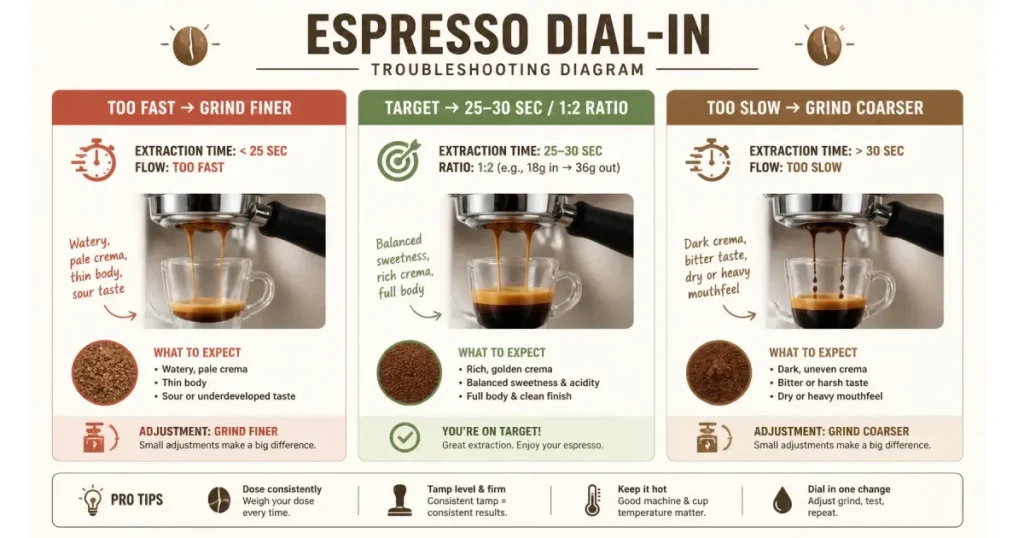
Don’t change several variables at once.
If you make the grind finer, keep the dose and yield the same for the next test. This lets you see whether the grind adjustment actually improved the shot.
Why Is My Double Espresso Sour?
A sour or sharply acidic espresso can indicate under-extraction.
Water hasn’t extracted enough desirable compounds from the coffee, which can leave the espresso tasting sharp, acidic or thin.
Try:
- Grinding slightly finer
- Checking that your dose is appropriate for the basket
- Ensuring the puck is evenly distributed
- Allowing the shot to extract a little further if appropriate
Don’t automatically assume that every sour espresso needs a longer shot. Taste and the overall recipe both matter.
Why Is My Double Espresso Bitter?
A bitter, harsh or overly dry espresso can indicate over-extraction.
Try:
- Grinding slightly coarser
- Reducing the extraction slightly
- Checking that the shot isn’t running excessively slowly
- Reviewing your dose and yield
Remember that naturally bitter flavors can also come from the coffee itself, particularly with darker roasts.
Why Is My Double Espresso Running Too Fast?
If your espresso reaches 36 grams much sooner than expected, the coffee may be ground too coarsely.
Try moving the grinder slightly finer.
Other possibilities include:
- Uneven distribution
- Incorrect dose
- Channeling
- A coffee that behaves differently from your previous beans
Make a small adjustment and pull another shot.
Why Is My Double Espresso Running Too Slowly?
If the espresso barely flows or takes substantially longer than expected to reach your target yield, your grind may be too fine.
Try moving the grinder slightly coarser.
Also check that:
- You’re using the correct dose
- The basket isn’t overfilled
- The puck is prepared evenly
- Your machine and basket are clean
18 g vs 20 g vs 22 g: How Much Coffee Should You Use?
This is one of the most confusing parts of making espresso at home.
You may see one recipe calling for 18 grams while another calls for 20 or 22 grams.
That doesn’t necessarily mean one of them is wrong.
The basket capacity is the first thing to consider.
A double basket may be designed for a particular dose range. Modern espresso baskets commonly accommodate different amounts of coffee, so your recipe should be matched to the basket rather than a number you found online.
For example:
| Basket | Sensible starting dose |
|---|---|
| 18 g basket | 18 g |
| 20 g basket | 20 g |
| 22 g basket | 22 g |
You can then experiment with the dose and brew ratio to find what produces the best flavor.
The important principle is:
Don’t cram 22 grams into an 18-gram basket just because you saw a 22-gram recipe elsewhere.
What Is the Best Double Espresso Ratio?
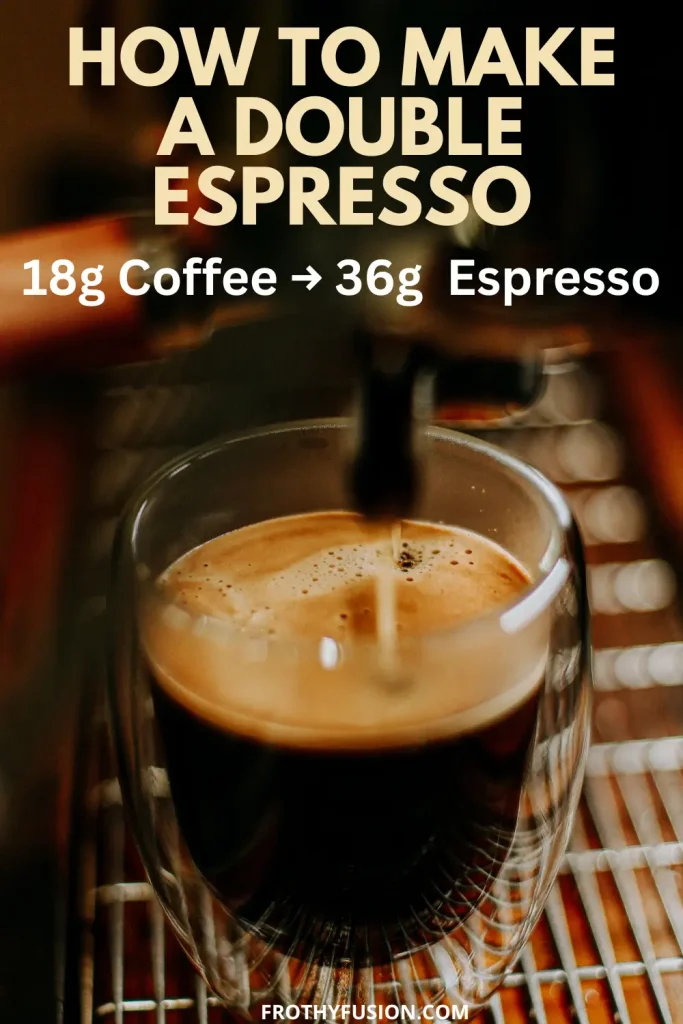
A 1:2 brew ratio is a useful starting point for espresso.
That means:
1 gram of dry coffee → approximately 2 grams of espresso
So:
- 18 g coffee → 36 g espresso
- 20 g coffee → 40 g espresso
- 22 g coffee → 44 g espresso
This doesn’t mean every coffee should be extracted at exactly 1:2.
Lighter roasts, darker roasts and different processing methods can respond differently to extraction ratios.
Once you’ve learned the basic recipe, you can experiment.
Double Espresso vs Single Espresso
The main difference is the amount of coffee used and the resulting beverage.
A single espresso generally uses a smaller basket and dose, while a double espresso uses a larger dose and double basket.
For home espresso, the double is often easier to work with because the larger dose provides a more forgiving starting point for dialing in.
It also gives you a practical amount of espresso for drinks such as:
- Cappuccino
- Latte
- Flat white
- Americano
- Cortado
Double Espresso vs Triple Espresso
A triple espresso uses more coffee than a traditional double and generally produces a larger espresso yield.
The same basic principles still apply:
dose → grind → distribute → tamp → extract → evaluate
The difference is the amount of coffee in the basket and the resulting yield.
If you’d like to experiment with a larger espresso dose, see our guide:
How to Make a Triple Shot Espresso: Step-by-Step Guide
This gives you a natural progression from learning the standard double shot to working with a triple shot.
Can You Make a Double Espresso Without an Espresso Machine?
You can make concentrated coffee using methods such as a moka pot, AeroPress or pod machine, but these methods don’t produce a traditional espresso in the same way as an espresso machine.
True espresso relies on a combination of finely ground coffee, pressure, temperature and controlled extraction through a compact coffee puck.
If you specifically want a traditional double espresso, an espresso machine and suitable grinder are the most appropriate tools.
How Much Caffeine Is in a Double Espresso?
The caffeine content of a double espresso varies considerably depending on the coffee beans, roast, dose and extraction.
There isn’t one universal caffeine number that applies to every double espresso.
For a more detailed look at caffeine content, see:
How Much Caffeine Is in Espresso?
That article provides the broader caffeine context while this guide focuses on preparing the espresso itself.
Frequently Asked Questions
How many grams of coffee are in a double espresso?
An 18-gram dose is a useful starting point for a double espresso when using an 18-gram basket. Other double baskets may be designed for 20 grams, 22 grams or another dose.
How much espresso should 18 grams of coffee make?
A 1:2 brew ratio would produce approximately 36 grams of espresso from 18 grams of coffee.
How long should a double espresso take?
A useful starting target is approximately 25–30 seconds, although the ideal extraction time varies depending on the coffee, equipment and recipe.
What grind size is best for a double espresso?
Use a fine grind designed for espresso. The exact grinder setting varies between grinders, so use extraction speed and, most importantly, taste to dial it in.
Is 18 grams enough for a double espresso?
Yes, if your basket is designed for approximately 18 grams. The appropriate dose depends on your basket’s capacity.
Why is my double espresso sour?
A sour espresso can be a sign of under-extraction. Try grinding slightly finer and evaluate the shot again.
Why is my double espresso bitter?
A bitter or dry espresso can be a sign of over-extraction. Try grinding slightly coarser and compare the result.
Is a doppio the same as a double espresso?
Yes. Doppio is the Italian term commonly used for a double espresso.
Is 1:2 the best espresso ratio?
A 1:2 ratio is an excellent starting point, but it isn’t a universal rule. Different coffees can taste better at different ratios.
The Bottom Line
Making a double espresso becomes much easier once you stop looking for one perfect recipe and start thinking in terms of dose, yield, time and taste.
For a reliable starting point, try:
18 g coffee → 36 g espresso → approximately 25–30 seconds
Then taste the result.
If it’s sour and running quickly, try a finer grind. If it’s bitter and running slowly, try a coarser grind. Make small adjustments and change one variable at a time.
Once you’ve mastered the double espresso, you have a strong foundation for experimenting with different coffees, extraction ratios and larger doses—including the triple shot.
The goal isn’t to make every espresso identical. It’s to learn how to make the adjustments that produce the cup you enjoy.
☕ Just a heads up—this post contains affiliate links. If you buy through them, Frothy Fusion may earn a small commission (at no cost to you). Thanks for supporting our coffee-fueled content!