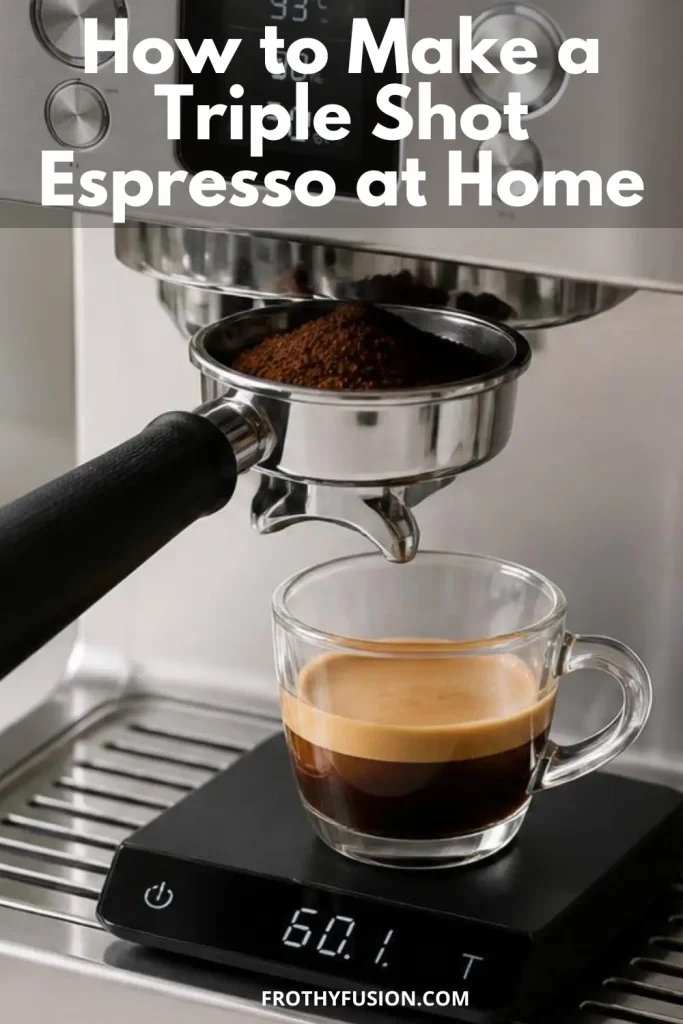
A triple shot espresso is made by extracting a larger dose of finely ground coffee through an espresso machine to produce a concentrated, full-bodied shot.
- Quick Answer: How Do You Make a Triple Shot Espresso?
- What Is a Triple Shot Espresso?
- What You Need to Make a Triple Shot Espresso
- How to Make a Triple Shot Espresso Step by Step
- Triple Shot Espresso Recipe
- How Much Coffee Is in a Triple Shot Espresso?
- How Much Espresso Does a Triple Shot Make?
- How Long Should a Triple Shot Espresso Take?
- Why Is My Triple Shot Espresso Too Fast?
- Why Is My Triple Shot Espresso Too Slow?
- Why Does My Triple Shot Taste Sour?
- Why Does My Triple Shot Taste Bitter?
- Triple Shot vs Double Shot Espresso
- How Much Caffeine Is in a Triple Shot Espresso?
- Can You Make a Triple Shot Without a Triple Basket?
- Can You Make a Triple Shot With a Nespresso Machine?
- Tips for Making a Better Triple Shot Espresso
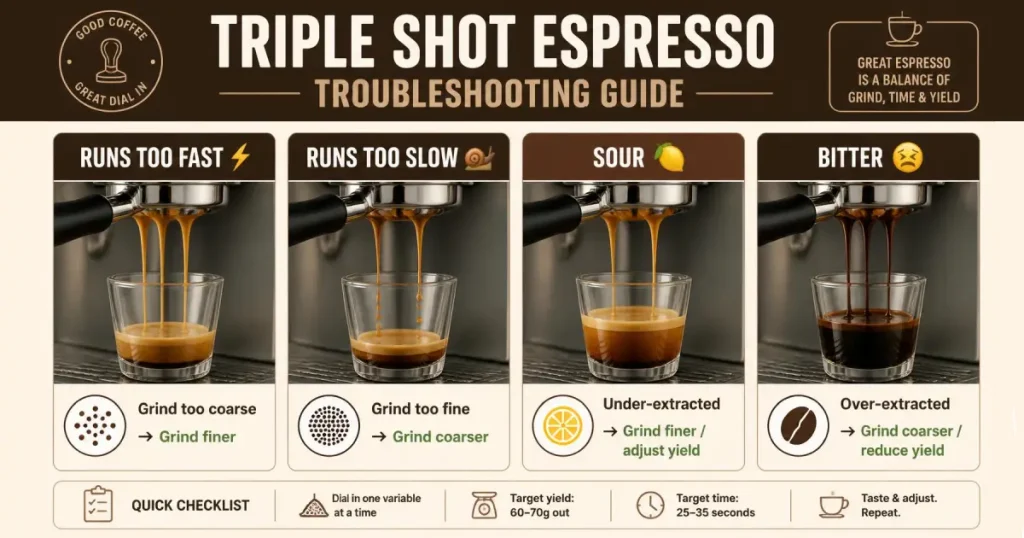
- Triple Shot Espresso Troubleshooting Guide
- Frequently Asked Questions
- Is a triple shot espresso the same as three shots?
- How many grams of coffee are in a triple shot?
- What is the best ratio for a triple shot espresso?
- How long should a triple shot take?
- Can I use a double basket for a triple shot?
- Does a triple shot have more caffeine?
- Why is my triple espresso bitter?
- Why is my triple espresso sour?
- The Bottom Line
For most home baristas, a good starting point is 18–21 grams of coffee for approximately 45–60 grams of espresso, depending on the basket and the style of espresso you prefer.
Making a triple shot isn’t simply a matter of adding more coffee. The dose, grind size, water ratio, extraction time, and basket size all need to work together.
In this guide, you’ll learn exactly how to make a triple shot espresso at home, including the measurements to use, how to dial in your grinder, and what to do if your espresso tastes too bitter, sour, weak, or watery.
Quick Answer: How Do You Make a Triple Shot Espresso?
To make a triple shot espresso:
- Use a triple or larger-capacity espresso basket.
- Dose approximately 18–21 grams of freshly ground coffee as a starting point.
- Grind the coffee finely enough for espresso.
- Distribute the grounds evenly and tamp with consistent pressure.
- Lock the portafilter into the espresso machine.
- Start the extraction and aim for approximately 45–60 grams of espresso.
- Use an extraction time of roughly 25–35 seconds as a starting point.
- Taste the espresso and adjust the grind, dose, or yield if necessary.
The exact numbers vary by coffee, basket, espresso machine, and personal preference, so use these measurements as a starting point rather than rigid rules.
👉 How Long Do Espresso Machines Last?
What Is a Triple Shot Espresso?
A triple shot espresso is a larger espresso preparation made with more coffee than a traditional single or double shot.
There isn’t one universal definition of a triple shot. Espresso terminology varies between coffee shops, machines, baskets, and countries. For that reason, it is more useful to define a triple shot by its coffee dose and final espresso yield rather than assuming that every triple shot contains exactly the same amount of coffee.
A practical home-barista starting point is:
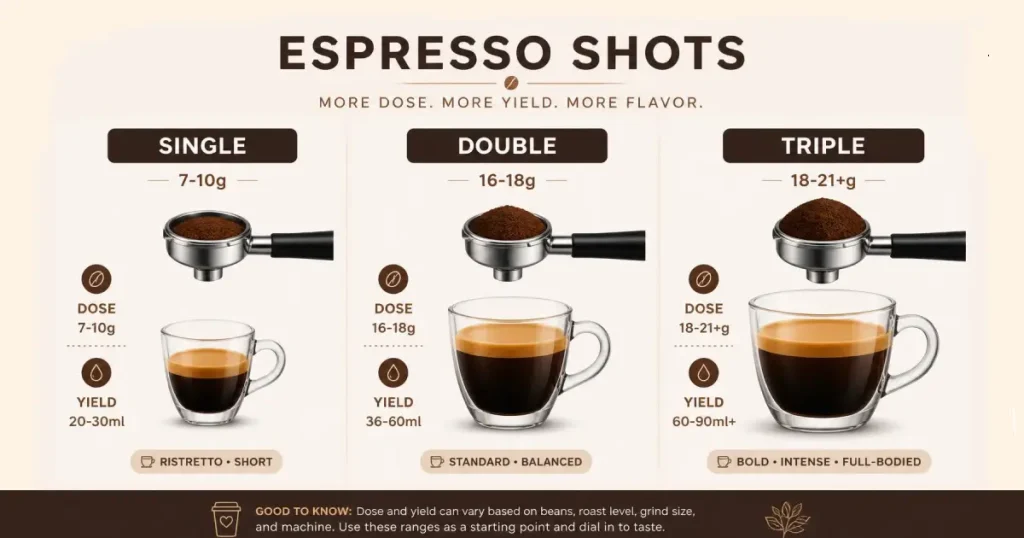
| Espresso | Typical Starting Dose | Approximate Yield |
|---|---|---|
| Single | 7–10 g | 14–20 g |
| Double | 16–18 g | 32–36 g |
| Triple | 18–21+ g | 45–60 g |
These are guidelines rather than strict standards.
A triple basket may also hold more coffee than this, particularly when using a modern high-capacity basket. Always check the basket manufacturer’s recommended dose.
Is a Triple Shot Just Three Shots of Espresso?
Not necessarily.
A triple shot doesn’t automatically mean pulling three separate single espressos. In most home setups, it is produced by using a larger basket and extracting a larger dose of coffee in a single brewing process.
This is important because espresso is affected by the relationship between the coffee dose and water output, not simply by counting shots.
How to Build a Morning Ritual with Espresso at Home ☕
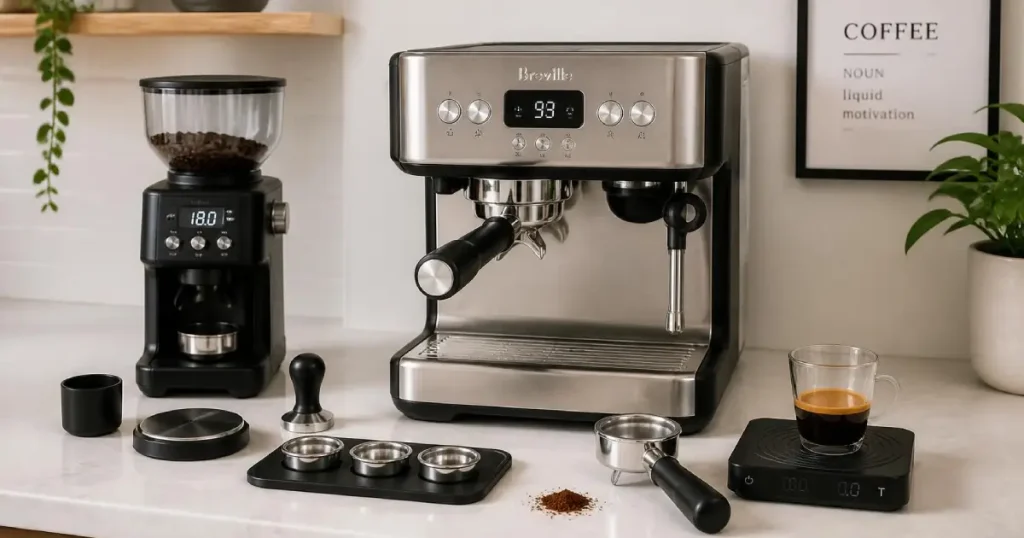
What You Need to Make a Triple Shot Espresso
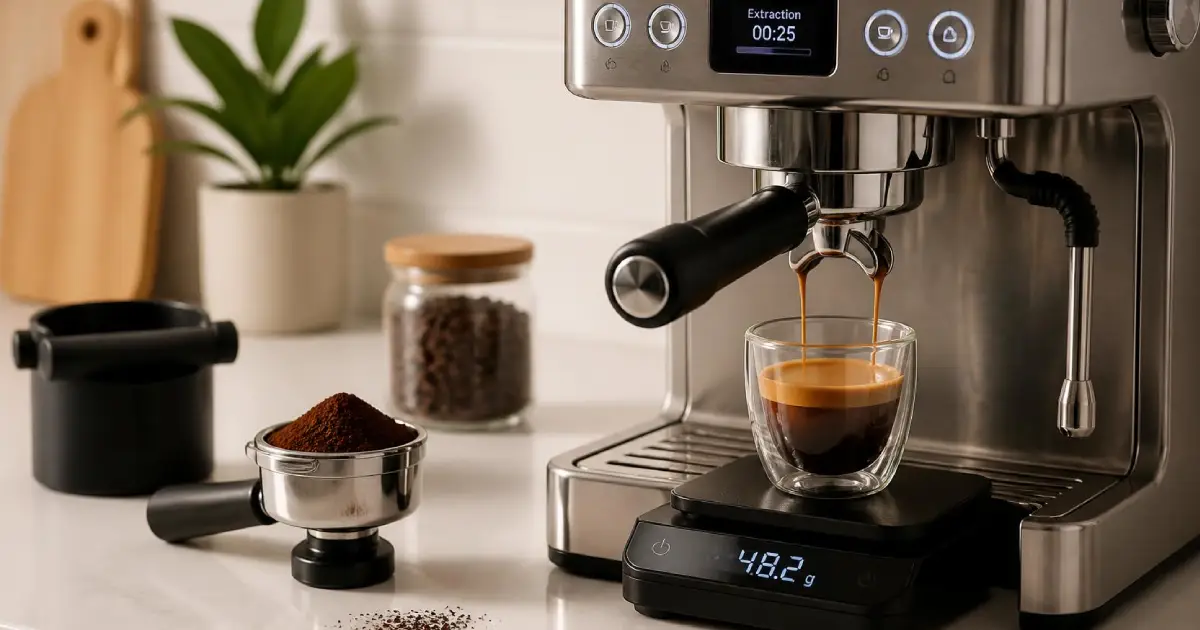
You don’t need a complicated setup, but a few pieces of equipment make a significant difference.
Espresso Machine
You’ll need an espresso machine capable of brewing the amount of coffee you’re planning to use.
A machine with a suitable portafilter and basket is particularly important. If your machine only has a small single or double basket, trying to force too much coffee into it can lead to poor extraction.
Espresso Grinder
A good burr grinder with sufficiently fine and consistent adjustment is one of the most important pieces of equipment for making espresso.
Freshly ground coffee gives you much more control than pre-ground coffee because you can adjust the grind when the extraction is too fast or too slow.
Triple Espresso Basket
A larger-capacity basket gives the coffee enough room for the appropriate dose.
Don’t simply overfill a standard double basket to create a triple shot. If the grounds are packed too tightly against the shower screen, water may not flow evenly through the coffee.
Digital Coffee Scale
A scale makes dialing in espresso much easier.
You can use it to measure:
- Coffee dose
- Espresso yield
- Brew ratio
- Extraction consistency
A scale with a timer is particularly useful.
Fresh Espresso Beans
Freshly roasted beans generally provide better flavour and aroma than stale beans.
For espresso, look for beans that are suitable for espresso brewing and grind them immediately before extraction whenever possible.
How to Make a Triple Shot Espresso Step by Step
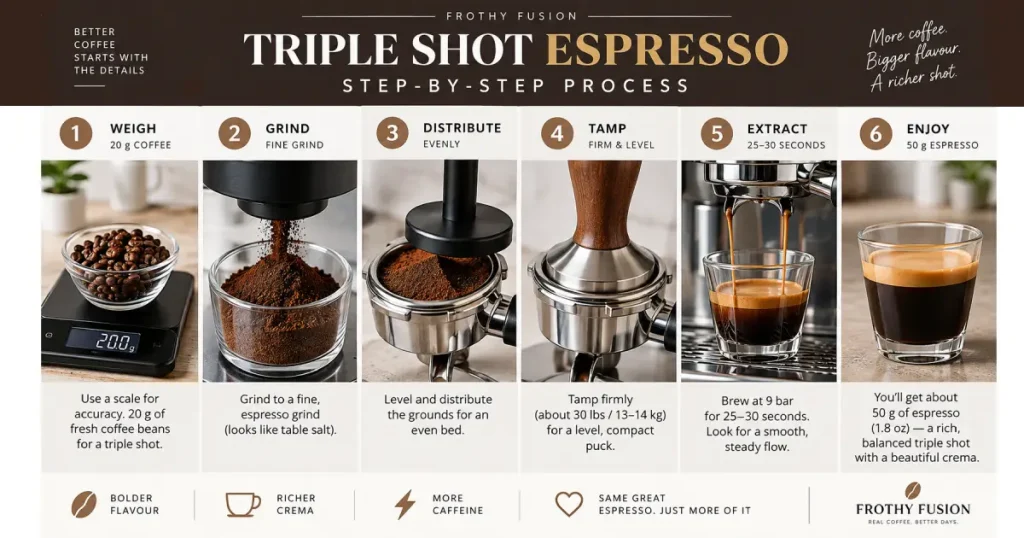
Step 1: Choose Fresh Coffee Beans
Start with freshly roasted whole coffee beans.
The roast level is largely a matter of preference. A darker roast can produce a more traditional, intense espresso profile, while lighter roasts often bring more acidity and distinctive fruit or floral flavors.
If you’re new to espresso, a medium or medium-dark roast can be a relatively forgiving starting point.
Step 2: Prepare Your Espresso Machine
Turn on your espresso machine and allow it to reach its normal brewing temperature.
If your machine requires a longer warm-up period, give it enough time to heat thoroughly.
Before brewing, make sure the portafilter, basket, group head, and cup are clean.
A warm cup can also help maintain the temperature of the espresso after extraction.
Step 3: Weigh Your Coffee
Place your empty portafilter and basket on your coffee scale and tare the scale.
Start with approximately:
18–21 grams of coffee
This is a useful starting range for a triple shot, but your basket may call for a different dose.
If your basket is marked with a recommended capacity, use that as your starting point.
For example, if your basket is designed for 20 grams, begin with 20 grams rather than trying to fit 21 or 22 grams into it.
Step 4: Grind the Coffee
Grind the beans finely enough for espresso.
The correct setting depends on your grinder and the coffee you’re using, so there isn’t a single universal espresso grind setting.
Your goal is to produce a relatively fine, consistent grind that allows the water to flow through the coffee at the appropriate rate.
If your espresso runs extremely quickly, the grind may be too coarse.
If it barely drips or takes far too long to extract, the grind may be too fine.
Step 5: Distribute the Coffee Evenly
Transfer the grounds into the basket and distribute them as evenly as possible.
Uneven coffee grounds can encourage channeling, where water finds easier paths through the coffee instead of flowing evenly through the entire puck.
You can gently level the grounds or use a distribution tool if you have one.
The objective is simple: create an even bed of coffee before tamping.
Step 6: Tamp the Coffee
Place the portafilter on a stable surface and tamp the grounds evenly.
You don’t need to obsess over hitting a particular number of pounds of pressure.
What matters more is that the coffee bed is:
- Level
- Firm
- Evenly compressed
- Free of obvious gaps around the edges
An uneven tamp can contribute to uneven extraction.
Step 7: Lock in the Portafilter
Wipe away any loose grounds from the rim of the basket and lock the portafilter securely into the group head.
If coffee grounds remain around the sealing surface, they can interfere with the seal.
Step 8: Start the Extraction
Place your espresso cup or scale beneath the portafilter.
Start the extraction and begin timing.
For a starting target, aim for approximately:
18–21 g coffee → 45–60 g espresso
A roughly 1:2 to 1:3 brew ratio gives you room to experiment depending on the coffee and the style of espresso you prefer.
For example:
20 g dose → 40 g yield is approximately a 1:2 ratio.
20 g dose → 50 g yield is approximately a 1:2.5 ratio.
20 g dose → 60 g yield is approximately a 1:3 ratio.
For a triple shot, you may prefer a larger yield, but the ideal ratio depends heavily on the coffee.
Step 9: Stop the Shot
Stop the extraction when you reach your target yield.
A good starting extraction time is around 25–35 seconds, although time should not be treated as the only measure of a good espresso.
The coffee should taste good.
If the shot reaches your target yield much faster than expected and tastes thin or sour, you may need a finer grind.
If it takes considerably longer and tastes bitter or harsh, you may need a coarser grind.
Step 10: Taste and Adjust
Taste the espresso before making further changes.
Ask yourself:
- Is it sour?
- Is it bitter?
- Is it thin?
- Is it harsh?
- Is it balanced?
- Does it have enough body?
- Does the flavor linger pleasantly?
Use the taste to guide your next adjustment.
This process is called dialing in your espresso.
Triple Shot Espresso Recipe
If you want a simple starting recipe, use this:
Triple Shot Espresso Starting Recipe
- Coffee: 20 g
- Grind: Fine, espresso setting
- Basket: Approximately 20 g capacity
- Espresso yield: 45–60 g
- Starting ratio: 1:2 to 1:3
- Extraction time: Approximately 25–35 seconds
- Temperature: Use your machine’s normal espresso brewing temperature
- Equipment: Espresso machine, burr grinder, scale and timer
The most important point is that these numbers are starting targets, not rules.
Your coffee may taste better at a different dose, yield or extraction time.
👉 How to Choose a Coffee Machine for Your Home
How Much Coffee Is in a Triple Shot Espresso?
There is no single amount that applies to every triple shot.
A practical starting dose is around 18–21 grams of ground coffee, although some high-capacity baskets can accommodate more.
The basket you’re using is therefore important.
If you’re unsure, look for the capacity printed on the basket or check the manufacturer’s specifications.
Trying to turn a standard double basket into a triple by adding excessive coffee can cause problems with puck depth and water distribution.
👉 Triple Shot vs Double Shot Espresso: What’s the Difference?
How Much Espresso Does a Triple Shot Make?
A useful starting range is approximately 45–60 grams of liquid espresso.
The final amount depends on the brew ratio you choose.
For example:
- 18 g coffee → 45 g espresso = 1:2.5
- 20 g coffee → 50 g espresso = 1:2.5
- 20 g coffee → 60 g espresso = 1:3
- 21 g coffee → 42 g espresso = 1:2
The weight of the espresso is more useful for dialing in than measuring volume because crema can make volume measurements inconsistent.
How Long Should a Triple Shot Espresso Take?
A good starting point is approximately 25–35 seconds from the beginning of the extraction.
However, extraction time isn’t a pass-or-fail measurement.
For example, an espresso that takes 30 seconds isn’t automatically better than one that takes 27 seconds.
Coffee freshness, roast level, grind size, dose, machine design and brewing ratio all influence extraction.
Use time alongside dose, yield and taste.
Why Is My Triple Shot Espresso Too Fast?
If your triple shot reaches its target yield much faster than expected, the coffee may be under-extracted.
Possible causes include:
- Grind is too coarse
- Coffee dose is too low
- Coffee is stale
- Coffee distribution is uneven
- Tamp is uneven
- Channeling is occurring
What to Try
Start by making the grind slightly finer.
Change only one variable at a time so you can see what effect the adjustment has.
Why Is My Triple Shot Espresso Too Slow?
If the espresso takes significantly longer than expected to reach your target yield, the grind may be too fine.
Other possible causes include:
- Too much coffee in the basket
- Excessively fine grind
- Restricted flow
- Uneven puck preparation
- Coffee that has been ground too finely for the machine
Try making a small adjustment toward a coarser grind and repeat the shot.
Why Does My Triple Shot Taste Sour?
Sour or sharply acidic espresso is often associated with under-extraction.
Possible causes include:
- Grind is too coarse
- Extraction is too short
- Water is flowing through the coffee too quickly
- Brew ratio is too short for the coffee
Try grinding slightly finer and see whether the flavour becomes more balanced.
However, remember that some coffees naturally have bright acidity. A lighter roast can taste fruitier and more acidic even when it has been properly extracted.
Why Does My Triple Shot Taste Bitter?
A harsh or bitter espresso can be associated with over-extraction, although bitterness can also come from the coffee itself or from an excessively dark roast.
Possible causes include:
- Grind is too fine
- Extraction is taking too long
- Yield is too large
- Water temperature is too high for the coffee
- Coffee is heavily roasted
Try a slightly coarser grind or reduce the yield and compare the result.
Triple Shot vs Double Shot Espresso
The primary difference is the amount of coffee used and the resulting beverage size.
| Feature | Double Shot | Triple Shot |
|---|---|---|
| Coffee dose | Typically 16–18 g | Often around 18–21+ g |
| Espresso yield | Often around 32–40 g | Often around 45–60 g |
| Flavour | Concentrated | Larger, potentially more intense |
| Caffeine | Lower overall | Higher overall |
| Basket | Double | Triple/high-capacity |
| Best for | Traditional espresso drinks | Larger or stronger drinks |
The exact numbers vary between coffee shops, machines and recipes.
How Much Caffeine Is in a Triple Shot Espresso?
A triple shot generally contains more caffeine than a single or double shot because it uses more coffee.
However, there is no reliable universal caffeine number for every triple espresso.
Caffeine content varies according to:
- Coffee bean variety
- Arabica vs Robusta content
- Dose
- Roast
- Grind
- Extraction
- Serving size
If you’re monitoring caffeine intake, don’t assume that every triple shot contains exactly three times the caffeine of one particular espresso.
For a more detailed explanation, see our guide to How Much Caffeine Is in Espresso?.
Can You Make a Triple Shot Without a Triple Basket?
Yes, but it depends on the equipment.
If your machine has a large double basket designed to accommodate the dose you want to use, you may be able to produce a larger espresso.
However, you shouldn’t simply overload a basket beyond its intended capacity.
The coffee puck needs enough space for proper water distribution and expansion during brewing.
If you regularly want triple shots, using an appropriately sized basket is the better approach.
Can You Make a Triple Shot With a Nespresso Machine?
Not in exactly the same way as a traditional espresso machine.
Nespresso machines use pre-portioned capsules and a different brewing system, so you generally can’t simply add 20 grams of freshly ground coffee to a Nespresso capsule.
Some Vertuo machines can produce larger coffee servings, but these aren’t necessarily equivalent to a traditional triple espresso extracted through a portafilter.
If you’re looking for a true triple-shot preparation, a traditional espresso machine with a suitable basket and grinder gives you much greater control.
Tips for Making a Better Triple Shot Espresso
1. Weigh Everything
Using a scale removes much of the guesswork.
Measure both your coffee dose and espresso yield.
2. Change One Variable at a Time
If your espresso tastes wrong, don’t simultaneously change the grind, dose, temperature and yield.
Make one adjustment and see what happens.
3. Use Freshly Ground Coffee
Grinding immediately before brewing gives you greater control and generally produces a more aromatic espresso.
4. Don’t Chase the Clock
Extraction time matters, but taste matters more.
Use the clock as a diagnostic tool rather than a rigid target.
5. Keep Your Equipment Clean
Coffee oils and residue can negatively affect flavor.
Regularly clean the portafilter, basket, group head and other machine components according to the manufacturer’s instructions.
6. Use a Suitable Basket
A correctly sized basket makes it much easier to maintain an appropriate coffee dose and puck depth.
7. Keep Notes
If you’re dialing in a new coffee, record:
- Bean name
- Roast date
- Dose
- Grind setting
- Yield
- Extraction time
- Taste
This makes it much easier to reproduce a good shot.
Triple Shot Espresso Troubleshooting Guide
| Problem | Likely Cause | What to Try |
|---|---|---|
| Shot runs too fast | Grind too coarse | Grind finer |
| Shot runs too slowly | Grind too fine | Grind coarser |
| Sour taste | Under-extraction | Grind finer or adjust yield |
| Bitter taste | Over-extraction | Grind coarser or reduce yield |
| Weak body | Too much yield or insufficient dose | Reduce yield or review dose |
| Uneven extraction | Channeling | Improve distribution and tamp |
| Inconsistent shots | Inconsistent dose or grind | Use a scale and improve puck preparation |
| Watery espresso | Excessive yield | Reduce the yield |
| Harsh espresso | Over-extraction or dark roast | Adjust grind/yield and reassess beans |
Frequently Asked Questions
Is a triple shot espresso the same as three shots?
Not necessarily. A triple shot usually refers to a larger dose of coffee extracted as one espresso preparation, rather than three separate single-shot extractions.
How many grams of coffee are in a triple shot?
A practical starting point is around 18–21 grams, although the correct amount depends on the basket’s capacity and your recipe.
What is the best ratio for a triple shot espresso?
A 1:2 to 1:3 coffee-to-espresso ratio is a useful starting range. For example, 20 grams of coffee could produce 40–60 grams of espresso.
How long should a triple shot take?
Start with approximately 25–35 seconds, then adjust based on taste, dose and yield.
Can I use a double basket for a triple shot?
Only if the basket is designed to accommodate the amount of coffee you’re using. Overfilling a standard double basket can interfere with extraction.
Does a triple shot have more caffeine?
Generally, yes. Because a triple shot usually uses more coffee, it typically contains more caffeine than a double shot. The exact amount varies according to the beans, dose and brewing process.
Why is my triple espresso bitter?
Bitterness can result from over-extraction, an excessively long extraction, a very fine grind, a large yield or the characteristics of the coffee itself. Try a slightly coarser grind or smaller yield.
Why is my triple espresso sour?
Sourness can indicate under-extraction. Try grinding slightly finer or allowing the extraction to run a little longer. Keep in mind that some lighter-roasted coffees naturally have more acidity.
The Bottom Line
Making a triple shot espresso at home is mostly about finding the right relationship between dose, grind, yield and extraction time.
A good starting recipe is 18–21 grams of freshly ground coffee producing approximately 45–60 grams of espresso in around 25–35 seconds.
But don’t treat those numbers as rules.
The best triple shot is the one that tastes balanced in your cup. Start with the recommended range, make small adjustments, and use the flavor of the espresso to guide your dialing-in process.
Once you understand how dose, grind and yield interact, making a consistent triple shot becomes much easier — and the same principles can be applied to almost every espresso recipe you make at home.
Recommended Next Read
If you’re working on your espresso technique, continue with:
- How Much Caffeine Is in Espresso?
- How to Make a Double Espresso
- Espresso Distribution Tools: Do You Need One?
- Espresso Machine Maintenance Guide
- Best Coffee Water for Espresso Machines
☕ Just a heads up—this post contains affiliate links. If you buy through them, Frothy Fusion may earn a small commission (at no cost to you). Thanks for supporting our coffee-fueled content!