Pre-Infusion Explained: The Short Version
You grind fresh beans, tamp carefully, and still end up with a shot that tastes sour in one sip and bitter in the next.
- Pre-Infusion Explained: The Short Version
- Pre-Infusion vs No Pre-Infusion at a Glance
- What Is Pre-Infusion in Espresso Machines?
- Pre-Infusion on Different Espresso Machines
- Pros and Cons of Pre-Infusion
- Who Is Pre-Infusion Best For?
- How to Use and Dial In Pre-Infusion at Home
- What to Look for in an Espresso Machine With Pre-Infusion
- FAQs About Pre-Infusion
- Final Verdict: Is Pre-Infusion Worth Understanding?
One quiet culprit is how water first hits the coffee. So, what is pre-infusion in espresso machines? It is a short, gentle soak of the coffee puck at low pressure before the pump builds to full brewing pressure.
That pause helps the grounds swell and settle so water flows through them evenly. This guide explains how pre-infusion works, what it changes in your cup, how it differs across machines, and how to use it at home.
Quick Answer
Pre-infusion is a brief, low-pressure soak at the start of an espresso shot, typically 3 to 10 seconds at roughly 2 to 4 bar, before the machine ramps up to about 9 bar.
It wets the whole puck evenly, reduces channeling, and usually gives a sweeter, more balanced and consistent shot.
Key Takeaways
- Pre-infusion wets the coffee puck gently before full pressure, so water does not blast through weak spots.
- Its main benefit is more even extraction, which means fewer sour and bitter patches in the same shot.
- Most pre-infusion phases last 3 to 10 seconds. Longer is not automatically better.
- It helps most with lighter roasts, fresher beans, and imperfect puck prep, which is common for beginners.
- Many mid-range and premium home machines include it. Entry-level models often skip it or apply it automatically with no control.
- Pre-infusion does not fix a poor grind, stale beans, or inconsistent tamping. Treat it as a fine-tuning tool.
Pre-Infusion vs No Pre-Infusion at a Glance
The table below shows how a shot with and without pre-infusion typically differs. Results vary with your grind, beans, and machine.
| Factor | With pre-infusion | Without pre-infusion |
|---|---|---|
| Water pressure at the start | Low, about 2 to 4 bar | Rises quickly to about 9 bar |
| Puck wetting | Gradual and even | Fast and uneven |
| Channeling risk | Lower | Higher |
| Flavour balance | Sweeter, more rounded | Can be sharper, thinner, or patchy |
| Forgiveness with puck prep | More forgiving | Less forgiving |
| Shot consistency | Easier to repeat | Depends more on technique |
| Typical machines | Mid-range and premium, lever, E61 | Basic entry-level pump machines |
Pre-infusion is not one single feature. Machines handle it in different ways:
| Type | How it works | Control level | Common examples |
|---|---|---|---|
| Automatic (fixed) pre-infusion | Machine runs a short low-pressure phase on every shot | None or minimal | Many beginner and mid-range machines |
| Adjustable (timed) pre-infusion | You set the pre-infusion duration, and sometimes the pressure | Time, sometimes pressure | Prosumer and some mid-range machines |
| Line-pressure pre-infusion | Water at mains pressure soaks the puck before the pump engages | Mostly mechanical | Some E61 group machines |
| Lever or manual flow control | You or a spring control the flow and pressure by hand | Full | Lever machines, paddle or flow-control machines |
What Is Pre-Infusion in Espresso Machines?
Pre-infusion is the first phase of an espresso shot, where the machine lightly saturates the ground coffee before applying full brewing pressure.
Think of it like wetting a dry sponge slowly instead of hitting it with a firehose. The puck absorbs water, the grounds swell, and tiny air pockets fill in before the real extraction begins.
A standard espresso shot is brewed at about 9 bar of pressure. Without pre-infusion, the pump ramps up almost immediately, and that sudden force can push water through the easiest path in the puck.
With pre-infusion, the first few seconds are gentle, and the pressure climbs only once the puck is fully wet.
How Does Pre-Infusion Work?
The process follows a simple sequence:
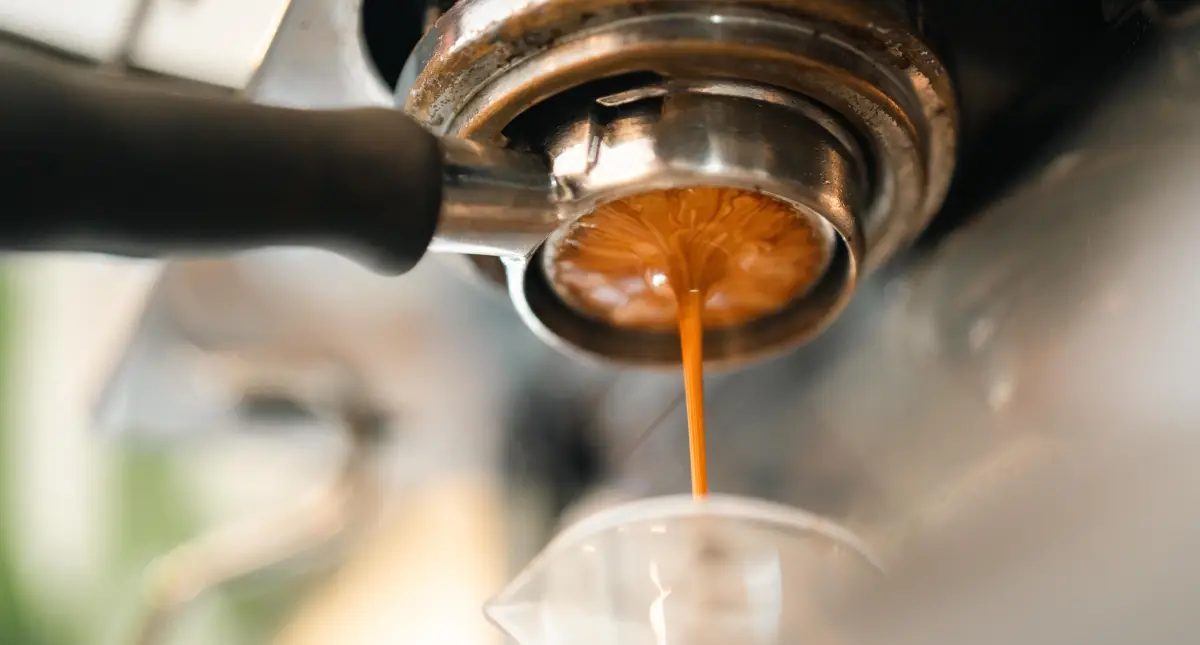
- You start the shot, and the machine sends water to the group head at low pressure, usually around 2 to 4 bar.
- Water slowly soaks the puck for a set time, typically 3 to 10 seconds. The first drops may or may not appear at the end of this phase.
- The pump or lever then moves to full pressure, around 9 bar, and main extraction begins.
- The shot finishes at your target yield, commonly about twice the dose of ground coffee (for example, 18 g in and 36 g out).
How the machine achieves the low-pressure phase depends on its design. Some use a timed pump ramp, some use a bypass or a restricted valve, and lever machines use a spring or your own hand to control flow.
Why Does Pre-Infusion Matter for Extraction?
Espresso extraction works best when water moves through the coffee evenly. A dry puck is full of tiny gaps and dense spots. If high-pressure water hits it all at once, it tends to carve narrow paths through the weakest areas. This is called channeling.
Channeling causes uneven extraction. Water over-extracts the coffee along the channels, which tastes bitter and harsh, while the rest of the puck is under-extracted and tastes sour or thin. Pre-infusion reduces this problem by letting the puck swell and settle first, which makes it more uniform and more resistant to being punched through.
Benefits you can expect, depending on your setup:
- Sweeter, better balanced flavour
- More consistent shots from one pull to the next
- Better crema in many cases, as the extraction is more even
- Easier dialing in with fresh or lighter-roasted beans, which can be stubborn
- More forgiveness when your tamping or distribution is not perfect
Static, Ramped, and Manual Pre-Infusion
Because machines differ, it helps to know the common approaches:
- Static pre-infusion: Water is held at a steady low pressure for a set time, then jumps to full pressure.
- Ramped (pressure-ramping) pre-infusion: Pressure rises gradually from low to 9 bar, with no hard step.
- Manual or lever pre-infusion: The barista controls pressure with a lever or flow-control paddle. This offers the most control and the steepest learning curve.
No single style is best. Static is simple and repeatable, ramping can be smoother, and manual control rewards experienced users who like to experiment.
Frothy Fusion Tip: Pre-infusion is a tool for fine-tuning, not a cure-all. Get your dose, grind size, and fresh beans right first, then add pre-infusion and change one variable at a time.
Pre-Infusion on Different Espresso Machines
Pre-infusion looks different depending on what is on your counter. Always check your own model’s manual for exact timings and pressures, since specifications vary between brands and generations.
Entry-Level Home Machines
Many budget machines either skip pre-infusion or apply a short, fixed one you cannot change. If your machine has none, a common workaround is a brief “manual” pre-infusion: start the pump for a second or two, pause, then restart. Results vary, and it works better on some machines than others.
Mid-Range and Prosumer Machines
Many popular semi-automatic machines include an automatic pre-infusion phase, and some let you adjust its length. This is where most home enthusiasts first meet the feature. Adjustable models let you test shorter or longer soaks to match your beans and grinder.
E61 Group Machines
The classic E61 group head has a design that can pre-wet the puck before full pump pressure, depending on the machine and how it is plumbed. Behaviour differs between models, so check the manufacturer’s guidance rather than assuming.
Lever and Flow-Control Machines
Spring-lever machines pre-infuse by design. Raising the lever lets water in at low pressure, and releasing it pushes the spring-driven piston down for the main phase. Flow-control paddles and pressure-profiling machines give you direct control over the whole curve.
Nespresso and Capsule Machines
Capsule machines are built for convenience, so any pre-wetting happens automatically and is not adjustable. If you own a Nespresso, you generally cannot change it, and that is by design. If you want control over pre-infusion, you would need to move to a manual espresso machine.
Pros and Cons of Pre-Infusion
Pros
- ✔ More even extraction and less channeling
- ✔ Often sweeter, more balanced flavour
- ✔ More forgiving of imperfect puck prep
- ✔ Helps with fresh and lighter-roasted beans
- ✔ Improves shot-to-shot consistency
Cons
- ✘ Adds another variable to dial in
- ✘ Too long can make shots taste flat or over-extracted
- ✘ Not adjustable on many entry-level and capsule machines
- ✘ Will not rescue stale beans or a bad grind
- ✘ Machines with full control cost more
Who Is Pre-Infusion Best For?
- Beginners: A built-in, automatic pre-infusion adds forgiveness while you are learning.
- Light-roast drinkers: Dense, fresh beans are prone to channeling, so a gentle start helps.
- Enthusiasts and tinkerers: Adjustable pre-infusion is another lever for refining flavour.
- Milk-drink fans: A smoother extraction often holds up better in lattes and flat whites, though the effect is subtler under milk.
- Capsule users: Not much to adjust, but it helps to know what the machine is already doing for you.
How to Use and Dial In Pre-Infusion at Home
If your machine lets you adjust pre-infusion, treat it like any other variable: change one thing at a time and taste each result. The numbers below are starting points, not rules.
- Start with a solid baseline. Use fresh beans, a consistent dose (for example, 18 g), and a grind that gives roughly a 1:2 ratio (18 g in, 36 g out) in about 25 to 30 seconds total. Count the pre-infusion time as part of that total unless your machine says otherwise.
- Pull a shot with your machine’s default pre-infusion. Note the timing, the flow, and the taste. This is your reference point.
- Change the pre-infusion time by a few seconds. If the shot tastes sharp or sour and runs fast, a slightly longer soak may help. If it tastes flat or bitter and runs slow, try shortening it.
- Adjust the grind separately. Longer pre-infusion can slow the shot. If so, a slightly coarser grind may bring the total time back in range. Never change grind and pre-infusion at the same time.
- Watch the flow. A bottomless portafilter lets you see the first drops and spot channeling as spurts or uneven streams. Even, centered flow is a good sign.
- Keep notes. Record dose, yield, time, pre-infusion setting, and taste. Small notes make repeating a great shot much easier.
Frothy Fusion Tip: If the first drip appears before pre-infusion ends, your puck may be too coarse or under-dosed. If it is very slow to appear at full pressure, the grind may be too fine.
Common Mistakes to Avoid
- ❌ Setting a very long pre-infusion to fix a bad grind
- ❌ Changing grind, dose, and pre-infusion all at once
- ❌ Expecting pre-infusion to fix stale beans
- ❌ Skipping puck prep, such as even distribution and a level tamp
- ❌ Ignoring total shot time and yield, and judging only by the pre-infusion setting
What to Look for in an Espresso Machine With Pre-Infusion
If pre-infusion matters to you, these are the features worth checking before you buy:
- Adjustable or fixed: Decide whether you want a set-and-forget feature or the ability to change pre-infusion time and pressure.
- Pressure control: Some machines let you see or tune pre-infusion pressure. Others only offer a timer.
- Temperature stability: Even extraction depends on steady water temperature. A good boiler or thermoblock setup matters as much as pre-infusion.
- Grinder quality: A consistent grinder with fine adjustment makes pre-infusion far more useful. A poor grinder undermines it.
- Portafilter and basket: A standard 58 mm portafilter gives you access to a wide range of baskets and accessories, and a bottomless portafilter helps you diagnose flow.
- Ease of cleaning and maintenance: Look for a removable drip tray, accessible group head, and clear descaling guidance.
- Budget: Adjustable pre-infusion tends to appear in mid-range and higher price brackets. Check the specifications rather than assuming.
- Warranty and brand reputation: Look for clear warranty terms, available spare parts, and a manufacturer with good support.
Plan for the whole setup, not just the machine. A capable grinder, fresh beans, and a scale will usually improve your shots more than any single machine feature.
🔍 Do All Espresso Machines Have Pre-Infusion?
Not all machines include this feature. Some entry-level models don’t, while many mid-range and prosumer machines offer programmable pre-infusion times or built-in automatic pre-infusion.
☕ Beginner Espresso Machine Buying Guide
⚙️ Can I Control Pre-Infusion?
On high-end machines, yes—you can adjust the time and sometimes even the pressure. But on many machines, it’s automatic and pre-set. Even manual espresso makers like the Flair or Lever machines allow a form of manual pre-infusion by lightly pressing or pausing before a full pull.
FAQs About Pre-Infusion
What does pre-infusion do in espresso?
Pre-infusion gently wets the coffee puck at low pressure before full brewing pressure begins. This lets the grounds swell and settle, so water flows through more evenly. The result is usually less channeling, a sweeter and more balanced flavour, and better shot-to-shot consistency, especially with fresh or lighter-roasted beans.
How long should pre-infusion be?
Most espresso pre-infusion phases run between 3 and 10 seconds, and many people start around 5 to 8 seconds. The best time depends on your beans, grind, and machine. Treat these numbers as starting points, then adjust by a few seconds and taste the difference.
Does pre-infusion improve crema?
It can, indirectly. Pre-infusion encourages more even extraction, and an even extraction often produces a more stable, consistent crema. Crema also depends heavily on bean freshness, roast level, and grind, so pre-infusion alone will not guarantee a thick crema.
Do all espresso machines have pre-infusion?
No. Many entry-level machines skip it or use a short fixed phase. Mid-range, prosumer, lever, and many E61 machines are more likely to include or support it. Check the specifications for your model, since features differ between brands and versions.
Can I pre-infuse manually on a machine without it?
Sometimes. On many pump machines you can start the pump briefly, pause to let the puck soak, then restart for full extraction. It is less precise than a built-in system, so results vary, and it may not suit every machine. Check your manual first.
Does Nespresso pre-infuse?
Capsule machines typically perform a short automatic wetting step as part of the brew cycle, but it is not adjustable. If you want to control pre-infusion time or pressure, a manual or semi-automatic espresso machine offers that flexibility.
Is pre-infusion the same as blooming?
They are similar ideas. Blooming is a pour-over term for wetting coffee grounds so trapped gases can escape before the main pour. Pre-infusion does something comparable for espresso, but under pressure and with a focus on saturating the puck evenly.
Is pre-infusion worth it for beginners?
Yes, usually. A built-in pre-infusion step makes shots more forgiving while you learn grinding, dosing, and tamping. You do not need an adjustable system to benefit. Focus on fresh beans, a good grinder, and consistent technique first, then experiment with adjustments later.
Final Verdict: Is Pre-Infusion Worth Understanding?
Pre-infusion is a simple idea with a real effect: a gentle start helps water move through the puck evenly, which tends to give sweeter, more consistent espresso. If you are wondering what pre-infusion in espresso machines really is, think of it as a smart warm-up for the coffee bed, not a magic fix.
Who it is for: Home baristas who want more consistent shots, lighter-roast fans, and anyone buying a mid-range or higher machine.
Who can skip it: Capsule users and casual drinkers who just want a quick, reliable cup. The machine is already handling it for them.
Best alternatives to explore: Better puck prep (distribution and tamping), a higher-quality grinder, and pressure or flow profiling for those who want more control.
📌 TL;DR
Pre-infusion is a short, low-pressure water soak that prepares the coffee puck before full espresso extraction. It helps reduce channeling and boosts shot consistency—especially useful for beginners and perfectionists alike.
What to Read Next
- Learn how to dial in your espresso with a step-by-step guide
- Compare latte vs flat white to see how milk changes the cup
- Browse our beginner espresso recipes for your new setup
- Explore our guide to the best grinders for home espresso
☕ Just a heads up—this What is Pre-Infusion post contains affiliate links. If you buy through them, Frothy Fusion may earn a small commission (at no cost to you). Thanks for supporting our coffee-fueled content!