How Coffee Grind Size Affects Flavor could be the issue if you have ever bought good coffee beans, followed your brewing recipe, and still ended up with a disappointing cup?
- Quick Answer: How Does Grind Size Affect Coffee Flavor?
- What Is Coffee Grind Size?
- How Grind Size Affects Extraction
- How Coffee Grind Size Affects Flavor
- Too Coarse: Under-Extraction
- Too Fine: Over-Extraction
- Just Right: Balanced Extraction
- Coffee Grind Size Chart by Brewing Method
- Why Different Brewing Methods Need Different Grind Sizes
- Why Fresh Grinding Matters
- Blade vs. Burr Grinders
- How to Adjust Your Coffee Grind
- Grind Size Isn't the Only Brewing Variable
- Signs Your Grind Size May Be Wrong
- Common Coffee Grind Mistakes
- FAQs How Coffee Grind Size Affects Flavor
- Final Verdict: How Important Is Coffee Grind Size?
- You May Also Like ☕

The problem may not be your beans, brewer, or technique.
It could be your coffee grind size.
Grind size is one of the most important factors affecting coffee flavor because it influences how quickly water extracts flavor compounds from the grounds.
A grind that is too fine can contribute to bitter, harsh coffee, while a grind that is too coarse can produce weak, sour, or watery coffee.
The key is matching the grind to your brewing method and then making small adjustments based on how the finished coffee tastes.
Quick Answer: How Does Grind Size Affect Coffee Flavor?
Coffee grind size affects flavor primarily by controlling extraction speed.
- Finer grounds expose more surface area to water and generally extract faster.
- Coarser grounds expose less surface area and generally extract more slowly.
- Too coarse can lead to under-extraction and sour, weak, or watery coffee.
- Too fine can lead to over-extraction and bitter, harsh, dry, or astringent coffee.
- The best grind depends on your brewing method, brew time, water flow, and recipe.
If your coffee doesn’t taste right, adjusting the grind is often one of the first variables worth checking.
What Is Coffee Grind Size?
Coffee grind size refers to how large or small the coffee particles are after grinding.
Think of coffee grounds like ice cubes:
- Crushed ice melts quickly.
- Large ice cubes melt more slowly.
Coffee behaves in a similar way during brewing.
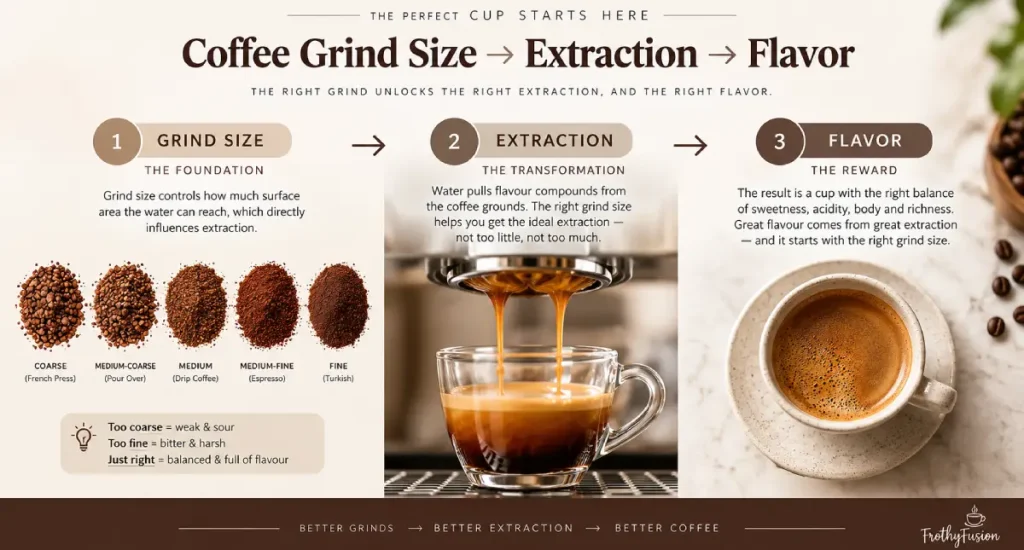
Smaller coffee particles expose more surface area to water, which generally allows extraction to happen more quickly. Larger particles expose less surface area, slowing the extraction process.
This is why grind size can make such a noticeable difference even when you use the same beans and brewing equipment.
How Grind Size Affects Extraction
When hot water passes through coffee grounds, it extracts compounds that contribute to aroma, flavor, acidity, sweetness, body, and bitterness.
Grind size influences how quickly that extraction takes place.
Finer Grind
A finer grind creates smaller particles with more surface area exposed to the water.
This generally allows extraction to happen faster.
Coarser Grind
A coarser grind creates larger particles with less surface area exposed to the water.
This generally slows extraction.
The goal isn’t simply to use a fine or coarse grind.
The goal is to find the grind size that produces a balanced extraction for your particular brewing method and recipe.
How Coffee Grind Size Affects Flavor
The relationship can be simplified like this:
GRIND SIZE → EXTRACTION → FLAVOR
When extraction is too low, the coffee can taste sour, sharp, thin, weak, or watery.
When extraction is too high, the coffee can taste bitter, harsh, dry, astringent, or muddy.
A well-matched grind can help produce a cup with:
- Balanced sweetness
- Pleasant acidity
- Fuller body
- Clearer flavor notes
- Better overall balance
This is why changing the grind can sometimes improve a disappointing cup without changing the beans or equipment.
Too Coarse: Under-Extraction
When coffee is ground too coarsely for the brewing method, water may pass through or around the larger particles without extracting enough flavor.
This can result in under-extraction.
Common signs include:
- Sour taste
- Sharp acidity
- Thin body
- Watery mouthfeel
- Weak flavor
- Brew time that seems unusually fast
What to try
If your coffee tastes sour, weak, or watery, try going slightly finer and brew again.
Make a small adjustment rather than changing several variables at once.
Too Fine: Over-Extraction
When coffee is ground too finely for the brewing method, extraction can become excessive.
This can result in over-extraction.
Common signs include:
- Bitter taste
- Harsh flavor
- Dry mouthfeel
- Astringency
- Heavy or muddy character
- Brew time that seems unusually slow
What to try
If your coffee tastes bitter, harsh, or overly dry, try going slightly coarser and brew again.
Again, make one change at a time so you can tell what actually improved the cup.
Just Right: Balanced Extraction
The ideal grind produces a balanced extraction rather than simply maximizing extraction.
A well-matched grind can contribute to:
- Sweetness
- Balance
- Pleasant acidity
- Full body
- Clear flavor notes
The exact setting will vary because different brewing methods have different contact times, water flow, filtration, and brewing conditions.
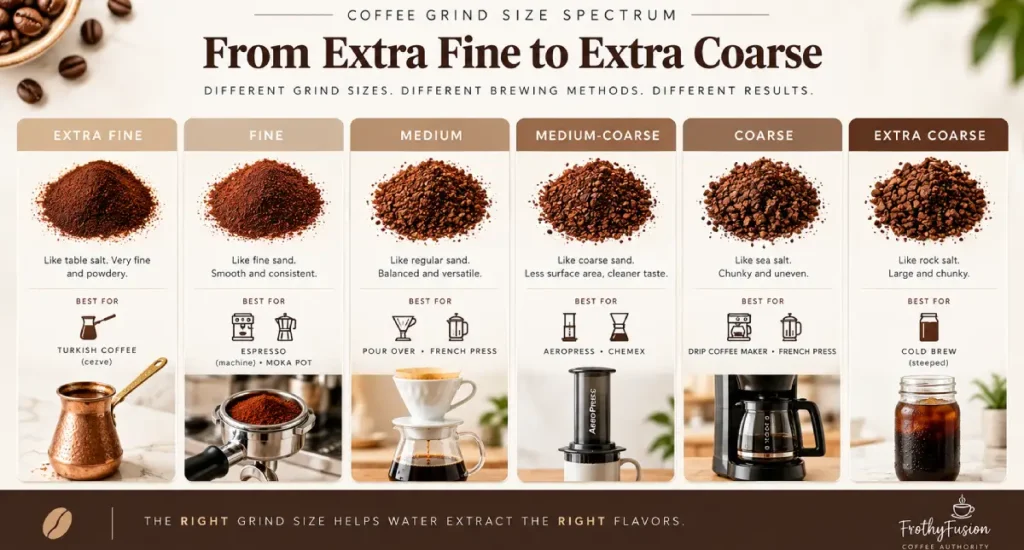
Coffee Grind Size Chart by Brewing Method
Use this chart as a starting point, not an absolute rule.
| Brewing Method | Starting Grind | Approximate Texture |
|---|---|---|
| Cold Brew | Extra coarse | Cracked pepper or kosher salt |
| French Press | Coarse | Sea salt |
| Percolator | Coarse | Sea salt |
| Chemex | Medium-coarse | Rough sand |
| Drip Coffee Maker | Medium | Sand |
| Siphon | Medium | Beach sand |
| Pour Over | Medium-fine | Fine sand or table salt |
| AeroPress | Fine to medium | Depends on recipe |
| Moka Pot | Fine-medium | Finer than drip, coarser than espresso |
| Espresso | Fine | Powdered sugar |
| Turkish Coffee | Extra fine | Flour-like |
The supplied grind guides consistently position French Press around coarse, drip around medium, pour-over around medium-fine, espresso around fine, and cold brew around extra coarse. They also emphasize that methods such as AeroPress can require different settings depending on the recipe.
Why Different Brewing Methods Need Different Grind Sizes
There isn’t one perfect grind size for every brewing method.
Different brewers expose coffee grounds to water in different ways.
Espresso
Espresso has a short brewing time, so a fine grind helps provide the resistance and extraction needed during the shot.
If the grind is too coarse, the shot may run quickly and taste sour.
If it is too fine, the shot may run slowly and taste bitter.
Pour Over
Pour-over brewing generally works well with a medium-fine grind.
The grind needs to work with the brewer’s filter and water flow to produce an even extraction.
French Press
French Press uses immersion brewing, meaning the coffee remains in contact with water for several minutes.
A coarse grind is commonly used to help with filtration and reduce excessive extraction and sediment.
Drip Coffee
Most automatic drip coffee makers commonly use a medium grind.
This provides a practical starting point for consistent extraction.
Cold Brew
Cold brew uses a much longer brewing period, commonly around 12–24 hours in the supplied guides.
An extra-coarse grind slows extraction and can make filtering easier.
Why Fresh Grinding Matters
Even a well-chosen grind size cannot compensate completely for stale coffee.
The supplied guide notes that coffee begins losing aroma and flavor after grinding, while grinding fresh can provide better aroma, sweetness, flavor clarity, and improved espresso crema.
For better consistency:
- Grind shortly before brewing.
- Use consistent measurements.
- Keep your grinder clean.
- Store coffee beans appropriately.
- Adjust the grind when your coffee needs dialing in.
If you’re looking to improve your grinder setup, see our guide to choosing the right coffee grinder for home use.
Blade vs. Burr Grinders
Grinder consistency matters because uneven particles can extract differently.
Blade Grinders
Advantages:
- Affordable
- Easy to find
Disadvantages:
- Less consistent particle sizes
- Less control over grind size
- Can contribute to uneven extraction
Burr Grinders
Advantages:
- More consistent particle sizes
- More precise adjustment
- Better control when dialing in coffee
For home brewers who regularly adjust grind size, a burr grinder provides a useful level of control. The supplied articles consistently identify burr grinders as the better option when consistency and precise adjustment matter.
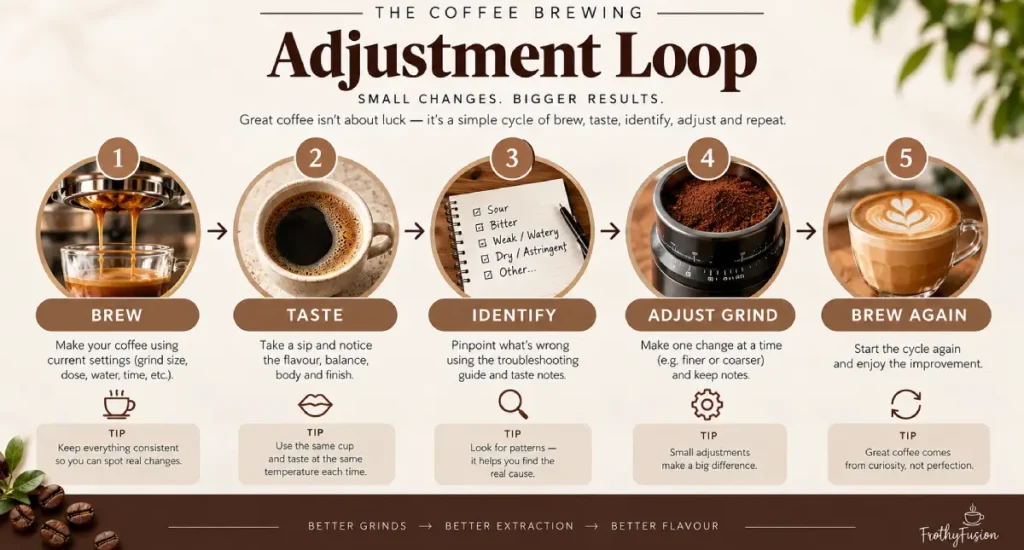
How to Adjust Your Coffee Grind
You don’t need to find the perfect grind setting immediately.
Instead, treat grind adjustment as a process.
1. Choose your brewing method
Start with the recommended grind range for your brewer.
2. Brew your coffee
Keep the rest of your recipe as consistent as possible.
3. Taste the result
Pay attention to whether the coffee tastes balanced, sour, weak, bitter, harsh, or dry.
4. Make one small adjustment
Sour, weak, or watery?
→ Try slightly finer.
Bitter, harsh, or dry?
→ Try slightly coarser.
5. Brew again
Taste the new cup and compare it with the previous one.
This simple brew → taste → adjust → brew again process is the foundation of dialing in grind size.
Grind Size Isn’t the Only Brewing Variable
Grind size is important, but it isn’t working alone.
The supplied articles identify several other variables that can affect the finished cup:
Water Quality
Filtered water can contribute to a cleaner-tasting brew.
Brewing Temperature
The supplied guide identifies approximately 90–96°C (195–205°F) as a commonly useful brewing range.
Coffee-to-Water Ratio
The amount of coffee relative to water affects strength and balance.
Freshness
Freshly roasted and freshly ground coffee can provide better flavor potential.
This is why troubleshooting coffee should be approached as a system rather than assuming that grind size is always the only cause.
Signs Your Grind Size May Be Wrong
| What You Notice | Possible Direction |
|---|---|
| Sour | Try finer |
| Sharp | Try finer |
| Weak | Try finer |
| Watery | Try finer |
| Bitter | Try coarser |
| Harsh | Try coarser |
| Dry / astringent | Try coarser |
| Heavy or muddy | Try coarser |
| Unusually fast brew | Check whether grind is too coarse |
| Unusually slow brew | Check whether grind is too fine |
These are starting points, not guarantees. Other brewing variables can produce similar symptoms.
If changing the grind doesn’t solve the problem, use our Coffee Brewing Troubleshooting guide to work through the other possible causes.
Common Coffee Grind Mistakes
Using One Grind for Every Brewing Method
Different brewing methods have different requirements. There is no single grind size that is ideal for everything.
Buying Pre-Ground Coffee Without Considering the Method
Pre-ground coffee may not be ground appropriately for your brewer, and the coffee also loses freshness after grinding.
Changing Too Many Variables at Once
If you change the grind, ratio, temperature, brew time, and beans simultaneously, you won’t know which change affected the result.
Ignoring Taste Feedback
Your cup is the final test.
If it tastes sour or weak, try going finer.
If it tastes bitter or harsh, try going coarser.
Then brew again.
FAQs How Coffee Grind Size Affects Flavor
Does a finer coffee grind make coffee stronger?
Not necessarily.
A finer grind generally increases extraction speed, which can make coffee taste more intense. But if the grind is too fine for the brewing method, excessive extraction can produce bitterness or harshness.
Why does my coffee taste sour?
Sour coffee can be a sign of under-extraction.
If grind size is contributing to the problem, try a slightly finer grind and brew again.
Why does my coffee taste bitter?
Bitterness can be a sign of over-extraction.
If grind size is contributing to the problem, try a slightly coarser grind.
What grind size is best for drip coffee?
A medium grind is a common starting point for automatic drip coffee makers.
You may need to adjust it based on your brewer, recipe, beans, and taste.
Is a burr grinder worth it?
A burr grinder can be worthwhile if you want more consistent particle size and greater control over grind adjustments. This is particularly useful for brewing methods such as espresso and pour over.
How often should I adjust my grind size?
Adjust your grind when you:
Change coffee beans
Change brewing methods
Notice a change in flavor
Notice a significant change in brew time
Need to dial in a new recipe
Final Verdict: How Important Is Coffee Grind Size?
Very important.
Grind size influences how quickly water extracts flavor from coffee grounds, which means it can have a major effect on the finished cup.
But the goal isn’t simply to choose “fine” or “coarse.”
The goal is to:
- Match the grind to your brewing method.
- Start with a sensible grind range.
- Brew consistently.
- Taste the result.
- Make a small adjustment.
- Brew again.
For most home brewers, the biggest improvements come from matching grind size to the brewing method, grinding fresh, using a consistent grinder, and making controlled adjustments.
Once you understand the relationship between grind size, extraction, and flavor, dialing in your coffee becomes much more straightforward.
You May Also Like ☕
- Coffee Brewing Fundamentals
- How to Brew French Press Coffee
- Espresso Extraction: How to Dial In the Perfect Shot
- Coffee Brewing Troubleshooting
- Best Coffee Grinders for Precision Brewing
- How to Build a Better Home Coffee Station