Why can the same coffee beans produce a delicious cup one day and a disappointing cup the next? Could it be related to coffee brewing fundamentals
- What Is Coffee Brewing?
- The 6 Variables That Control Coffee Brewing
- What Is Coffee Extraction?
- How Brewing Variables Work Together
- The Main Brewing Variables at a Glance
- How Coffee Brewing Fundamentals Apply to Different Methods
- Does Better Equipment Make Better Coffee?
- How to Troubleshoot Coffee That Doesn't Taste Right
- How to Start Making Better Coffee
- Coffee Brewing Fundamentals FAQs
- Final Thoughts
The answer usually isn’t the coffee itself. Small changes in grind size, coffee-to-water ratio, water quality, temperature, brewing time, and water flow can all change how coffee is extracted.
Understanding these variables is the foundation of better coffee brewing.
You don’t need to change everything at once or own expensive equipment. Once you understand what each variable does, you can make deliberate adjustments and learn what works best for your coffee and brewing method.
👉 Coffee Brewing Troubleshooting
What Is Coffee Brewing?
Coffee brewing is the process of using water to extract soluble compounds from roasted coffee grounds.
In simple terms:
Coffee + Water + Time → Extraction → Flavor
When hot water comes into contact with ground coffee, it dissolves compounds from the coffee. The amount and balance of those compounds in your finished cup influence its flavor, aroma, body, acidity, sweetness, and bitterness.
The goal isn’t to extract absolutely everything from the coffee.
The goal is to extract the right balance of compounds for a pleasant cup.
That’s why brewing is less about finding one perfect recipe and more about understanding how different variables interact.
👉 How Coffee Grind Size Affects Flavor →
The 6 Variables That Control Coffee Brewing
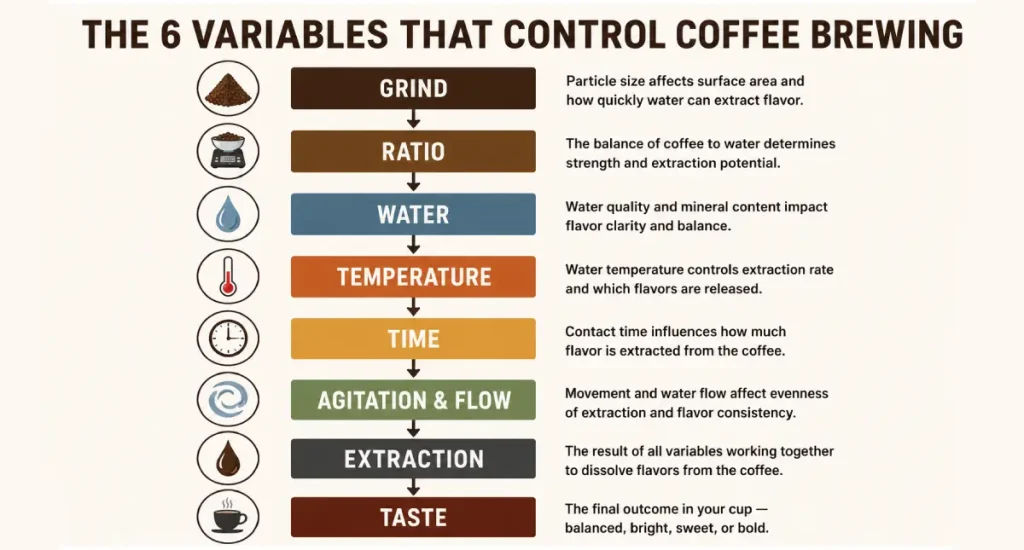
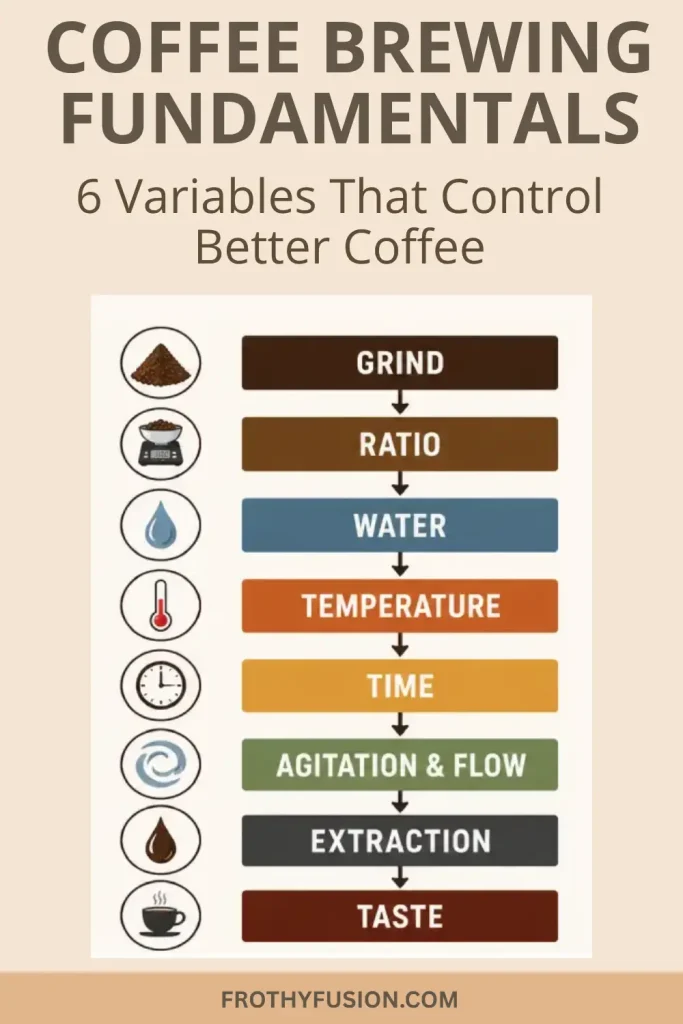
Although brewing methods differ considerably, six variables have an especially important influence on the finished cup:
- Grind size
- Coffee-to-water ratio
- Water quality
- Water temperature
- Brew time
- Agitation and flow
These variables don’t operate independently. Changing one can affect how the others behave.
1. Grind Size
Grind size determines how much surface area of the coffee is exposed to water and how easily water can move through or around the coffee grounds.
In general:
- Finer grounds provide more surface area and tend to extract more quickly.
- Coarser grounds provide less surface area and tend to extract more slowly.
Different brewing methods therefore require different grind ranges.
Espresso, for example, uses a much finer grind than French press brewing.
If you’re learning how grind size affects your coffee, see our guide to Coffee Grind Size for a deeper explanation.
The important principle is simple:
Grind size controls how easily and quickly water can extract the coffee.
👉 Adjust Your Espresso Grind Size
2. Coffee-to-Water Ratio
Your coffee-to-water ratio describes how much coffee you use in relation to the amount of brewing water.
For example, a 1:16 ratio means:
1 gram of coffee for every 16 grams of water.
Ratio primarily affects the concentration and strength of the finished coffee.
Using more coffee relative to water generally produces a stronger cup. Using more water relative to the same amount of coffee generally produces a weaker cup.
Ratio and extraction are related, but they aren’t the same thing.
A coffee can be strong but under-extracted, or weak but over-extracted.
Our Coffee Brew Ratio Calculator can help you quickly work out the amount of coffee or water required for a target ratio.
3. Water Quality
Water is not just the substance that carries coffee into your cup.
It is one of the main ingredients.
Because brewed coffee consists largely of water, the characteristics of that water can have a noticeable effect on flavor and extraction.
Factors such as:
- mineral content
- hardness
- alkalinity
- taste
- filtration
can influence the final cup.
Water that tastes unpleasant on its own is unlikely to produce great-tasting coffee.
For espresso machines in particular, water quality also matters for machine maintenance and scale management.
If you’re exploring water specifically for espresso, see our Coffee Water for Espresso Machines guide.
4. Water Temperature
Water temperature influences how quickly compounds are extracted from coffee.
Hotter water generally extracts more quickly, while cooler water generally extracts more slowly.
That doesn’t mean hotter is always better.
The ideal temperature depends on factors including:
- the coffee
- roast level
- grind size
- brewing method
- contact time
Temperature is therefore another variable that needs to be considered alongside the rest of the brewing recipe.
5. Brew Time
Brew time is the amount of time water remains in contact with the coffee.
Depending on the brewing method, this might mean:
- seconds for espresso
- several minutes for French press
- several minutes for pour-over
- longer periods for cold brew
More contact time can allow more compounds to be extracted, but longer isn’t automatically better.
If other variables aren’t balanced, extending the brewing time can produce an unpleasant cup.
Think of brew time as one part of the extraction equation rather than an isolated target.
6. Agitation and Flow
Agitation describes movement of the coffee and water during brewing.
Flow describes how water moves through or around the coffee.
These become particularly important in brewing methods where water passes through a coffee bed.
Uneven water movement can result in some coffee being extracted more than other areas.
In espresso, puck preparation, distribution and water flow can therefore have a major effect on extraction.
Our guides to espresso distribution and WDT and espresso puck preparation explore these techniques in greater detail.
What Is Coffee Extraction?
Coffee extraction is the process of dissolving soluble compounds from ground coffee into water.
It is one of the most important concepts in coffee brewing.
Extraction is influenced by variables such as:
- grind size
- water temperature
- brew time
- water-to-coffee ratio
- agitation
- water flow
The goal isn’t simply to extract more.
It’s to achieve a balanced extraction that produces desirable flavor.
Under-Extraction
When too little desirable material is extracted from the coffee, the result can taste:
- sour
- sharp
- thin
- weak
- lacking sweetness
Under-extraction can occur when water moves through the coffee too quickly, the grind is too coarse, the water is too cool, or there isn’t enough effective contact between water and coffee.
Over-Extraction
When extraction goes too far, coffee can become:
- bitter
- harsh
- drying
- astringent
- unpleasantly intense
Over-extraction can occur when coffee is ground too finely, contact time is excessive, or other brewing conditions allow too much extraction.
Balanced Extraction
A well-extracted coffee can have a pleasant balance of:
- sweetness
- acidity
- bitterness
- body
- clarity
- aroma
The ideal balance depends partly on personal preference and the coffee itself.
How Brewing Variables Work Together
One of the biggest mistakes beginners make is treating each brewing variable as if it exists independently.
It doesn’t.
Consider grind size.
Changing the grind can change how quickly water moves through the coffee and how much contact occurs between water and coffee.
That can change extraction.
And if extraction changes, flavor changes.
The same principle applies to temperature, ratio, time, agitation and flow.
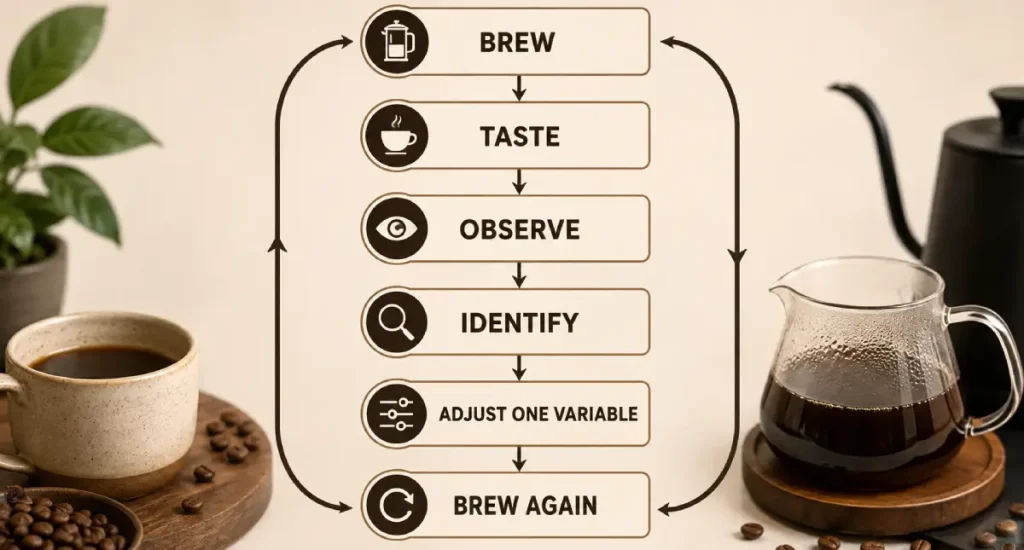
This is why troubleshooting is most effective when you make one deliberate adjustment at a time.
Instead of changing your grind, ratio, temperature and brew time simultaneously, make one adjustment and evaluate the result.
A simple brewing adjustment cycle is:
BREW → TASTE → OBSERVE → IDENTIFY → ADJUST → BREW AGAIN
This gives you useful information about what actually changed.
The Main Brewing Variables at a Glance
| Variable | What it influences | What changing it can do |
|---|---|---|
| Grind size | Extraction speed and water contact | Speed extraction up or slow it down |
| Coffee-to-water ratio | Coffee concentration | Produce a stronger or weaker cup |
| Water quality | Extraction environment and flavor | Affect taste and consistency |
| Temperature | Extraction rate | Increase or decrease extraction speed |
| Brew time | Contact time | Allow more or less extraction |
| Agitation & flow | Water contact and extraction evenness | Change how uniformly coffee is extracted |
The important thing to remember is that there is no single perfect setting for every coffee and every brewing method.
How Coffee Brewing Fundamentals Apply to Different Methods
The same basic principles appear across many brewing methods, but each method uses them differently.
| Brewing method | Important variables |
|---|---|
| Espresso | Grind, dose, yield, flow, puck preparation and extraction |
| Pour Over | Grind, ratio, temperature, water flow and brew time |
| French Press | Grind, ratio, temperature and steep time |
| Moka Pot | Grind, dose, heat and water flow |
| Drip Coffee | Grind, ratio, water, temperature and brew time |
| Cold Brew | Grind, ratio, water and steeping time |
This is why a brewing technique that works beautifully for one method may not transfer directly to another.
For example, the grind required for espresso is dramatically different from the grind used for French press coffee.
The fundamentals stay the same.
The application changes.
👉 How To Brew French Press Coffee Perfectly
Does Better Equipment Make Better Coffee?
Good equipment can make brewing easier and more consistent, but expensive equipment isn’t a substitute for understanding the fundamentals.
Some equipment can have a particularly large impact on consistency.
A Good Grinder
A capable grinder can produce a more consistent particle distribution and make grind adjustments easier.
A Reliable Scale
A scale allows you to measure coffee and water accurately instead of relying on guesswork.
A Suitable Brewer
Different brewing methods require different equipment, but the brewer itself is only one part of the process.
Good Water
Appropriate water can make a significant difference to both flavor and consistency.
Espresso Equipment
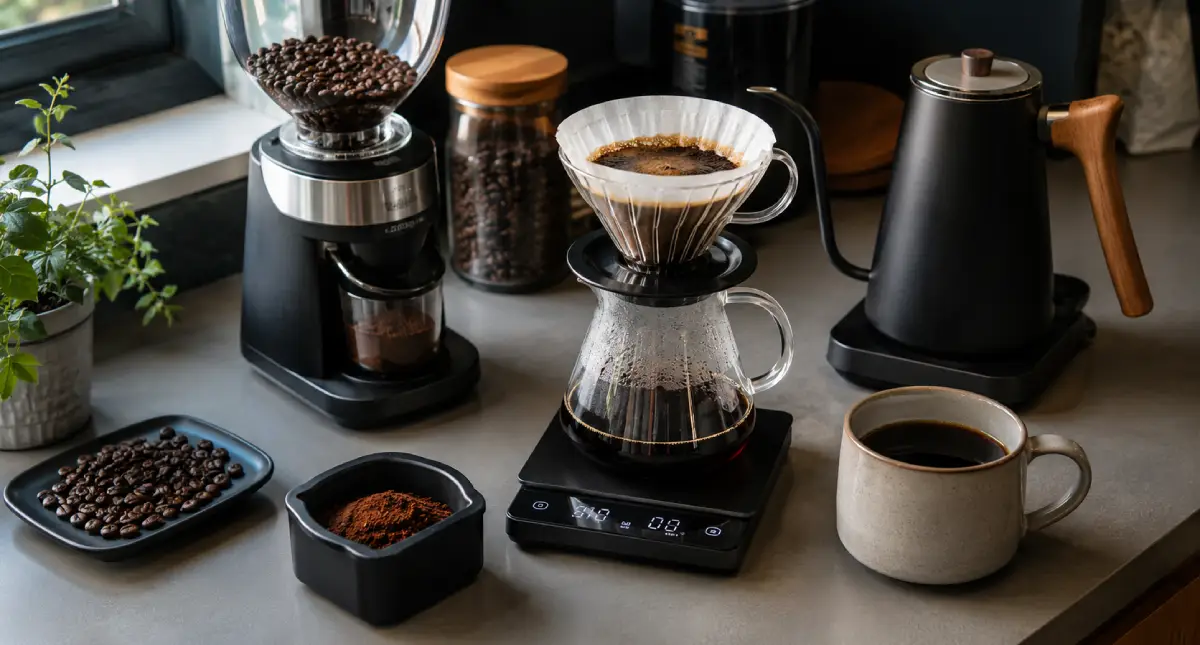
For espresso, the grinder, espresso machine, basket, dose, puck preparation and extraction all work together.
The most useful equipment is therefore the equipment that helps you control and repeat your brewing variables.
How to Troubleshoot Coffee That Doesn’t Taste Right
When coffee doesn’t taste the way you expected, resist the temptation to change everything.
Start with the cup.
Taste
Ask yourself:
Is it sour? Bitter? Weak? Harsh? Flat?
Observe
Look at the brewing process.
For espresso, you might observe:
- flow
- extraction time
- puck condition
- dose
- yield
For other brewing methods, consider:
- grind
- brew time
- water temperature
- flow
- ratio
Identify
Think about which variable is most likely contributing to the problem.
Adjust
Change one variable where possible.
Brew Again
Repeat the process and compare the result.
For espresso-specific problems, our Espresso Troubleshooting Guide provides a more detailed diagnostic process.
The same mindset can be applied to other brewing methods:
Don’t change everything at once.
How to Start Making Better Coffee
If you’re new to coffee brewing, don’t try to master every variable immediately.
Start with three:
1. Measure Your Coffee
Use a consistent amount of coffee.
2. Measure Your Water
A scale makes this much easier.
3. Pay Attention to Grind Size
Grind size is one of the most powerful adjustments available to most home brewers.
Once those three are consistent, you can start exploring:
Temperature → brew time → flow → agitation → extraction
This turns brewing from guesswork into a repeatable process.
Coffee Brewing Fundamentals FAQs
What are the most important coffee brewing variables?
The main variables are grind size, coffee-to-water ratio, water quality, water temperature, brew time, and agitation or flow. Their relative importance depends on the brewing method.
What happens if coffee is ground too fine?
A finer grind generally increases surface area and can speed extraction. If the coffee becomes excessively fine for the brewing method, it can contribute to over-extraction and a bitter, harsh or drying taste.
What happens if coffee is ground too coarse?
A coarse grind generally slows extraction. If it is too coarse for the brewing method, the coffee may be under-extracted and taste sour, sharp, thin or lacking sweetness.
What is a good coffee-to-water ratio?
There isn’t one ratio that is perfect for every brewing method. A common starting point for many filter-style methods is around 1:15 to 1:17, then you can adjust according to taste.
Espresso uses a different approach involving dose and beverage yield.
Does water temperature affect coffee taste?
Yes. Temperature influences how quickly compounds are extracted from coffee. It should be considered alongside grind size, brew time, ratio and the brewing method.
What is coffee extraction?
Extraction is the process of dissolving soluble compounds from ground coffee into water. The balance of those extracted compounds contributes to the flavour of the finished coffee.
How can I make my coffee taste better?
Start by making your brewing process consistent. Measure your coffee and water, use an appropriate grind size, pay attention to water quality and temperature, and change one variable at a time when troubleshooting.
Final Thoughts
Better coffee doesn’t require you to memorise dozens of complicated rules.
It starts with understanding a few fundamental variables.
Grind size. Ratio. Water. Temperature. Time. Agitation and flow.
Together, these variables influence extraction, and extraction influences what you taste in the cup.
Once you understand that relationship, brewing becomes much less about guessing and much more about making deliberate adjustments.
Start with consistency.
Measure your coffee and water.
Learn how grind size affects your brew.
Then change one variable at a time and taste the result.
That’s the foundation of becoming a better home brewer.