
There’s nothing more frustrating than brewing a fresh cup of coffee only to take a sip and think, “What went wrong?”
- Quick Answer: Why Does My Coffee Taste Bad?
- Coffee Brewing Troubleshooting Chart
- How to Troubleshoot Coffee That Tastes Sour
- How to Fix Bitter Coffee
- Why Does My Coffee Taste Weak or Watery?
- Why Does My Coffee Taste Too Strong?
- Why Does Coffee Taste Dry or Astringent?
- Why Does My Coffee Taste Flat or Dull?
- Why Does My Coffee Taste Burnt?
- The Coffee Brewing Variables That Matter Most
- The One-Variable Rule
- The Coffee Brewing Adjustment Loop
- How to Troubleshoot Coffee Step by Step
- Troubleshooting by Brewing Method
- Common Coffee Brewing Mistakes
- A Simple Coffee Troubleshooting Decision Tree
- Frequently Asked Questions
- The Bottom Line
- ☕ Frothy Fusion Verdict
- You May Also Like
The good news is that bad-tasting coffee usually isn’t a mystery. Your cup is giving you clues.
Coffee flavor is affected by several variables, including grind size, coffee-to-water ratio, water temperature, brew time, agitation, water quality, and coffee freshness. When one of those variables is out of balance, the result can taste sour, bitter, weak, harsh, flat, or simply unpleasant.
The trick is not to change everything at once.
Instead:
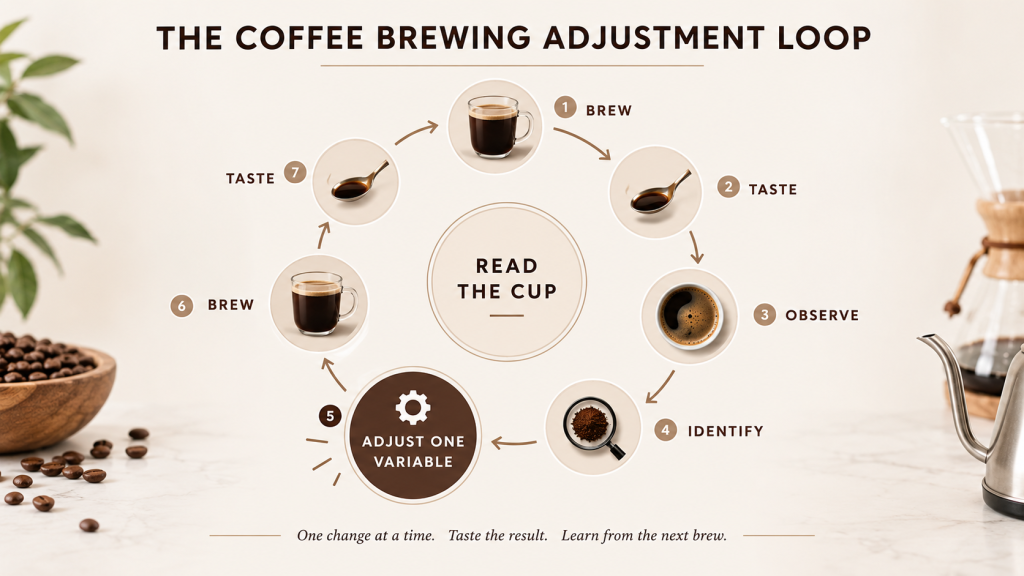
BREW → TASTE → OBSERVE → IDENTIFY → ADJUST ONE VARIABLE → BREW AGAIN
Once you learn how to read those signals, troubleshooting coffee becomes much easier.
Quick Answer: Why Does My Coffee Taste Bad?
Coffee can taste bad because of under-extraction, over-extraction, incorrect coffee-to-water ratio, unsuitable grind size, water temperature, brew time, poor water quality, stale coffee, or excessive agitation.
As a starting point:
- Sour or sharp: often under-extracted
- Bitter or harsh: often over-extracted
- Weak or watery: often too little coffee or too much water
- Dry or astringent: may indicate excessive extraction or agitation
- Flat or dull: check coffee freshness, water, and extraction
- Burnt or unpleasantly harsh: check the coffee itself as well as brewing temperature
These aren’t absolute rules. Taste can result from several variables interacting, so the best approach is to make one controlled adjustment at a time.
👉 Espresso Extraction: How to Dial In the Perfect Shot
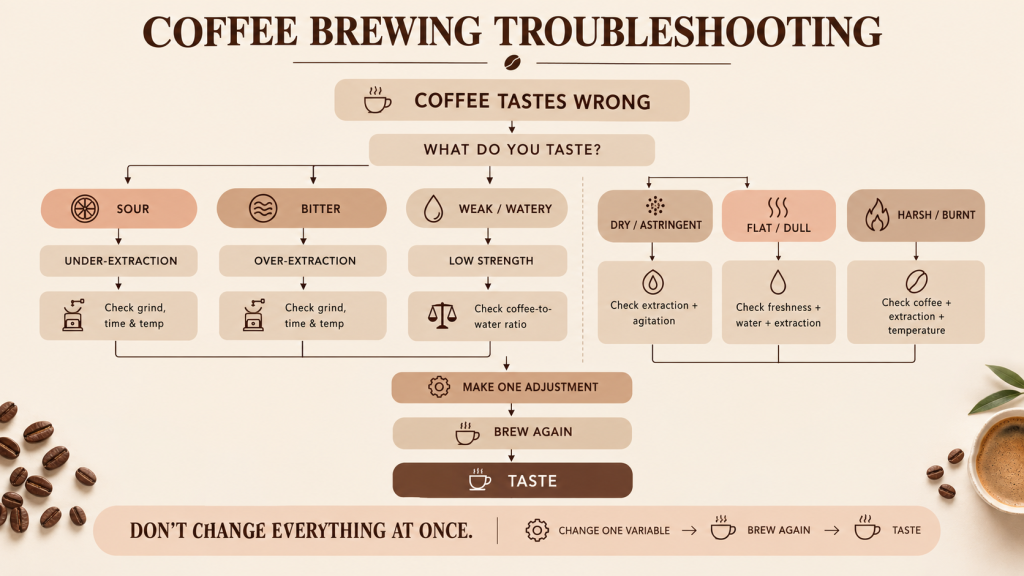
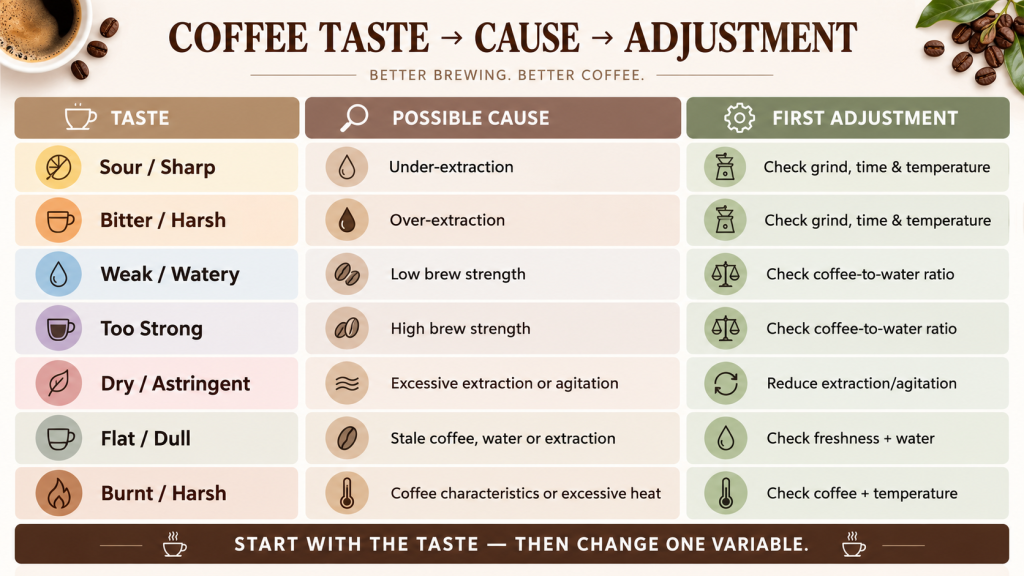
Coffee Brewing Troubleshooting Chart
| What your coffee tastes like | Possible cause | First thing to check |
|---|---|---|
| Sour or sharp | Under-extraction | Grind size and brew time |
| Bitter | Over-extraction | Grind size and brew time |
| Weak or watery | Low brew strength | Coffee-to-water ratio |
| Too strong | High brew strength | Coffee-to-water ratio |
| Dry or astringent | Excessive extraction or agitation | Agitation and grind |
| Flat or dull | Stale coffee, poor water, or extraction issues | Freshness and water |
| Harsh | Over-extraction, excessive agitation, or coffee characteristics | Grind and brewing technique |
| Burnt | Dark-roast characteristics or excessive heat | Coffee and water temperature |
Start with the most obvious taste problem rather than changing every variable simultaneously.
How to Troubleshoot Coffee That Tastes Sour
A sour or sharply acidic cup is one of the most common signs of under-extraction.
Under-extraction means the brewing process hasn’t extracted enough of the soluble compounds from the coffee grounds.
Possible causes include:
- Grind is too coarse
- Brew time is too short
- Water temperature is too low
- Insufficient contact between water and coffee
- Uneven extraction
- Insufficient agitation in some brewing methods
What should you change?
Start with grind size if your brewing method allows it.
Try grinding slightly finer and brew again.
Don’t make a dramatic adjustment. A small change gives you a better idea of whether grind size was actually the problem.
If the coffee improves but remains sour, investigate another variable such as brew time or water temperature.
Important distinction
Not every sour coffee is badly brewed.
Some coffees naturally have pronounced acidity, particularly lighter-roasted specialty coffees.
The question is whether the acidity tastes bright and pleasant or sharp, thin, and unfinished.
How to Fix Bitter Coffee
Bitter coffee can be associated with over-extraction, where the brewing process extracts more from the coffee than produces a balanced cup.
Possible causes include:
- Grind is too fine
- Brew time is too long
- Water temperature is too high
- Excessive agitation
- Uneven brewing
- Very dark-roasted coffee
What should you change?
If the coffee is clearly over-extracted, try a slightly coarser grind.
Then brew again using the same ratio, water and technique.
This is important because if you change several variables at once, you won’t know which adjustment actually helped.
Why Does My Coffee Taste Weak or Watery?
Weak coffee isn’t necessarily the same thing as under-extracted coffee.
Your coffee can be properly extracted but too weak in strength.
That distinction matters.
Check your coffee-to-water ratio first.
If you’re using too much water for the amount of coffee, the resulting brew may taste thin even if extraction is reasonable.
Other possibilities include:
- Grind is too coarse
- Brew time is too short
- Insufficient extraction
- Poor-quality or stale coffee
Try this first
Keep your brewing method and grind consistent, then slightly increase the amount of coffee or reduce the amount of water.
Taste the result.
If the coffee becomes stronger but still tastes sour or thin, you may also have an extraction problem.
Why Does My Coffee Taste Too Strong?
If your coffee tastes overwhelmingly intense, first determine whether you mean:
Too strong in concentration
or
Too intense because it tastes bitter, harsh, or unpleasant.
Those are different problems.
If the coffee is simply too concentrated, adjust the coffee-to-water ratio.
If it’s concentrated and bitter, you may also need to investigate extraction.
This is why diagnosing the taste before changing the recipe is so useful.
Why Does Coffee Taste Dry or Astringent?
A dry, puckering sensation in the mouth can indicate an extraction or brewing problem.
Possible contributors include:
- Excessive extraction
- Excessive agitation
- Very fine particles
- Uneven extraction
- Brewing characteristics of the coffee itself
Astringency can be more difficult to diagnose than simple sourness or bitterness.
Instead of immediately changing the ratio, look at how the water is interacting with the coffee.
If you’re stirring aggressively, pouring too turbulently, or otherwise creating excessive agitation, try reducing that variable while keeping everything else consistent.
Why Does My Coffee Taste Flat or Dull?
A flat cup can have several causes.
Start by checking the coffee itself.
Coffee freshness
Coffee loses aromatic compounds as it ages, and stale coffee can taste noticeably less vibrant.
Also check:
- How the coffee has been stored
- Whether the beans were ground long before brewing
- Whether the coffee has been exposed to excessive air, heat, light, or moisture
Water quality
Coffee is mostly water, so the water you use matters.
If your brewing water has an unpleasant taste or is poorly suited to coffee brewing, it can affect the finished cup.
Extraction
If freshness and water aren’t the problem, return to your brewing variables.
Grind size, ratio, temperature and brew time can all influence the character of the finished cup.
Why Does My Coffee Taste Burnt?
A burnt or intensely harsh flavor isn’t automatically caused by your brewing temperature.
The coffee itself matters.
Very dark roasts can naturally have smoky, roasted or bitter characteristics that some drinkers interpret as burnt.
However, if a coffee that normally tastes balanced suddenly becomes harsh, check:
- Water temperature
- Brewing time
- Grind size
- Coffee freshness
- Brewing equipment cleanliness
Don’t assume that every unpleasant bitter flavor has the same cause.
The Coffee Brewing Variables That Matter Most
Once you’ve identified what you’re tasting, it’s time to investigate the variables.
1. Grind Size
Grind size controls how quickly water can interact with the coffee.
In general:
Finer grind → greater potential extraction
Coarser grind → lower potential extraction
But grind size doesn’t work independently.
The effect depends on the brewing method, brew time, ratio and other variables.
That’s why “just grind finer” isn’t a universal solution.
2. Coffee-to-Water Ratio
Your ratio controls brew strength.
More coffee relative to water generally produces a stronger brew.
More water relative to coffee generally produces a weaker brew.
This is different from extraction.
You can have:
- Strong but under-extracted coffee
- Weak but over-extracted coffee
- Strong and balanced coffee
- Weak and balanced coffee
Understanding this distinction makes troubleshooting much easier.
3. Water Temperature
Temperature affects extraction.
Water that’s too cool may make extraction more difficult, while excessively hot water can contribute to faster extraction and may emphasize undesirable characteristics depending on the coffee and method.
Rather than obsessing over one universal temperature, use your brewing method and coffee as your starting point, then adjust based on taste.
4. Brew Time
Time determines how long water remains in contact with coffee.
Too little contact can contribute to under-extraction.
Too much contact can contribute to over-extraction.
But again, time can’t be considered separately from grind size and brewing method.
A four-minute French Press and a four-minute pour-over are not equivalent brewing processes.
5. Agitation
Agitation affects how water moves through or around the coffee.
Examples include:
- Stirring
- Pouring technique
- Blooming
- Swirling
- Pressing
Too little agitation can sometimes produce uneven extraction.
Too much can increase extraction or disturb the coffee bed unnecessarily.
Use agitation deliberately rather than simply assuming more is better.
6. Water Quality
Water contributes directly to the final beverage.
If your tap water tastes unpleasant, that flavor can show up in your coffee.
Mineral content also influences extraction, so water isn’t merely a neutral ingredient.
If your coffee consistently tastes dull or unpleasant despite otherwise controlled brewing, your water is worth investigating.
The One-Variable Rule
🔥 This may be the most important troubleshooting principle in the entire article.
When your coffee tastes wrong:
Don’t change everything.
If you simultaneously change:
- grind
- ratio
- temperature
- brew time
- agitation
you may get a better cup—but you won’t know why.
Instead:
Change ONE variable.
Then brew again.
Taste the new cup.
If it improved, you’ve learned something.
If it didn’t, return to your previous setting and investigate another variable.
That’s how you turn coffee brewing from guesswork into a repeatable process.
The Coffee Brewing Adjustment Loop
Think of troubleshooting as a continuous loop:
BREW
↓
TASTE
↓
OBSERVE
↓
IDENTIFY
↓
ADJUST ONE VARIABLE
↓
BREW AGAIN
The objective isn’t to find a magical recipe that works forever.
It’s to develop the ability to diagnose and adjust your own coffee.
How to Troubleshoot Coffee Step by Step
Step 1: Brew Your Coffee Normally
Start with your normal recipe.
Don’t troubleshoot while changing several things simultaneously.
Step 2: Taste Before Changing Anything
Ask yourself:
What specifically is wrong?
Is it:
- Sour?
- Bitter?
- Weak?
- Too strong?
- Dry?
- Flat?
- Harsh?
Be specific.
Step 3: Identify the Most Likely Cause
Connect the taste to the brewing variables.
For example:
Sour + thin
→ investigate under-extraction.
Bitter + harsh
→ investigate over-extraction.
Balanced flavor but too weak
→ investigate ratio.
Step 4: Change One Variable
Make a small adjustment.
Don’t completely rebuild the recipe.
Step 5: Brew Again
Keep everything else as consistent as possible.
Step 6: Taste and Compare
Ask:
Did that change improve the coffee?
If yes, you’ve identified a useful direction.
If no, restore the previous setting and investigate another variable.
Troubleshooting by Brewing Method
The same principles apply across brewing methods, but the variables behave differently.
French Press
French Press brewing gives you considerable control over:
- Grind size
- Ratio
- Water temperature
- Steep time
- Agitation
If your French Press tastes bitter or dry, investigate extraction and agitation rather than automatically assuming the coffee itself is bad.
Related Frothy Fusion guide: How to Brew French Press Coffee
Pour Over
Pour-over brewing adds another layer of control through:
- Pouring technique
- Flow rate
- Agitation
- Brew time
- Grind size
If your pour-over tastes sour, don’t immediately change everything. Start by considering whether the coffee is under-extracted and then investigate grind, flow and contact time.
Related Frothy Fusion guide: How to Brew Pour Over Coffee
AeroPress
AeroPress brewing gives you considerable flexibility with:
- Grind
- Ratio
- Water temperature
- Steep time
- Agitation
- Pressure
That flexibility also means it’s easy to change too many variables.
Use the one-variable approach to understand what each adjustment is actually doing.
Related Frothy Fusion guide: How to Make AeroPress Coffee
Moka Pot
Moka Pot brewing behaves differently from immersion and pour-over methods.
Pay particular attention to:
- Grind size
- Coffee dose
- Water
- Heat management
- Brewing process
If your Moka Pot coffee is harsh or bitter, don’t simply assume you need a different coffee.
Look at the brewing process first.
Related Frothy Fusion guide: How to Make Moka Pot Coffee
Espresso
Espresso is particularly sensitive to changes in grind size, dose, yield and extraction time.
However, Frothy Fusion already has dedicated espresso education and troubleshooting content.
👉 How To Adjust Espresso Grind Size
So if your problem is specifically espresso, use the dedicated espresso troubleshooting resources rather than treating espresso exactly like a French Press or pour-over.
Related Frothy Fusion guide: Espresso Troubleshooting
Common Coffee Brewing Mistakes
Sometimes the problem isn’t one individual variable.
It’s the way the brew is being approached.
Changing too many variables
This is the biggest troubleshooting mistake.
Change one thing at a time.
Measuring inconsistently
If you use a different amount of coffee or water every time, it’s difficult to learn from the results.
A scale can make brewing much more repeatable.
Ignoring coffee freshness
Old or poorly stored coffee can make troubleshooting unnecessarily difficult.
Ignoring water
If the water tastes bad on its own, it isn’t going to make great coffee.
Chasing brew time instead of taste
A target brew time is useful as a starting point.
It isn’t a guarantee that your coffee will taste good.
Making huge adjustments
Small changes make it easier to understand cause and effect.
Assuming every coffee should taste the same
Different coffees have different roast levels, origins, processing methods and flavor characteristics.
Your goal isn’t to force every coffee into one flavor profile.
Your goal is to find a balanced extraction that suits the coffee and your preferences.
A Simple Coffee Troubleshooting Decision Tree
When your coffee tastes wrong, start here:
☕ COFFEE TASTES WRONG
↓
Is it sour or sharply acidic?
YES
→ Investigate under-extraction
→ Check grind, time and temperature
↓
Is it bitter or harsh?
YES
→ Investigate over-extraction
→ Check grind, time and temperature
↓
Is it weak or watery?
YES
→ Check brew strength
→ Check coffee-to-water ratio
↓
Is it dry or astringent?
YES
→ Check extraction and agitation
↓
Is it flat or dull?
YES
→ Check freshness, water and extraction
↓
CHANGE ONE VARIABLE
↓
BREW AGAIN
↓
TASTE
This is the loop that turns troubleshooting into a skill.
Frequently Asked Questions
Why does my coffee taste bitter?
Bitter coffee can be caused by over-extraction, often associated with a grind that’s too fine, excessive brew time, high temperature, or excessive agitation. Dark-roasted coffee can also naturally have stronger bitter or roasted characteristics.
Why does my coffee taste sour?
Sour or sharply acidic coffee can indicate under-extraction. Check grind size, brew time, water temperature and how evenly the coffee is being extracted.
Why does my coffee taste weak?
Weak coffee can result from too little coffee relative to water, although insufficient extraction can also make coffee taste thin. Check your ratio first, then investigate extraction.
Why does my coffee taste watery?
Watery coffee often indicates low brew strength, but an under-extracted brew can also taste thin. Check your coffee-to-water ratio and extraction.
Should I change grind size or coffee ratio first?
It depends on what you’re tasting. If the coffee is too weak but otherwise balanced, investigate the ratio. If it’s sour or bitter, investigate extraction variables such as grind size and brew time.
How do I know if my coffee is under-extracted?
Common signs include sharp acidity, sourness, thin body and a flavor that seems incomplete. These characteristics should be considered alongside the coffee itself and the brewing method.
How do I know if my coffee is over-extracted?
Common signs include excessive bitterness, harshness or dryness. Again, these are clues rather than absolute diagnoses.
How do I make coffee taste better?
Start by identifying what you dislike about the cup. Then adjust one brewing variable at a time, brew again, and compare the result. This is more reliable than changing several things simultaneously.
The Bottom Line
You don’t need to throw away your coffee maker because one cup tastes bad.
You need to learn what the cup is telling you.
Coffee brewing is controlled by a group of interconnected variables:
GRIND → RATIO → WATER → TEMPERATURE → TIME → AGITATION
But troubleshooting doesn’t mean changing all six.
Start with the taste.
Taste → Identify → Adjust One Variable → Brew Again.
Once you develop that habit, you’ll stop guessing and start understanding why your coffee tastes the way it does.
And that is the real goal of better coffee brewing:
Not finding one perfect recipe—but learning how to make adjustments when the coffee isn’t quite right.
☕ Frothy Fusion Verdict
Best troubleshooting approach:
Taste first, change one variable, and brew again.
Most important distinction:
Strength and extraction are not the same thing.
Best starting point for sour coffee:
Investigate under-extraction.
Best starting point for bitter coffee:
Investigate over-extraction.
Best rule to remember:
Change one variable at a time.
The skill worth learning:
Read the cup, diagnose the problem, and adjust deliberately.
You May Also Like
- Espresso Extraction: How to Dial In the Perfect Shot
- How to Brew French Press Coffee